


Flexible Biosensors Based on Colorimetry, Fluorescence, and Electrochemistry for Point-of-Care Testing
- PMID: 34650963
- PMCID: PMC8505690
- DOI: 10.3389/fbioe.2021.753692
Flexible Biosensors Based on Colorimetry, Fluorescence, and Electrochemistry for Point-of-Care Testing
Erratum in
-
Corrigendum: Flexible biosensors based on colorimetry, fluorescence, and electrochemistry for point-of-care testing.Front Bioeng Biotechnol. 2022 Nov 15;10:1087738. doi: 10.3389/fbioe.2022.1087738. eCollection 2022. Front Bioeng Biotechnol. 2022. PMID: 36457856 Free PMC article.
Abstract
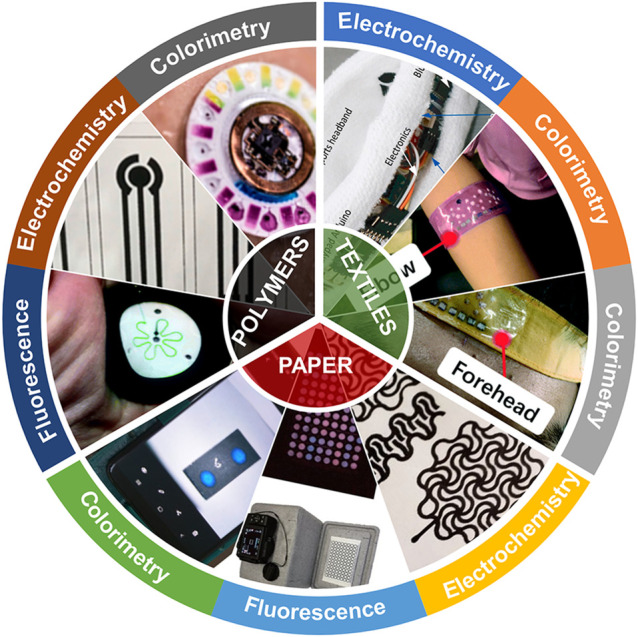
With the outbreak and pandemic of COVID-19, point-of-care testing (POCT) systems have been attracted much attention due to their significant advantages of small batches of samples, user-friendliness, easy-to-use and simple detection. Among them, flexible biosensors show practical significance as their outstanding properties in terms of flexibility, portability, and high efficiency, which provide great convenience for users. To construct highly functional flexible biosensors, abundant kinds of polymers substrates have been modified with sufficient properties to address certain needs. Paper-based biosensors gain considerable attention as well, owing to their foldability, lightweight and adaptability. The other important flexible biosensor employs textiles as substrate materials, which has a promising prospect in the area of intelligent wearable devices. In this feature article, we performed a comprehensive review about the applications of flexible biosensors based on the classification of substrate materials (polymers, paper and textiles), and illustrated the strategies to design effective and artificial sensing platforms, including colorimetry, fluorescence, and electrochemistry. It is demonstrated that flexible biosensors play a prominent role in medical diagnosis, prognosis, and healthcare.
Keywords: flexible biosensor; paper; point-of-care testing; polymer; textile.
Copyright © 2021 Yan, Zhang, Chai, Qu and Zhang.
Conflict of interest statement
The authors declare that the research was conducted in the absence of any commercial or financial relationships that could be construed as a potential conflict of interest.
Figures
References
-
- Andrysiewicz W., Krzeminski J., Skarżynski K., Marszalek K., Sloma M., Rydosz A. (2020). Flexible Gas Sensor Printed on a Polymer Substrate for Sub-ppm Acetone Detection. Electron. Mater. Lett. 16, 146–155. 10.1007/s13391-020-00199-z - DOI
Publication types
LinkOut - more resources
Full Text Sources
