


Bridging the Gap: A Geroscience Primer for Neuroscientists With Potential Collaborative Applications
- PMID: 34653247
- PMCID: PMC8751800
- DOI: 10.1093/gerona/glab314
Bridging the Gap: A Geroscience Primer for Neuroscientists With Potential Collaborative Applications
Abstract
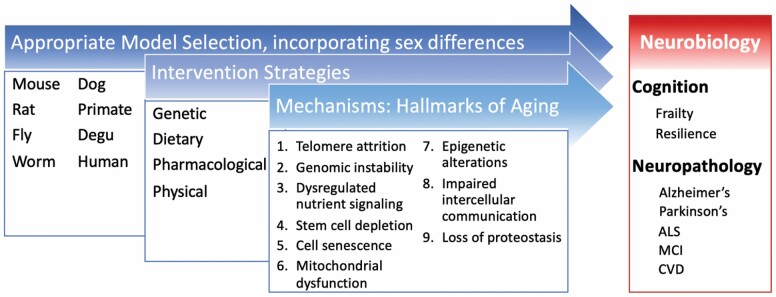
While neurodegenerative diseases can strike at any age, the majority of afflicted individuals are diagnosed at older ages. Due to the important impact of age in disease diagnosis, the field of neuroscience could greatly benefit from the many of the theories and ideas from the biology of aging-now commonly referred as geroscience. As discussed in our complementary perspective on the topic, there is often a "silo-ing" between geroscientists who work on understanding the mechanisms underlying aging and neuroscientists who are studying neurodegenerative diseases. While there have been some strong collaborations between the biology of aging and neuroscientists, there is still great potential for enhanced collaborative effort between the 2 fields. To this end, here, we review the state of the geroscience field, discuss how neuroscience could benefit from thinking from a geroscience perspective, and close with a brief discussion on some of the "missing links" between geroscience and neuroscience and how to remedy them. Notably, we have a corresponding, concurrent review from the neuroscience perspective. Our overall goal is to "bridge the gap" between geroscience and neuroscience such that more efficient, reproducible research with translational potential can be conducted.
Keywords: Cognitive decline; Frailty; Life-span–extending interventions; Resilience.
© The Author(s) 2021. Published by Oxford University Press on behalf of The Gerontological Society of America. All rights reserved. For permissions, please e-mail: journals.permissions@oup.com.
Figures
References
Publication types
MeSH terms
Grants and funding
LinkOut - more resources
Full Text Sources
Medical
Research Materials
Miscellaneous
