Review
. 2021 Dec:179:114002.
doi: 10.1016/j.addr.2021.114002. Epub 2021 Oct 13.

mRNA - A game changer in regenerative medicine, cell-based therapy and reprogramming strategies

Affiliations
Review

mRNA - A game changer in regenerative medicine, cell-based therapy and reprogramming strategies

Oleksandra Chabanovska et al. Adv Drug Deliv Rev. 2021 Dec.

Abstract

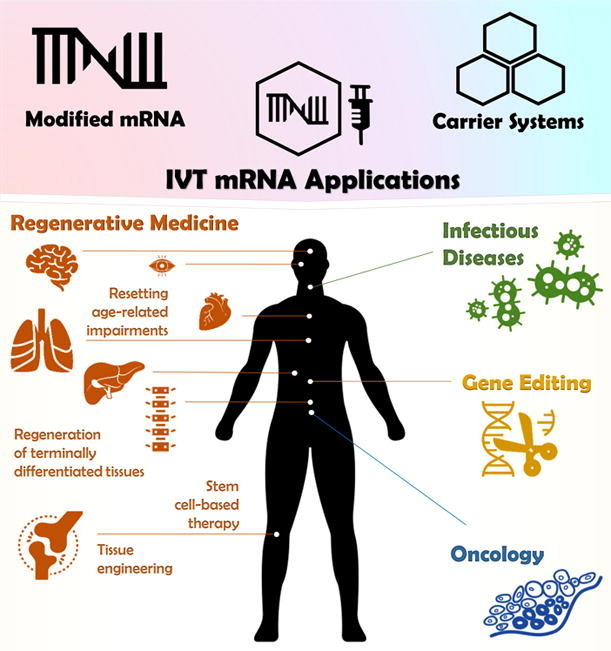
After thirty years of intensive research shaping and optimizing the technology, the approval of the first mRNA-based formulation by the EMA and FDA in order to stop the COVID-19 pandemic was a breakthrough in mRNA research. The astonishing success of these vaccines have brought the mRNA platform into the spotlight of the scientific community. The remarkable persistence of the groundwork is mainly attributed to the exceptional benefits of mRNA application, including the biological origin, immediate but transitory mechanism of action, non-integrative properties, safe and relatively simple manufacturing as well as the flexibility to produce any desired protein. Based on these advantages, a practical implementation of in vitro transcribed mRNA has been considered in most areas of medicine. In this review, we discuss the key preconditions for the rise of the mRNA in the medical field, including the unique structural and functional features of the mRNA molecule and its vehicles, which are crucial aspects for a production of potent mRNA-based therapeutics. Further, we focus on the utility of mRNA tools particularly in the scope of regenerative medicine, i.e. cell reprogramming approaches or manipulation strategies for targeted tissue restoration. Finally, we highlight the strong clinical potential but also the remaining hurdles to overcome for the mRNA-based regenerative therapy, which is only a few steps away from becoming a reality.

Keywords: Cell reprogramming; Clinical translation; Regenerative medicine; Tissue engineering; mRNA delivery.


Conflict of interest statement

Declaration of Competing Interest The authors declare that they have no known competing financial interests or personal relationships that could have appeared to influence the work reported in this paper.

Figures
None
Graphical abstract
Fig. 1
Fig. 1
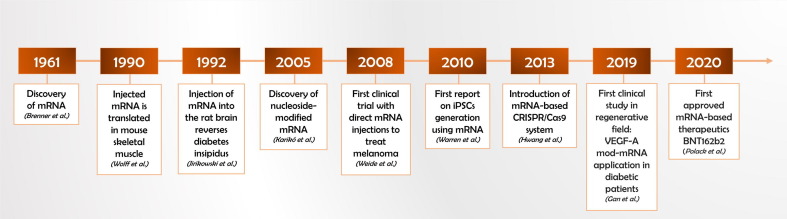
Milestones of mRNA application in regenerative medicine. Time history chart showing the key discoveries and breakthrough events that contributed to the rise of mRNA technology in regenerative therapy , , , , , , , , .
Fig. 2
Fig. 2
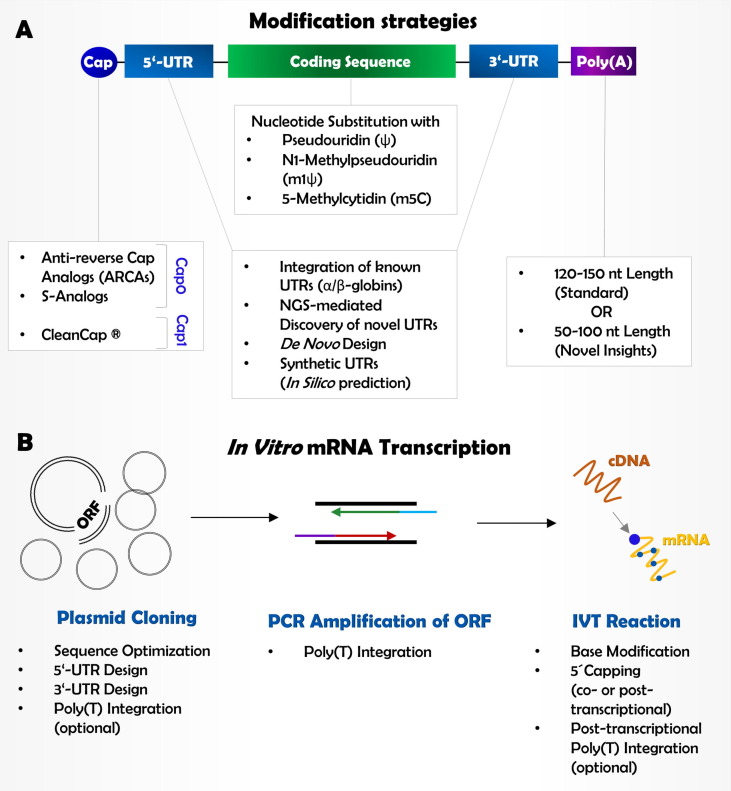
Molecular composition and modification strategies for in vitro mRNA synthesis. (A) Several strategies have been applied to improve mRNA stability and translational efficiency, including cap optimization, nucleotide substitution and UTR-modifications. (B) In vitro synthesis of modified mRNA starts with plasmid cloning, followed by PCR amplification of the respective ORF. Lastly, cDNA is transcribed into mRNA, containing the optimized molecular composition.
Fig. 3
Fig. 3
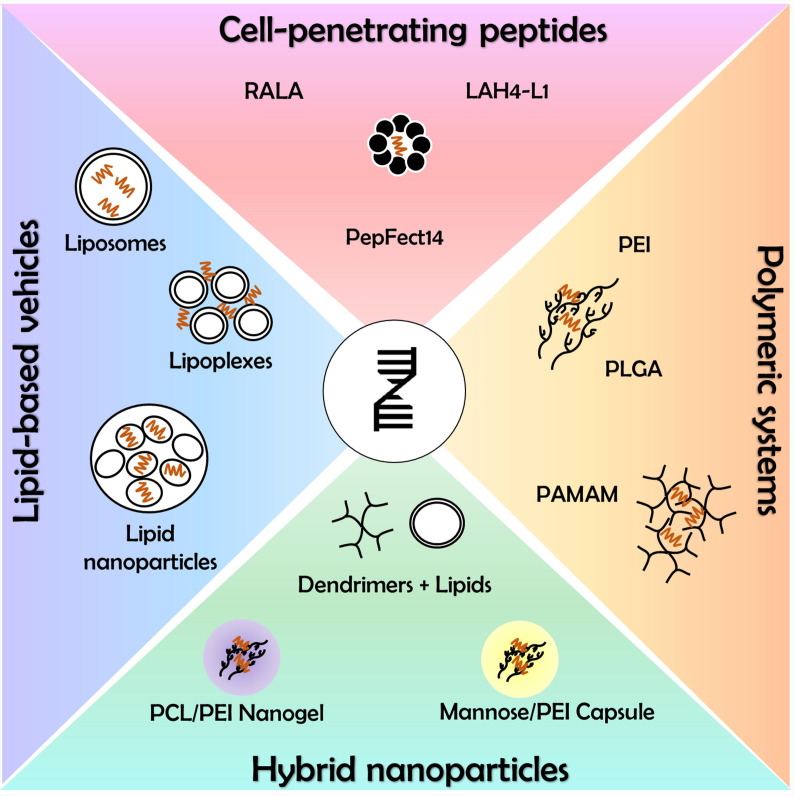
Non-viral carrier system for delivery of modified mRNA. Since mRNAs are large, hydrophilic, negatively charged molecules, entering the cell is challenging. Therefore, various carrier systems have been developed to improve cellular uptake and protecting the mRNA from degradation. Lipid-based delivery represents the most commonly applied technique to facilitate cellular entry. In addition, positively charged peptides can be used for complexation of mRNA, enabling access to the cell via an endocytotic mechanism. Similarly, polymers like polyethylenimine, polylactide-co-glycolide, polyamidoamine have been utilized to encapsulate mRNA molecules before cellular transfection. Novel delivery concepts aim to exploit the benefits of existing carrier systems by a combination of nanoparticles, lipids and proteins leading to hybrid nanoparticles.
Fig. 4
Fig. 4
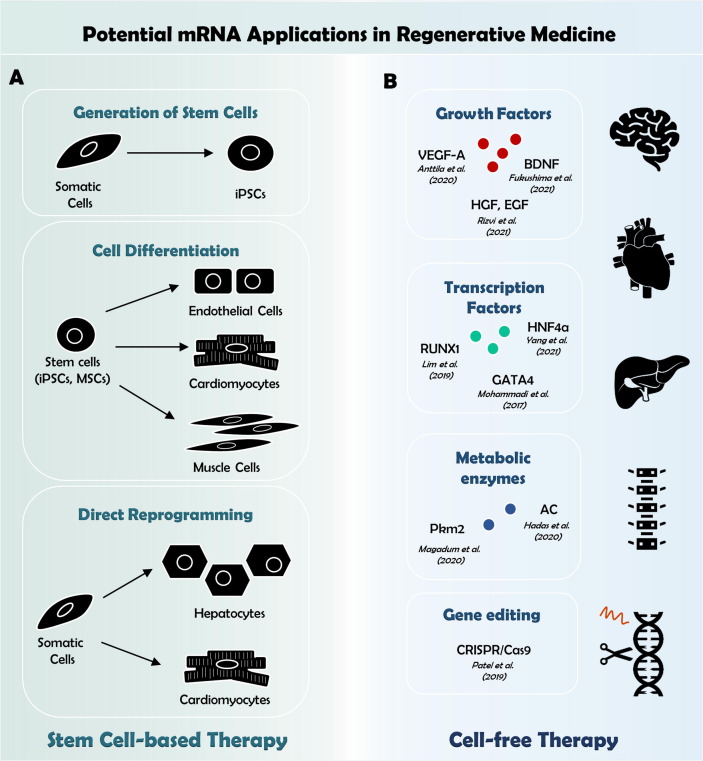
Potential mRNA applications in regenerative medicine. mRNAs can be applied to generate cells in vitro that are supposed to be transplanted for tissue repair following injury. In this regard, mRNA-based techniques are (A) either utilized to reprogram somatic cells into iPSCs, which can be further differentiated into any desired cell type. On the other hand, mRNA, transferred into stem cells or somatic cells, enable guided differentiation to obtain cells suitable for cell replacement therapy. For cell free strategies (B), mRNA technology enables to deliver signaling molecules into the tissue of interest. mRNAs encoding growth or transcription factors have been successfully applied in vivo to promote tissue regeneration , , , , , , , .

References

    1. Müller K. Drugs: from discovery to approval, second ed., By Rick Ng. ChemMedChem. 2009;4:1546–1547. doi: 10.1002/cmdc.200900232. - DOI
    1. F. Chast, A history of drug discovery, in: The Practice of Medicinal Chemistry, Elsevier, 2008, pp. 1–62.
    1. Lounnas V., Ritschel T., Kelder J., McGuire R., Bywater R.P., Foloppe N. Current progress in Structure-Based Rational Drug Design marks a new mindset in drug discovery. Comput. Struct. Biotechnol. J. 2013;5:e201302011. doi: 10.5936/csbj.201302011. - DOI - PMC - PubMed
    1. Kesik-Brodacka M. Progress in biopharmaceutical development. Biotechnol. Appl. Biochem. 2018;65:306–322. doi: 10.1002/bab.1617. - DOI - PMC - PubMed
    1. Deshaies R.J. Multispecific drugs herald a new era of biopharmaceutical innovation. Nature. 2020;580:329–338. doi: 10.1038/s41586-020-2168-1. - DOI - PubMed

Publication types