


Global impact of the first wave of COVID-19 on liver transplant centers: A multi-society survey (EASL-ESOT/ELITA-ILTS)
- PMID: 34653592
- PMCID: PMC8511875
- DOI: 10.1016/j.jhep.2021.09.041
Global impact of the first wave of COVID-19 on liver transplant centers: A multi-society survey (EASL-ESOT/ELITA-ILTS)
Abstract
Background and aims: The global impact of SARS-CoV-2 on liver transplantation (LT) practices across the world is unknown. The goal of this survey was to assess the impact of the pandemic on global LT practices.
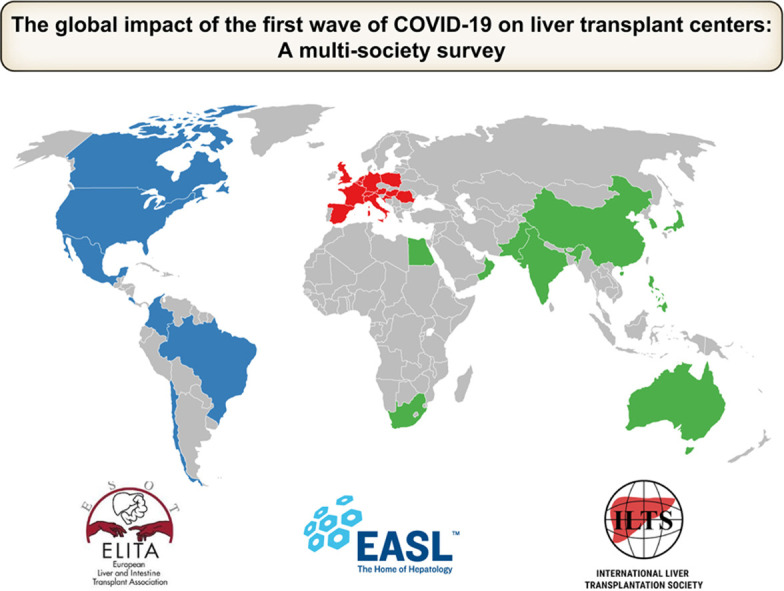
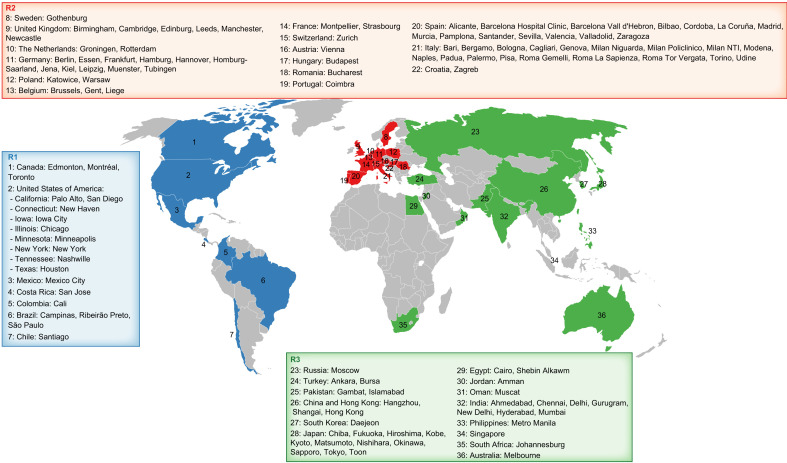
Method: A prospective web-based survey (available online from 7th September 2020 to 31st December 2020) was proposed to the active members of the EASL-ESOT/ELITA-ILTS in the Americas (including North, Central, and South America) (R1), Europe (R2), and the rest of the world (R3). The survey comprised 4 parts concerning transplant processes, therapy, living donors, and organ procurement.
Results: Of the 470 transplant centers reached, 128 answered each part of the survey, 29 centers (23%), 64 centers (50%), and 35 centers (27%) from R1, R2, and R3, respectively. When we compared the practices during the first 6 months of the pandemic in 2020 with those a year earlier in 2019, statistically significant differences were found in the number of patients added to the waiting list (WL), WL mortality, and the number of LTs performed. At the regional level, we found that in R2 the number of LTs was significantly higher in 2019 (p <0.01), while R3 had more patients listed, higher WL mortality, and more LTs performed before the pandemic. Countries severely affected by the pandemic ("hit" countries) had a lower number of WL patients (p = 0.009) and LTs (p = 0.002) during the pandemic. Interestingly, WL mortality was still higher in the "non-hit" countries in 2020 compared to 2019 (p = 0.022).
Conclusion: The first wave of the pandemic differentially impacted LT practices across the world, especially with detrimental effects on the "hit" countries. Modifications to the policies of recipient and donor selection, organ retrieval, and postoperative recipient management were adopted at a regional or national level.
Lay summary: The health emergency caused by the coronavirus pandemic has dramatically changed clinical practice during the pandemic. The first wave of the pandemic impacted liver transplantation differently across the world, with particularly detrimental effects on the countries badly hit by the virus. The resilience of the entire transplant network has enabled continued organ donation and transplantation, ultimately improving the lives of patients with end-stage liver disease.
Keywords: COVID; Liver Transplantation; Sars-Cov-2; pandemic; survey.
Copyright © 2021 European Association for the Study of the Liver. Published by Elsevier B.V. All rights reserved.
Conflict of interest statement
Conflict of interest The authors of this manuscript have no conflicts of interest to disclose. Please refer to the accompanying ICMJE disclosure forms for further details.
Figures
References
-
- Organization WH . 2021. WHO coronavirus (COVID-19) dashboard.
Publication types
MeSH terms
LinkOut - more resources
Full Text Sources
Medical
Miscellaneous
