


Burden of multiple sclerosis in Iran from 1990 to 2017
- PMID: 34654397
- PMCID: PMC8518301
- DOI: 10.1186/s12883-021-02431-1
Burden of multiple sclerosis in Iran from 1990 to 2017
Abstract
Background: Multiple Sclerosis (MS) is a burdensome, chronic and autoimmune disease of the central nervous system. We aimed to report the incidence, prevalence, mortality, and Disability Adjusted Life Years (DALYs) of MS in Iran at a national level for different age and sex groups over a period of 28 years (1990-2017).
Methods: Data were extracted from the Global Burden of Disease study (GBD) from 1990 to 2017, published by the Institute for Health Metrics and Evaluation. The incidence of DALYs and prevalence of MS were estimated to report the burden of MS based on sex and age in Iran from 1990 to 2017.
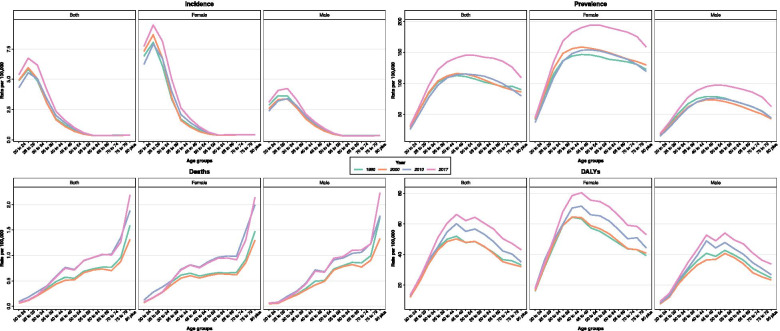
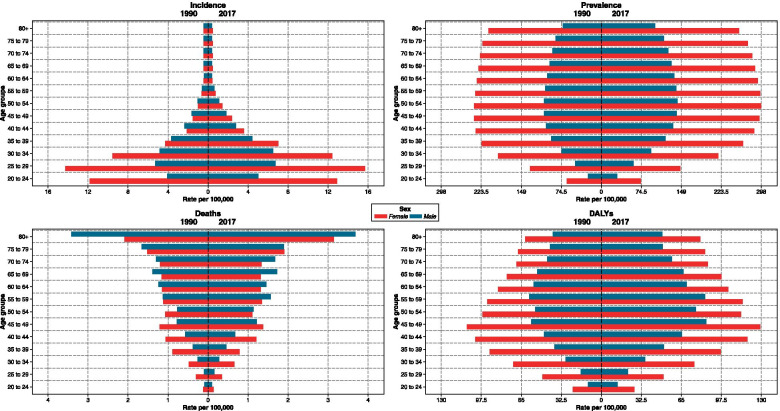
Results: At the national level, the Age-Standardized Incidence Rate (ASIR), Age-Standardized Prevalence Rate (ASPR), Age-Standardized DALYs Rate (ASDR) and the Age-Standardized Mortality Rate (ASMR) in Iran in 2017 were 2.4 (95% Uncertainty Interval [UI]: 2.1 to 2.7), 69.5 (62.1 to 77.8), 29.1 (23.6 to 34.7), and 0.4 (0.3 to 0.4) per 100,000 population, respectively. During the period of 1990 to 2017, all measures increased, and were higher among females. The incidence rate began upward trend at the age of 20 and attained its highest level at the age of 25.
Conclusion: In Iran, all of the age-standardized MS rates have been increasing during the 28 years from 1990 to 2017. Our findings can help policy makers and health planners to design and communicate their plans and to have a better resource allocation, depending on the incidence and prevalence of the growing numbers of MS patients in Iran.
Keywords: Burden of disease; Global burden of disease study; Iran; MS (multiple sclerosis); Trend.
© 2021. The Author(s).
Conflict of interest statement
The author(s) declared no potential conflicts of interest with respect to the research, authorship, and/or publication of this article.
Figures

References
-
- Stenager E. A global perspective on the burden of multiple sclerosis. Lancet Neurol. 2019. - PubMed
-
- Wallin MT, Culpepper WJ, Nichols E, Bhutta ZA, Gebrehiwot TT, Hay SI, et al. Global, regional, and national burden of multiple sclerosis 1990–2016: a systematic analysis for the global burden of disease study 2016. Lancet Neurol. 2019;18(3):269–285. doi: 10.1016/S1474-4422(18)30443-5. - DOI - PMC - PubMed
MeSH terms
LinkOut - more resources
Full Text Sources
Medical
