. 2022 Apr 30;434(8):167304.
doi: 10.1016/j.jmb.2021.167304. Epub 2021 Oct 13.

A Robust Platform for Unnatural Amino Acid Mutagenesis in E. coli Using the Bacterial Tryptophanyl-tRNA synthetase/tRNA pair

Affiliations

A Robust Platform for Unnatural Amino Acid Mutagenesis in E. coli Using the Bacterial Tryptophanyl-tRNA synthetase/tRNA pair

Elise D Ficaretta et al. J Mol Biol. .

Abstract

We report the development of a robust user-friendly Escherichia coli (E. coli) expression system, derived from the BL21(DE3) strain, for site-specifically incorporating unnatural amino acids (UAAs) into proteins using engineered E. coli tryptophanyl-tRNA synthetase (EcTrpRS)-tRNATrp pairs. This was made possible by functionally replacing the endogenous EcTrpRS-tRNATrp pair in BL21(DE3) E. coli with an orthogonal counterpart from Saccharomyces cerevisiae, and reintroducing it into the resulting altered translational machinery tryptophanyl (ATMW-BL21) E. coli strain as an orthogonal nonsense suppressor. The resulting expression system benefits from the favorable characteristics of BL21(DE3) as an expression host, and is compatible with the broadly used T7-driven recombinant expression system. Furthermore, the vector expressing the nonsense-suppressing engineered EcTrpRS-tRNATrp pair was systematically optimized to significantly enhance the incorporation efficiency of various tryptophan analogs. Together, the improved strain and the optimized suppressor plasmids enable efficient UAA incorporation (up to 65% of wild-type levels) into several different proteins. This robust and user-friendly platform will significantly expand the scope of the genetically encoded tryptophan-derived UAAs.

Keywords: BL21(DE3); genetic code expansion; tryptophan.


Conflict of interest statement

Declaration of Competing Interest The authors declare that they have no known competing financial interests or personal relationships that could have appeared to influence the work reported in this paper.

Figures
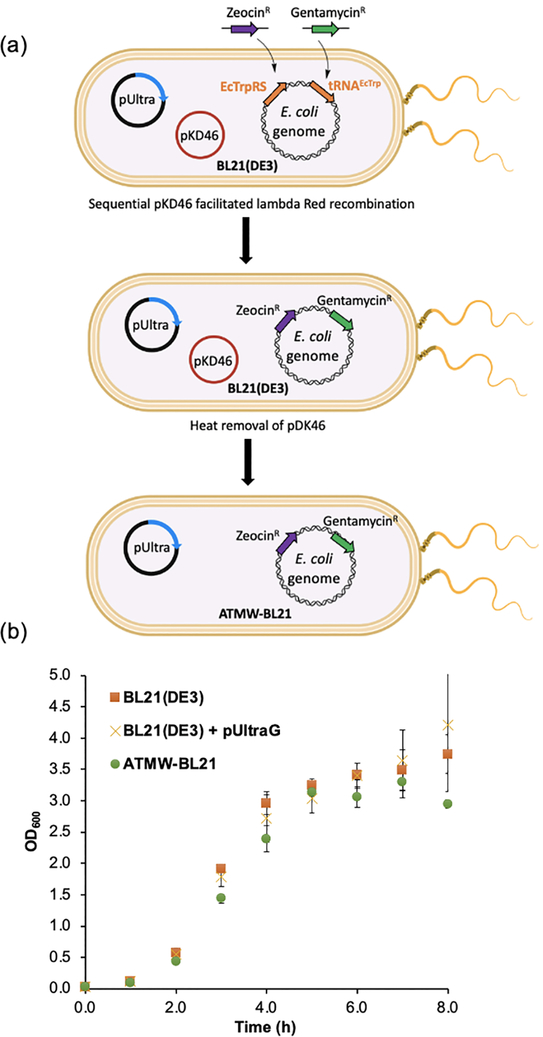
Figure 1.
Figure 1.
(a) The scheme demonstrating the strategy to develop ATMW-BL21 strain from BL21(DE3). In the presence of the pUltra plasmid expressing the yeast tryptophanyl pair, EcTrpRS and tRNAEcTrp were replaced with zeocin and gentamycin resistance genes, respectively, by recombination. The plasmid encoding the recombination machinery, pKD46, was removed at the end by heat induction. (b) ATMW-BL21 exhibits a growth rate comparable to its progenitor BL21(DE3) strain, with or without the pUltraG complementation plasmid. OD600, optical density measured at 600 nm.
Figure 2.
Figure 2.
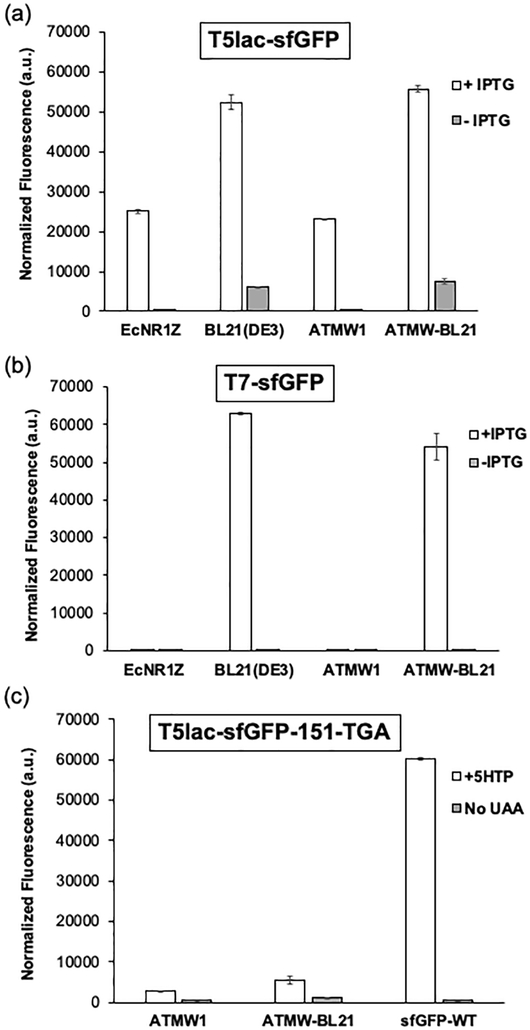
Evaluating protein expression in ATMW-BL21, ATMW1, and their progenitor strains. (a) Expression of wild-type sfGFP from a T5-lac promoter in different strains, measured as the normalized fluorescence of the reporter in resuspended cells. (b) Expression of a wild-type sfGFP from a T7 promoter compared in various strains, EcNR1Z and BL21(DE3), measured as the normalized fluorescence of the reporter in resuspended cells. (c) 5HTP-dependent expression of sfGFP-151-TGA in ATMW1 and ATMW-BL21 using the “unoptimized” pEVOL expression system: pEVOL-tacI EcTrpRS-14 proK. Expression of full-length sfGFP was measured in resuspended cells using its characteristic fluorescence.
Figure 3.
Figure 3.
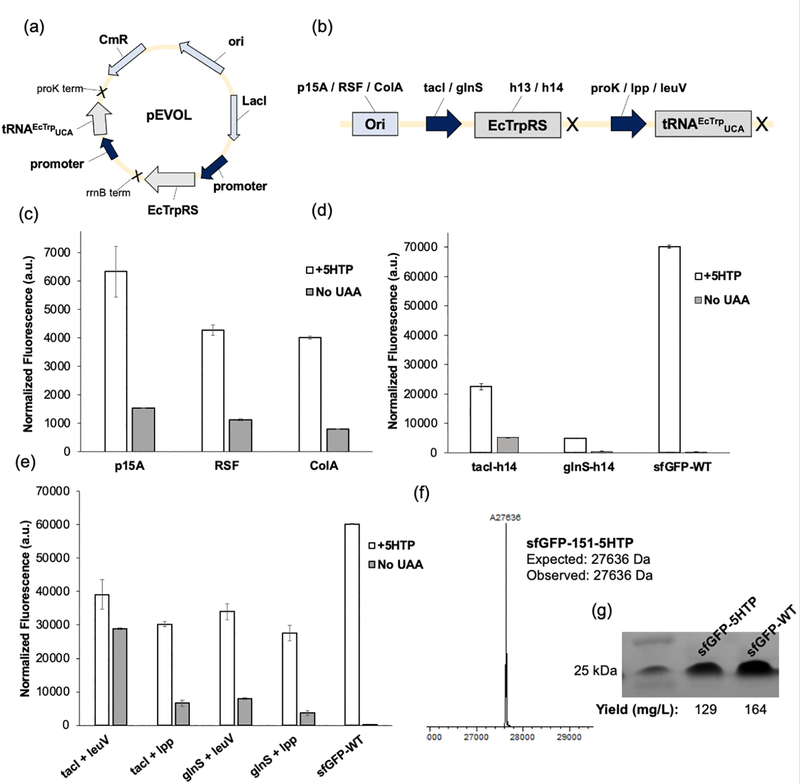
Development of an optimized pEVOL suppressor plasmid. a) Vector map of the first-generation pEVOL vector (full sequence provided in SI). (b) A scheme showing the components of the vector which were altered for optimization: p15A, RSF, or ColA ori (light blue); tacI or glnS promoter (navy blue); EcTrpRS-h13 or -h14 (gray); proK, lpp, or leuV promoter (navy blue). (c) Expression of sfGFP-151-TGA using pEVOL vectors (proK-tRNA and tacI-TrpRS) with varying oris in ATMW-BL21 in the presence or absence of 5HTP. (d) Expression of sfGFP-151-TGA using pEVOL vectors containing either an inducible tacI or constitutive glnS promoter on the EcTrpRS (tRNA expressed from proK). (e) Expression of sfGFP-151-TGA using pEVOL vectors with different combinations of EcTrpRS and tRNAEcTrpUCA promoters (tacI/glnS = EcTrpRS promoter; leuV/lpp = tRNAEcTrpUCA promoter). (f) MS analysis of the sfGFP-151-TGA reporter protein confirming 5HTP incorporation using pEVOL-tacI-EcTrpRS-h13-leuV-tRNA. Full MS spectrum is provided in Supplementary Figure 2. (g) SDS-PAGE analysis of purified sfGFP-151– 5HTP and sfGFP-WT. Full SDS-PAGE gel is provided in Supplementary Figure 3. For all sfGFP reporter expression analyses, its characteristic fluorescence was measured in resuspended cells and normalized to OD600.
Figure 4.
Figure 4.
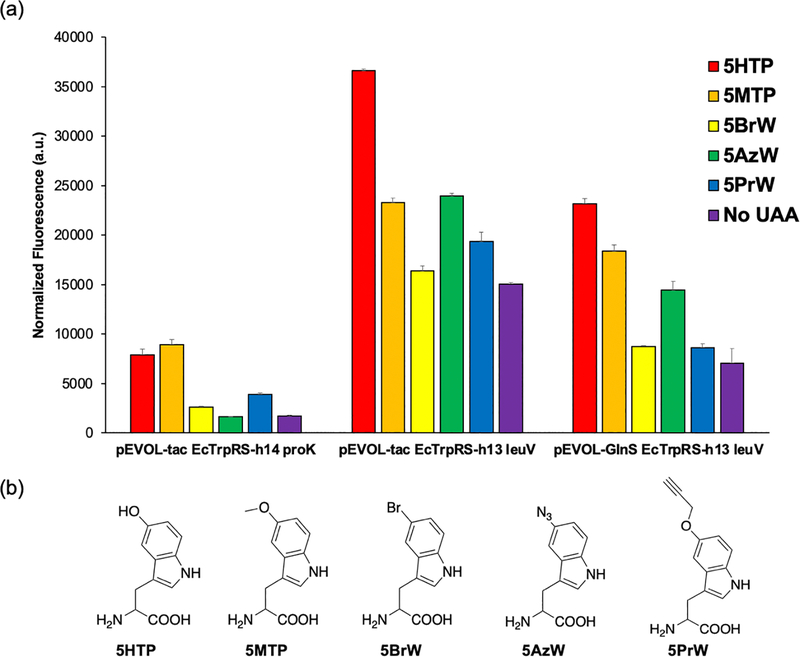
a) Evaluating the incorporation of different tryptophan analogs into sfGFP-151-TGA in ATMW-BL21 using three different pEVOL vectors. EcTrpRS-h13 and –h14 show slightly different substrate preference. The use of the stronger leuV promoter to express the tRNAEcTrpUCA and tacI promoter to express the EcTrpRS provides substantial increase in suppression efficiency. (b) Structures of the tryptophan analog UAAs used in the study.
Figure 5.
Figure 5.
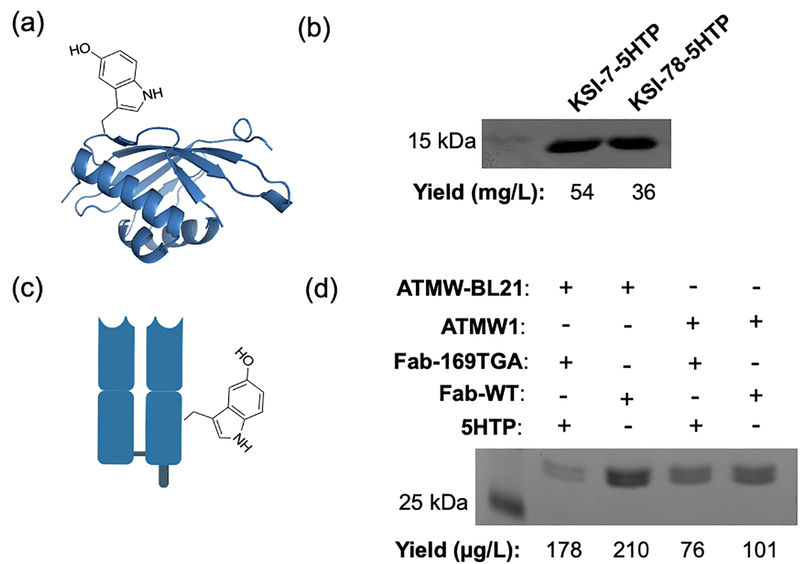
ATMW-BL21 expression of other recombinant proteins. (a) Structure of KSI showing incorporation with 5HTP (PDB: 1OCV). (b) SDS-PAGE analysis of KSI-7–5HTP and KSI-78–5HTP. Full SDS-PAGE gel is provided in Supplementary Figure 7. (c) Cartoon structure of Fab with 5HTP incorporated in the heavy chain. (d) SDS-PAGE analysis of Fab WT and 169–5HTP mutants purified using ATMW-BL21 and ATMW1, with yields shown below. Full-length SDS-PAGE gel is provided in Supplementary Figure 8.

References

    1. Chin JW, Expanding and reprogramming the genetic code, Nature. 550 (2017). 10.1038/nature24031. - DOI - PubMed
    1. Dumas A, Lercher L, Spicer CD, Davis BG, Designing logical codon reassignment-Expanding the chemistry in biology †, Chem. Sci. 6 (2015) 50–69. 10.1039/c4sc01534g. - DOI - PMC - PubMed
    1. Italia JS, Zheng Y, Kelemen RE, Erickson SB, Addy PS, Chatterjee A, Expanding the genetic code of mammalian cells, Biochem. Soc. Trans. 45 (2017) 555–562. 10.1042/BST20160336. - DOI - PubMed
    1. Mukai T, Lajoie MJ, Englert M, Söll D, Rewriting the Genetic Code, Annu. Rev. Microbiol. 71 (2017) 557–577. 10.1146/annurev-micro-090816-093247. - DOI - PMC - PubMed
    1. Young DD, Schultz PG, Playing with the Molecules of Life, ACS Chem. Biol. 13 (2018) 854–870. 10.1021/acschembio.7b00974. - DOI - PMC - PubMed

MeSH terms

LinkOut - more resources