Review
. 2021 Oct 16;40(1):327.
doi: 10.1186/s13046-021-02128-w.

The role of the tumor microbe microenvironment in the tumor immune microenvironment: bystander, activator, or inhibitor?

Affiliations
Review

The role of the tumor microbe microenvironment in the tumor immune microenvironment: bystander, activator, or inhibitor?

Jiayao Ma et al. J Exp Clin Cancer Res. .

Abstract

The efficacy of cancer immunotherapy largely depends on the tumor microenvironment, especially the tumor immune microenvironment. Emerging studies have claimed that microbes reside within tumor cells and immune cells, suggesting that these microbes can impact the state of the tumor immune microenvironment. For the first time, this review delineates the landscape of intra-tumoral microbes and their products, herein defined as the tumor microbe microenvironment. The role of the tumor microbe microenvironment in the tumor immune microenvironment is multifaceted: either as an immune activator, inhibitor, or bystander. The underlying mechanisms include: (I) the presentation of microbial antigens by cancer cells and immune cells, (II) microbial antigens mimicry shared with tumor antigens, (III) microbe-induced immunogenic cell death, (IV) microbial adjuvanticity mediated by pattern recognition receptors, (V) microbe-derived metabolites, and (VI) microbial stimulation of inhibitory checkpoints. The review further suggests the use of potential modulation strategies of the tumor microbe microenvironment to enhance the efficacy and reduce the adverse effects of checkpoint inhibitors. Lastly, the review highlights some critical questions awaiting to be answered in this field and provides possible solutions. Overall, the tumor microbe microenvironment modulates the tumor immune microenvironment, making it a potential target for improving immunotherapy. It is a novel field facing major challenges and deserves further exploration.

Keywords: Immune checkpoint inhibitor; Microbiome; Therapeutic target; Tumor immune microenvironment; Tumor microenvironment.


Conflict of interest statement

The authors declare that they have no competing interests.

Figures
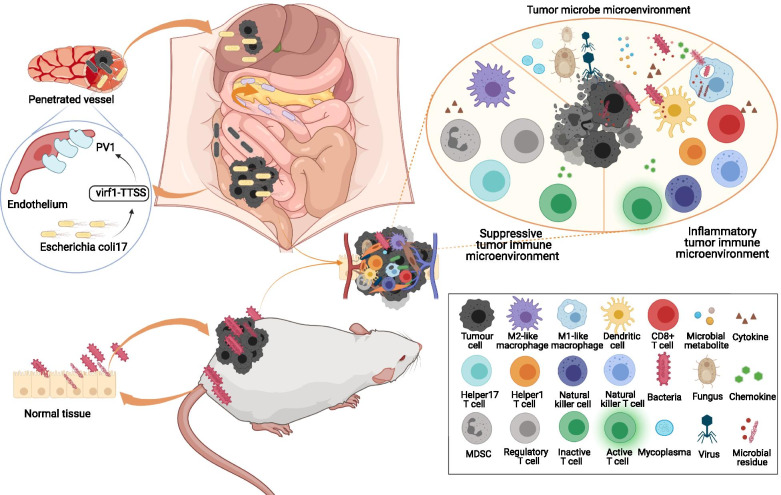
Fig. 1
Fig. 1
The landscape of the tumor microbe microenvironment and the tumor immune microenvironment. Microbes, microbial residues, and microbial metabolites reside within tumors, herein defined as the tumor microbe microenvironment. Intra-tumoral microbes come from the tissue where tumors initiate or from distal organs or metastasis through penetrated vessels. The major cells types in tumor immune microenvironment are divided into two categories: One is inflammatory and includes active CD8+ T cell, helper 1 T cell, dendritic cell, natural killer cell, natural killer T cell, M1-like macrophage, and so on; the other one is immunosuppressive and includes M2-like macrophage, regulatory T cell, helper 17 T cell, MDSC, inactive CD8+ T cell and so on. Abbreviations: CD = cluster of differentiation, MDSC = myeloid-derived immunosuppressive cell
Fig. 2
Fig. 2
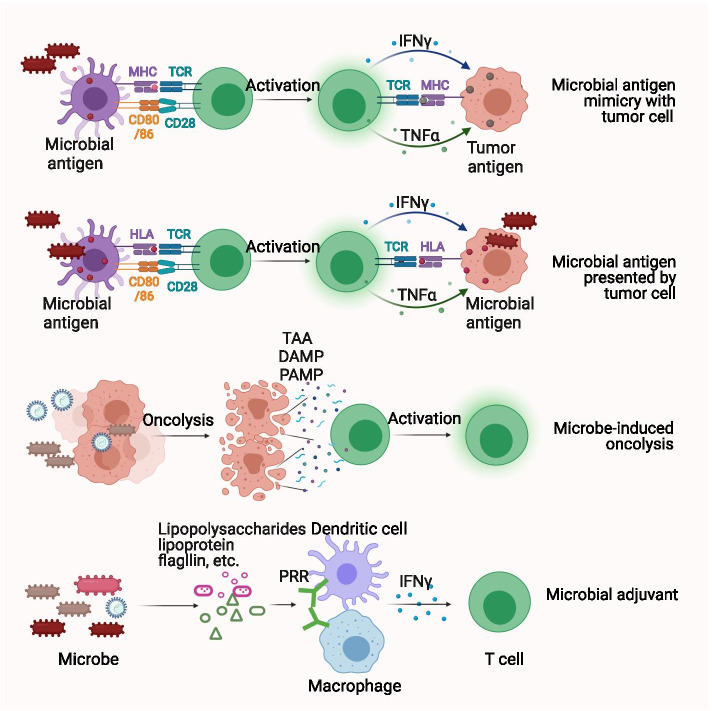
Intra-tumoral microbes provide antigenicity and adjuvanticity to promote inflammatory tumor immune microenvironment. Microbial antigens can be presented by HLA molecules on both tumor cells and tumor-infiltrating immune cells, informing their potential to elicit anti-tumoral response. Microbe antigens share similar antigen epitopes with tumor antigens and elicit microbe-specific T cells that can recognize and kill tumor cells. Microbes lyse tumor cells to release TAA, DAMP, and PAMP to elicit inflammatory tumor immune microenvironment. Also, microbe themselves serve as immunostimulatory adjuvants to further promote inflammatory tumor immune microenvironment. Abbreviations: CD = cluster of differentiation, DAMP = damage-associated molecular pattern, HLA = human leukocyte antigen, IFNγ = interferon-gamma, MHC = major histocompatibility complex, PAMP = pathogen-associated molecular pattern, PRR = pattern recognition receptor, TAA = tumor-associated antigen, TCR = T-cell receptor, TNFα = tumor necrosis factor-alpha
Fig. 3
Fig. 3
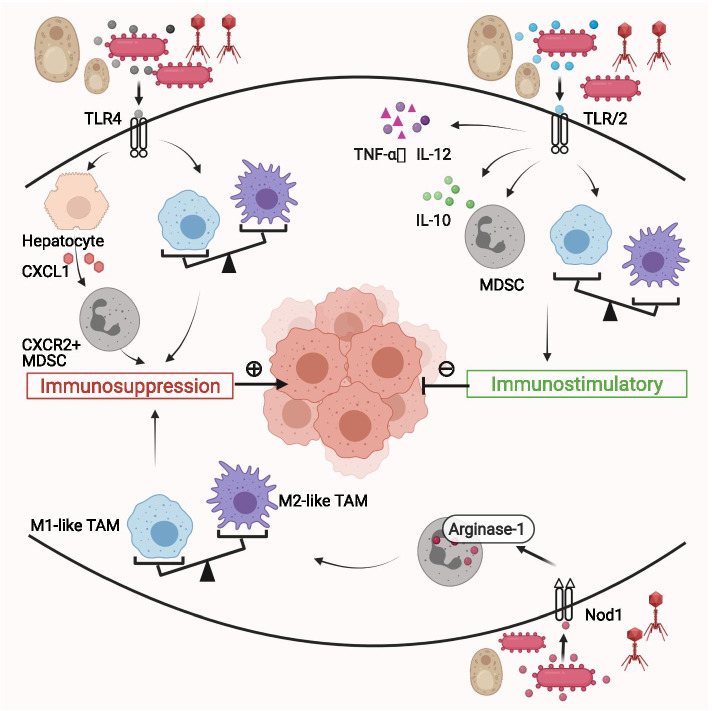
Microbial immunomodulation mediated by pattern recognition receptors in the tumor microenvironment. TLRs and NLRs are the major subtypes of pattern recognition receptors. Some microbes activate TLR4 to promote MDSCs infiltration and M2-like TAM polarization, resulting in an immunosuppressive tumor microenvironment. On the contrary, some microbes activate TLR2 to promote M1-like TAM polarization and suppress MDSCs function. TLR agonist synergizes with interferon-γ to increase pro-inflammatory cytokines TNF-α, IL-12 and decrease IL-10, forming an inflammatory tumor microenvironment. Nod1, a member of the NLRs family, promotes MDSCs proliferation and arginase-1 expression and thereby leading to M2-like TAM repolarization. Abbreviations: CXCL = The chemokine (C-X-C motif) ligand, CXCR = The chemokine (C-X-C motif) receptor, MDSC = myeloid-derived immunosuppressive cell, NLRs = Nucleotide-binding domain and leucine-rich repeat–containing receptors, Nod = Nucleotide-binding domain, TAM = tumor-associated macrophage, TLR = Toll-like receptor, TNF = tumor necrosis factor
Fig. 4
Fig. 4
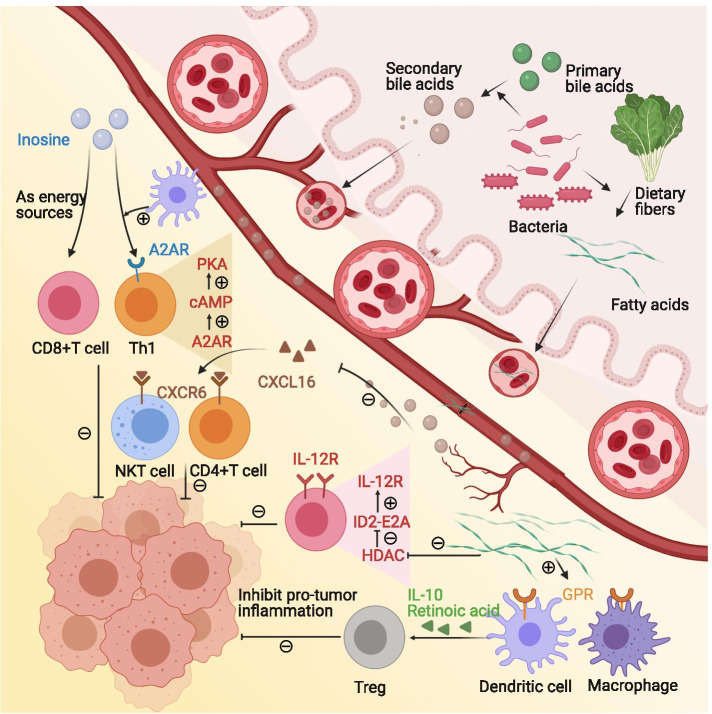
Microbe-derived metabolites modulate the tumor immune microenvironment. Microbial metabolites, such as short-chain fatty acids, bile acids, and inosine, can enter to blood and modulate the tumor immune microenvironment. Butyric acid, a member of short-chain fatty acids, increases the level of IL-10 and retinoic acid in the intestinal microenvironment, which promotes regulatory T cells differentiation and proliferation. Butyrate-mediated HDACs inhibition leads to up-regulation of the transcriptional regulator ID2 and thus upgrading the IL-12R signaling pathway in CD8+ T cells. Secondary bile acids are produced by gut microorganisms from primary bile acids. ω-murocholic acid, a member of secondary bile acids, down-regulates CXCL16 secretion and reduces natural killer T cells and CD4+ T cells recruitment. Inosine binds to A2AR on T cells and initiates the inosine-A2AR-cAMP-PKA signaling pathway. With the costimulatory effects from the dendritic cells, inosine induces naïve T cells to differentiate into Th1. Besides, Inosine is alternative energy of glucose in cytotoxic T cells. Abbreviations: A2AR = adenosine 2A receptor, CXCL = the chemokine (C-X-C motif) ligand, CXCR = the chemokine (C-X-C motif) receptor, HDAC = histone deacetylase, GPR = G protein-coupled receptor, Th1 = helper 1 T cell
Fig. 5
Fig. 5
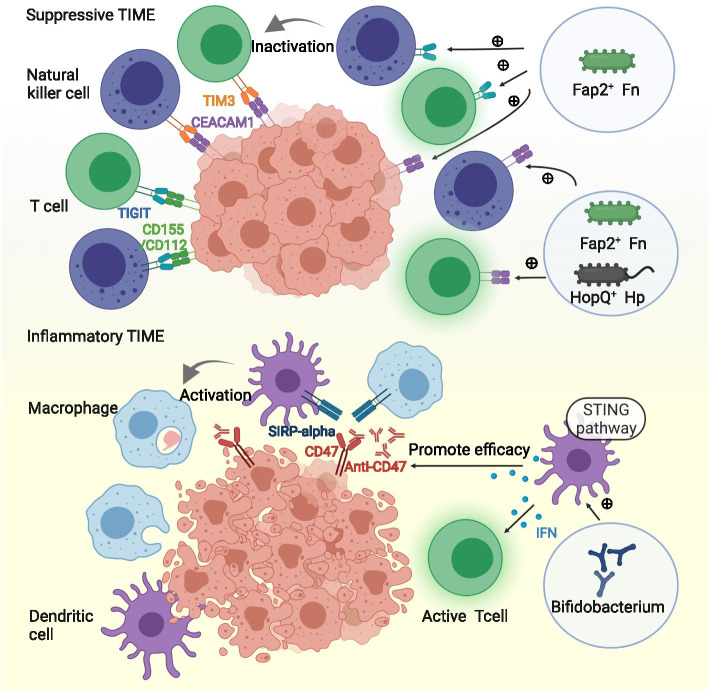
Microbial stimulation of inhibitory checkpoints modulates the tumor immune microenvironment. Fusobacterium nucleatum inhibits the activity of natural killer cells and cytotoxic T cells via interaction between Fap2 and TIGIT or CEACAM1. Helicobacter pylori acts on CEACAM1 through its outer membrane protein HopQ protein to inhibit immune cells. Bifidobacterium upregulates the expression of IFN-I in dendritic cells through the STING signaling pathway, thereby promoting antigen cross-presentation and T cell activation to enhance the efficacy of CD47 blockade. Abbreviations: STING = the stimulator of interferon gene
Fig. 6
Fig. 6
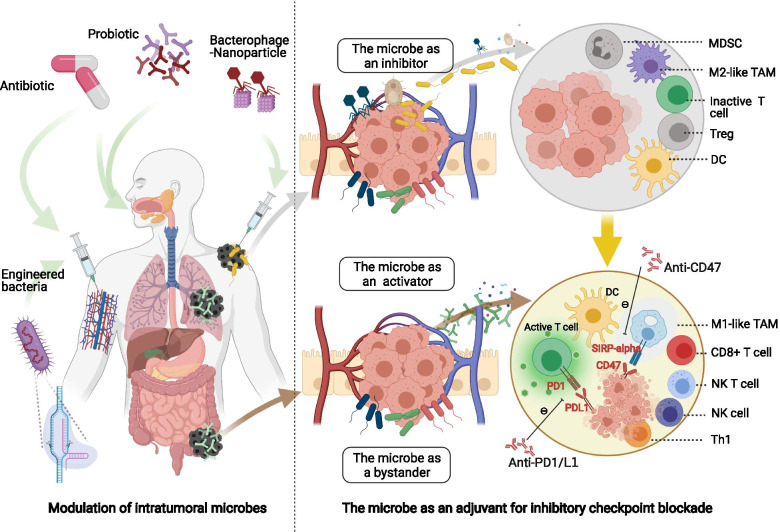
Modulation of the tumor microbe microenvironment acts as a combination for immune checkpoint inhibitors. The modulation strategies of the tumor microbe microenvironment include antibiotic, probiotic and synthetic biology. Microbes can role as an immune inhibitor, activator, or bystander. Adding immunostimulatory microbes or clearance of immunosuppressive microbes can enhance the efficacy of immune checkpoint inhibitors

References

    1. Bhatt AP, Redinbo MR, Bultman SJ. The role of the microbiome in cancer development and therapy. CA Cancer J Clin. 2017;67:326–344. doi: 10.3322/caac.21398. - DOI - PMC - PubMed
    1. Andreeva N, Gabbasova R, Grivennikov S. Microbiome in cancer progression and therapy. Curr Opin Microbiol. 2020;56:118–126. doi: 10.1016/j.mib.2020.09.001. - DOI - PMC - PubMed
    1. Gunjur A. Cancer and the microbiome. Lancet Oncol. 2020;21:888. doi: 10.1016/S1470-2045(20)30351-X. - DOI - PubMed
    1. Coley WB. II. Contribution to the knowledge of sarcoma. Ann Surg. 1891;14:199–220. doi: 10.1097/00000658-189112000-00015. - DOI - PMC - PubMed
    1. Coley WB. The treatment of inoperable sarcoma by bacterial toxins (the mixed toxins of the Streptococcus erysipelas and the Bacillus prodigiosus) Proc R Soc Med. 1910;3:1–48. - PMC - PubMed

LinkOut - more resources