Review
. 2021 Dec 1:192:1040-1057.
doi: 10.1016/j.ijbiomac.2021.10.015. Epub 2021 Oct 14.

State-of-the-art review - A review on snake venom-derived antithrombotics: Potential therapeutics for COVID-19-associated thrombosis?

Affiliations
Review

State-of-the-art review - A review on snake venom-derived antithrombotics: Potential therapeutics for COVID-19-associated thrombosis?

Bhargab Kalita et al. Int J Biol Macromol. .

Abstract

Severe acute respiratory syndrome coronavirus 2 (SARS-CoV-2), the causative agent responsible for the Coronavirus Disease-2019 (COVID-19) pandemic, has infected over 185 million individuals across 200 countries since December 2019 resulting in 4.0 million deaths. While COVID-19 is primarily associated with respiratory illnesses, an increasing number of clinical reports indicate that severely ill patients often develop thrombotic complications that are associated with increased mortality. As a consequence, treatment strategies that target COVID-associated thrombosis are of utmost clinical importance. An array of pharmacologically active compounds from natural products exhibit effects on blood coagulation pathways, and have generated interest for their potential therapeutic applications towards thrombotic diseases. In particular, a number of snake venom compounds exhibit high specificity on different blood coagulation factors and represent excellent tools that could be utilized to treat thrombosis. The aim of this review is to provide a brief summary of the current understanding of COVID-19 associated thrombosis, and highlight several snake venom compounds that could be utilized as antithrombotic agents to target this disease.

Keywords: Anticoagulant; Antiplatelet; Antithrombotic; COVID-19; Snake venom; Thrombosis.


Conflict of interest statement

The authors declare that there are no conflicts of interest.

Figures
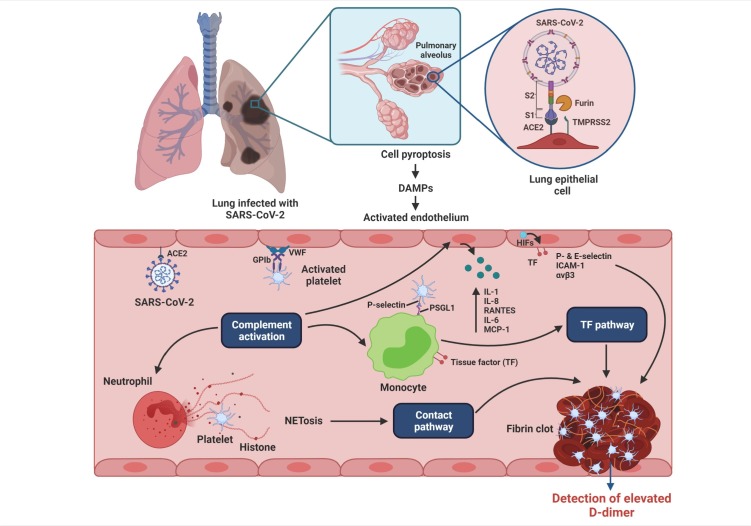
Fig. 1
Fig. 1
Proposed mechanisms of COVID-19-associated thrombosis [Redrawn from McFadyen et al. , Circulation Research, 127(4), pp.571-587]. SARS-CoV-2 gains entry to host lung epithelial cells by the binding of the transmembrane spike (S) glycoprotein to ACE-2 (angiotensin-converting enzyme 2). The S1 subunit of the S protein binds to ACE-2 and mediates viral attachment. Proteolytic cleavage of the S protein at the S1/2 junction by the proteases, furin, and TMPRSS-2 (transmembrane protease serine 2), facilitates viral entry. SARS-CoV-2 can also directly invade the endothelial cells by binding to ACE-2. Infected cells undergo pyroptosis leading to the release of danger-associated molecular patterns (DAMPs) and triggering the release of proinflammatory cytokines and chemokines. The activated endothelium upregulates the expression of VWF (von Willebrand factor) and adhesion molecules including ICAM (intercellular adhesion molecule)-1, αvβ3, P-selectin and E-selectin leading to recruitment of platelets and leukocytes and complement activation. Neutrophils release neutrophil extracellular traps (NETS), causing direct activation of the contact pathway. Complement activation potentiates these mechanisms by increasing endothelial and monocyte tissue factor (TF), further platelet activation and amplifies endothelial inflammation, which increases production of proinflammatory cytokines from the endothelium including IL (interleukin)-1, IL-8, RANTES (regulated on activation, normal T-cell expressed and secreted), IL-6, and MCP (monocyte chemoattractant protein)-1. The hypoxic environment can induce HIFs (hypoxia-inducible factors) which upregulates endothelial TF expression. These mechanisms ultimately lead to the unchecked generation of thrombin, resulting in thrombus formation. The fibrin degradation product, D-dimer, which is a marker of coagulation activation, appears to be a strong prognostic marker associated with high mortality in patients with COVID-19.
Fig. 2
Fig. 2
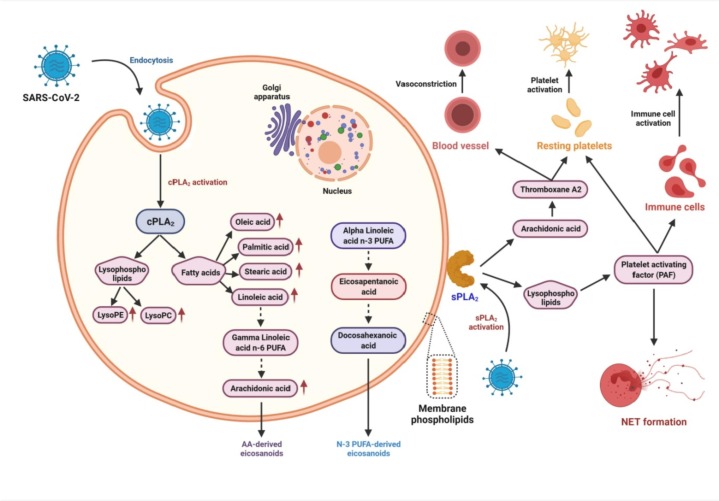
SARS-CoV-2 and activation of phospholipase A2s events [Redrawn from Casari et al. , Progress in Lipid Research, 82, p.101092]. Pathways activated by cytosolic phospholipase A2 (cPLA2) and secretory phospholipase A2 (sPLA2) potentially involved in virus entry and pathogenesis including COVID-19-associated thrombosis.
Fig. 3
Fig. 3
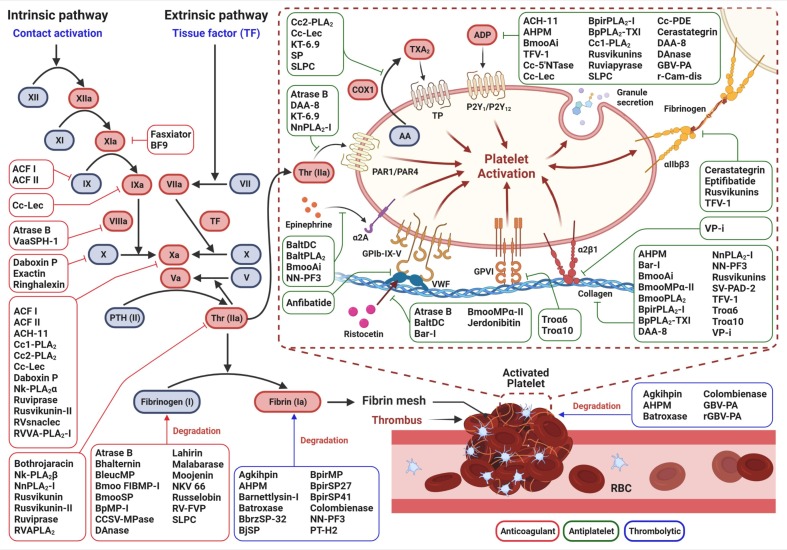
A schematic diagram of the different components of the hemostatic system that are affected by snake venom proteins with antithrombotic potential. Venom components exhibit antithrombotic action by virtue of their anticoagulant, antiplatelet, and thrombolytic activities. Anticoagulant venom proteins can inhibit one or more coagulation factors of the blood coagulation cascade. Antiplatelet agents suppress platelet aggregation induced by agonist, or via interaction with platelet receptors (integrins) that blocks platelet activation and aggregation. Thrombolytic venom proteins can cause dissolution of fibrin or blood clots.
Fig. 4
Fig. 4
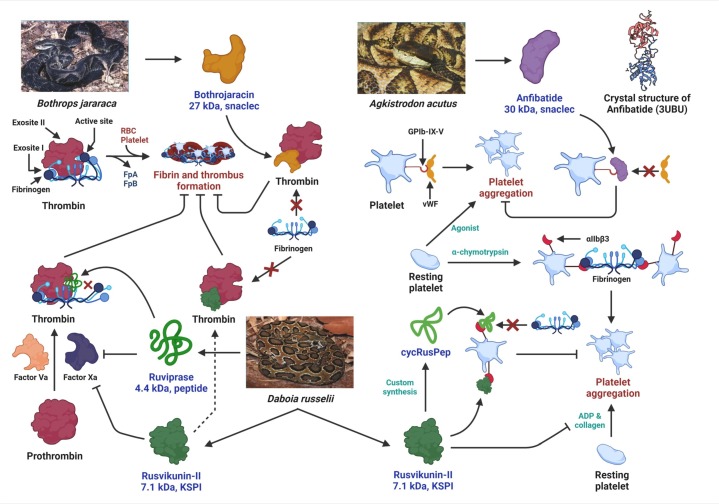
Antithrombotic mechanisms of Bothrojaracin, Anfibatide, Rusvikunin-II and Ruviprase. Bothrojaracin binds to exosite I of thrombin and interferes with the binding of fibrinogen to thrombin. Consequently, fibrinogen is not accessible to thrombin for catalysis and fibrin clot formation is inhibited. Anfibatide binds to the GPIb-IX-V platelet receptor and inhibits the association of vWF with this platelet receptor which subsequently inhibits platelet aggregation. Ruviprase and Rusvikunin II exhibit dual inhibition of thrombin and factor Xa. While Ruviprase binds to the active site of thrombin, Rusvikunin II occupies thrombin exosite I and inhibits the conversion of fibrinogen to fibrin. In addition, the synthetic peptide cycRusPep derived from Rusvikunin II binds to the αIIbβ3 receptor and inhibits platelet aggregation mediated by the association of fibrinogen to this receptor.
Fig. 5
Fig. 5
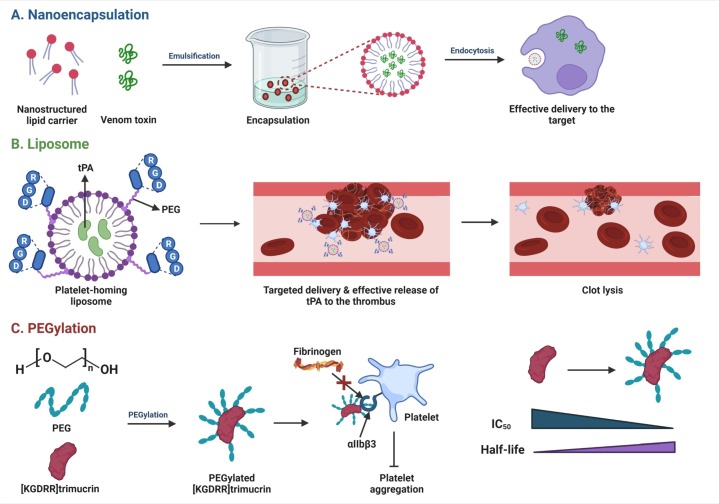
Improvement of efficacy and targeted delivery of antithrombotic agents using diverse strategies. A. Nanoencapsulation of venom proteins/peptides aids effective delivery to the target. B. Activated platelet-homing liposomes harboring tissue plasminogen activator (tPA) and cRGD peptides exhibit targeted delivery and improved thrombolytic effects of tPA with low toxicity risk. C. PEGylated [KGDRR]trimucrin (an αIIbβ3 antagonist) inhibits fibrinogen-induced platelet aggregation at an IC50 value ~4 times lower and at a half-life ~1.3 fold longer than the parent molecule.

References

    1. Fauci A.S., Lane H.C., Redfield R.R. Covid-19 - navigating the uncharted. N. Engl. J. Med. 2020;382(13):1268–1269. - PMC - PubMed
    1. WHO Pneumonia of unknown cause – China. Disease outbreak news, 5 January 2020. Geneva. 2020. www.who.int/csr/don/05january-2020-pneumonia-of-unkown-cause-china/en/
    1. Wu F., Zhao S., Yu B., Chen Y.M., Wang W., Song Z.G., Hu Y., Tao Z.W., Tian J.H., Pei Y.Y., Yuan M.L., Zhang Y.L., Dai F.H., Liu Y., Wang Q.M., Zheng J.J., Xu L., Holmes E.C., Zhang Y.Z. A new coronavirus associated with human respiratory disease in China. Nature. 2020;579(7798):265–269. - PMC - PubMed
    1. Ma J. Coronavirus: China’s first confirmed Covid-19 case traced back to November 17, South China Morning Post, 13 March 2020. 2020. www.scmp.com/news/china/society/article/3074991/coronavirus-chinas-first...
    1. Pekar J., Worobey M., Moshiri N., Scheffler K., Wertheim J.O. Timing the SARS-CoV-2 index case in Hubei province. Science. 2021;372(6540):412–417. - PMC - PubMed