


Cost-effectiveness of exergaming compared to regular day-care activities in dementia: Results of a randomised controlled trial in The Netherlands
- PMID: 34657346
- PMCID: PMC9544668
- DOI: 10.1111/hsc.13608
Cost-effectiveness of exergaming compared to regular day-care activities in dementia: Results of a randomised controlled trial in The Netherlands
Abstract
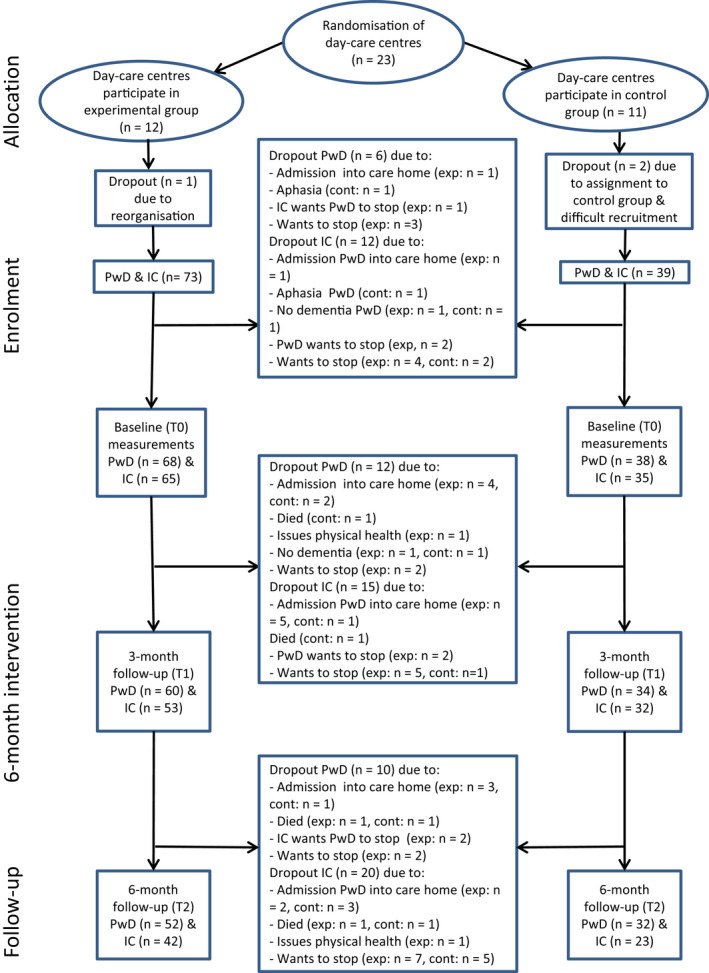
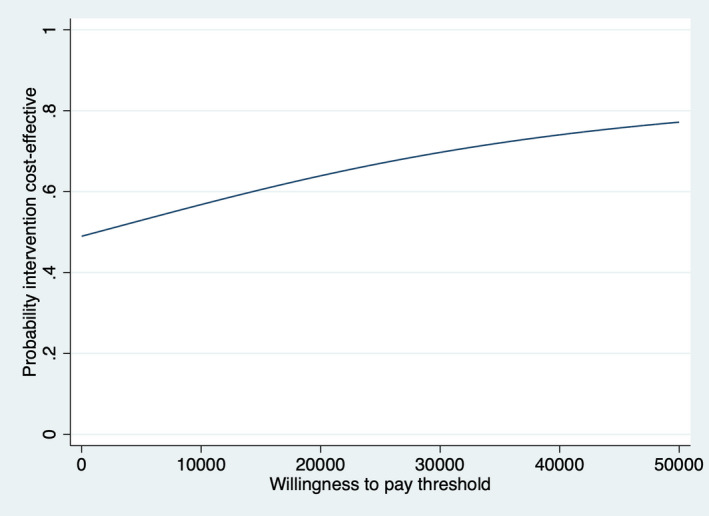
The growing number of people living with dementia will result in increased costs of dementia worldwide. The e-Health intervention 'Exergaming' may improve health and quality of life of people with dementia, but the cost-effectiveness is unknown. We assessed the cost-effectiveness of exergaming compared to regular activities from a societal perspective in day-care centres (DCC) for people with dementia and their informal caregivers (IC) alongside a cluster randomised controlled trial. We included 112 dyads (person with dementia and IC) from 20 psychogeriatric DCCs (11 exergaming, 9 control) across the Netherlands. Exergaming consisted of interactive cycling at least twice a week for 6 months. Measurements were conducted at baseline (T0), after 3 (T1) and 6 (T2) months. Primary outcomes were minutes of physical activity, mobility of the participants with dementia (Short Physical Performances Battery, SPPB), and Quality-Adjusted Life-Years (QALYs) of participants with dementia and ICs. ICs filled out cost diaries to measure healthcare and informal care utilisation during the study. There were no statistically significant differences in outcomes or costs between the groups at the level of participants with dementia, the ICs or the dyad. With regard to QALYs and SPPB, the probability that exergaming is cost-effective compared to control was low for all possible willingness-to-pay (WTP) thresholds. However, for physical activity at WTP thresholds of 0, 50 and 250 Euros per additional minute of physical activity, the probability of cost-effectiveness is 0.46, 0.84 and 0.87, respectively. Exergaming in DCC was not cost-effective compared to usual activities. However, considering the small sample size and the large number of missing observations, findings should be interpreted with caution. Future studies with larger samples are recommended to obtain definitive answers on the cost-effectiveness of exergaming. This trial was registered in the Netherlands Trial Register (NTR5537/NL5420).
Keywords: costs and cost analysis; dementia; exercise; healthcare costs; physical fitness; quality of life; randomised controlled trial.
© 2021 The Authors. Health and Social Care in the Community published by John Wiley & Sons Ltd.
Conflict of interest statement
All authors declare that they have no competing interests.
Figures
References
-
- Alzheimer Nederland . (2019). Factsheet cijfers en feiten over dementie. Retrieved from https://www.alzheimer‐nederland.nl/factsheet‐cijfers‐en‐feiten‐over‐deme...
-
- Corregidor‐Sánchez, A. I. , Segura‐Fragoso, A. , Rodríguez‐Hernández, M. , Criado‐Alvarez, J. J. , González‐Gonzalez, J. , & Polonio‐López, B. (2020). Can exergames contribute to improving walking capacity in older adults? A systematic review and meta‐analysis. Maturitas, 132, 40–48. 10.1016/j.maturitas.2019.12.006 - DOI - PubMed
Publication types
MeSH terms
LinkOut - more resources
Full Text Sources
Medical
