


Sleep, sleepiness and need for recovery of industrial employees after a change from an 8- to a 12-hour shift system
- PMID: 34657895
- PMCID: PMC8980689
- DOI: 10.2486/indhealth.2021-0052
Sleep, sleepiness and need for recovery of industrial employees after a change from an 8- to a 12-hour shift system
Abstract
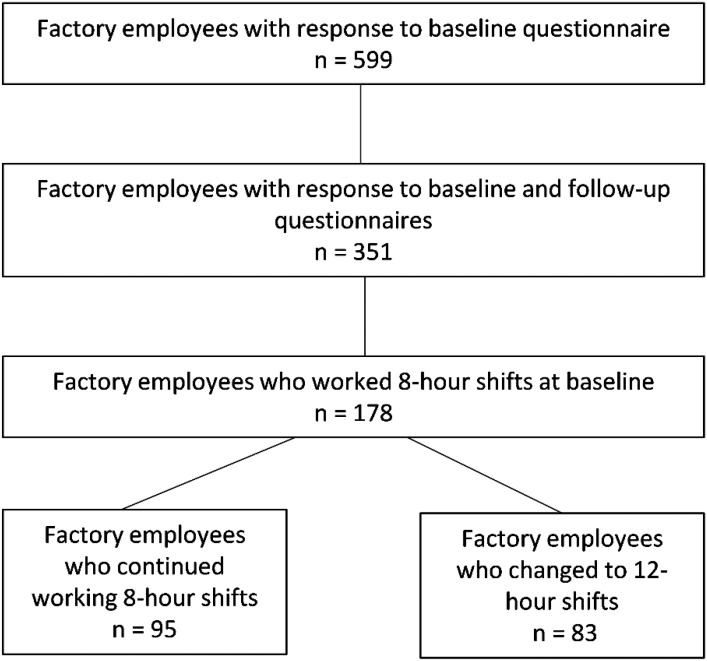
Employees often prefer 12-hour work shifts but they can increase sleepiness and injury risk. We assessed whether sleep, sleepiness, satisfaction and need for recovery changed after changing from an 8-hour to a 12-hour shift system. The participants were 178 employees of the paper, pulp and chemical industries. Using a quasi-experimental controlled intervention design, 83 employees, who changed from an 8-hour shift schedule to a 12-hour shift schedule were compared to those who remained in the 8-hour shift schedule (n=95). Participants filled in a survey on sleep, sleepiness, satisfaction and need for recovery at baseline and 9-12 months after the shift schedule change. We used generalized estimation equation models adjusted for age, sex, shift work experience in years and baseline shift system. Sleep length was longer in the 12-hour shift schedule before the first morning shift and between morning shifts. Sleepiness during morning shifts was less frequent and satisfaction with the shift system was more prevalent in the 12-hour shift schedule. Also, perceived negative associations of the current shift system with work-life balance were less common in the 12-hour shift schedule. The differences found between the shift systems were minor and the results did not indicate significant disadvantages of the 12-hour fast forward-rotating shift system.
Keywords: Controlled study; Extended work shift; Shift scheduling; Shift work; Sleep; Sleepiness; Work-life balance.
Conflict of interest statement
None.
References
-
- Gan Y, Yang C, Tong X, Sun H, Cong Y, Yin X, Li L, Cao S, Dong X, Gong Y, Shi O, Deng J, Bi H, Lu Z (2015) Shift work and diabetes mellitus: a meta-analysis of observational studies. Occup Environ Med 72, 72–8. - PubMed
-
- Torquati L, Mielke GI, Brown WJ, Kolbe-Alexander T (2018) Shift work and the risk of cardiovascular disease. A systematic review and meta-analysis including dose-response relationship. Scand J Work Environ Health 44, 229–38. - PubMed
-
- Yuan X, Zhu CJ, Wang MN, Mo F, Du W, Ma XL (2018) Night shift work increases the risks of multiple primary cancers in women: a systematic review and meta-analysis of 61 articles. Cancer Epidemiol Biomarkers Prev 27, 25–40. - PubMed
-
- Gan Y, Li L, Zhang L, Yan S, Gao C, Hu S, Qiao Y, Tang S, Wang C, Lu Z (2018) Association between shift work and risk of prostate cancer: a systematic review and meta-analysis of observational studies. Carcinogenesis 39, 87–97. - PubMed
-
- Garde AH, Begtrup L, Bjorvatn B, Bonde JP, Hansen J, Hansen AM, Härmä M, Jensen MA, Kecklund G, Kolstad HA, Larsen AD, Lie JA, Moreno CR, Nabe-Nielsen K, Sallinen M (2020) How to schedule night shift work in order to reduce health and safety risks. Scand J Work Environ Health 46, 557–69. - PMC - PubMed
