


High Sitting Time Is a Behavioral Risk Factor for Blunted Improvement in Depression Across 8 Weeks of the COVID-19 Pandemic in April-May 2020
- PMID: 34658975
- PMCID: PMC8519400
- DOI: 10.3389/fpsyt.2021.741433
High Sitting Time Is a Behavioral Risk Factor for Blunted Improvement in Depression Across 8 Weeks of the COVID-19 Pandemic in April-May 2020
Abstract
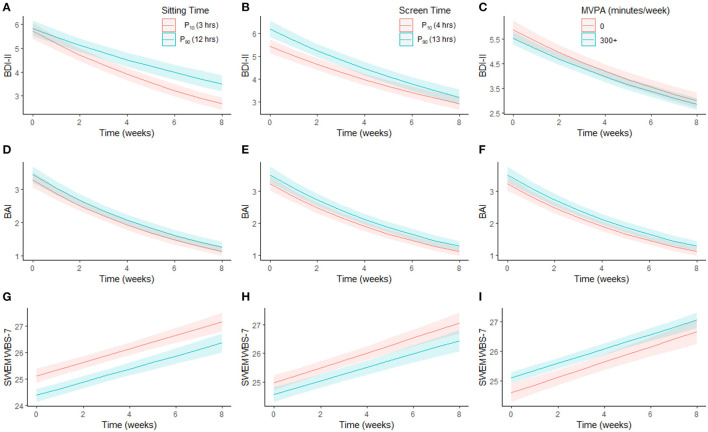
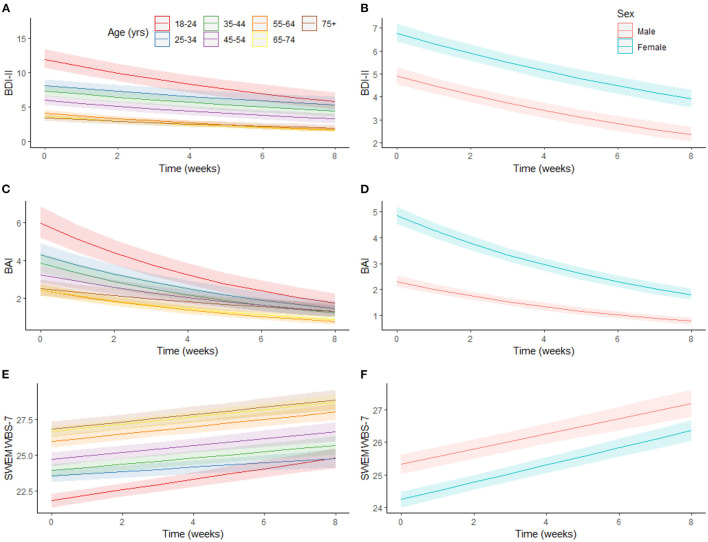
The COVID-19 pandemic has elicited increased sedentary behaviors, decreased moderate-to-vigorous physical activity (MVPA), and worsened mental health, yet the longitudinal impact of these changes and their inter-relations remains unknown. Our purpose was to examine associations between changes in self-reported activity behaviors and mental health over an 8-week period following the COVID-19 outbreak. Participants from all 50 states and the District of Colombia were recruited through convenience and snowball sampling at baseline April 3-10, 2020. Prospective data from 2,327 US adults with ≥2 responses (63.8% female; 74.3% response rate) were collected weekly via online survey for eight consecutive weeks (April 3-June 3, 2020). Primary exposures were self-reported time spent sitting, viewing screens and in MVPA, with primary outcomes being depressive symptoms, anxiety symptoms, and positive mental health (PMH). A significant sitting-by-time interaction (p < 0.05) showed slightly higher marginal effects for depressive symptoms for the 90th-percentile of sitting time than the 10th-percentile at baseline (5.8 [95% confidence interval = 5.5-6.2] vs. 5.7 [5.4-6.1]), with the difference magnifying over time (week 8: 3.5 [3.2-3.9] vs. 2.7 [2.4-2.9]). No other interactions over time were significant. Screen time was negatively associated with PMH and positively associated with depressive and anxiety symptoms (p < 0.05). Sitting time was negatively associated with PMH (p < 0.05). Rapid changes in sitting patterns (e.g., due to a pandemic) may have lasting effects on depressive symptoms. Strategies targeting those most affected (i.e., young adults, females) and/or focused on reducing sitting time may be critical for preventing long-term mental health effects resulting from COVID-19 or other large-scale behavior changes in the general population.
Keywords: COVID-19; anxiety; depression; exercise; longitudinal; positive mental health; screen time; sedentary.
Copyright © 2021 Meyer, O'Connor, McDowell, Lansing, Brower and Herring.
Conflict of interest statement
The authors declare that the research was conducted in the absence of any commercial or financial relationships that could be construed as a potential conflict of interest.
Figures
References
-
- KFF.org. State Actions to Mitigate the Spread of COVID-19. State Actions to Mitigate the Spread of COVID-19. (2020). Available online at: https://www.kff.org/other/state-indicator/state-actions-to-mitigate-the-... (accessed Sep 23, 2020).
LinkOut - more resources
Full Text Sources
Miscellaneous
