


Premenopausal Breast Cancer Risk Factors and Associations with Molecular Subtypes: A Case-Control Study
- PMID: 34659834
- PMCID: PMC8519716
- DOI: 10.1155/2021/5560559
Premenopausal Breast Cancer Risk Factors and Associations with Molecular Subtypes: A Case-Control Study
Abstract
Background: Breast cancer (BC) is the most prevalent cancer in women and the leading cause of women's cancer-related deaths and morbidity worldwide. In Rwanda, BC incidence is increasing with an unacceptably high mortality rate in premenopausal women.
Objectives: The purpose was to identify modifiable BC risk factors and assess associations between common breast cancer risks factors and molecular subtypes in premenopausal women in Rwanda.
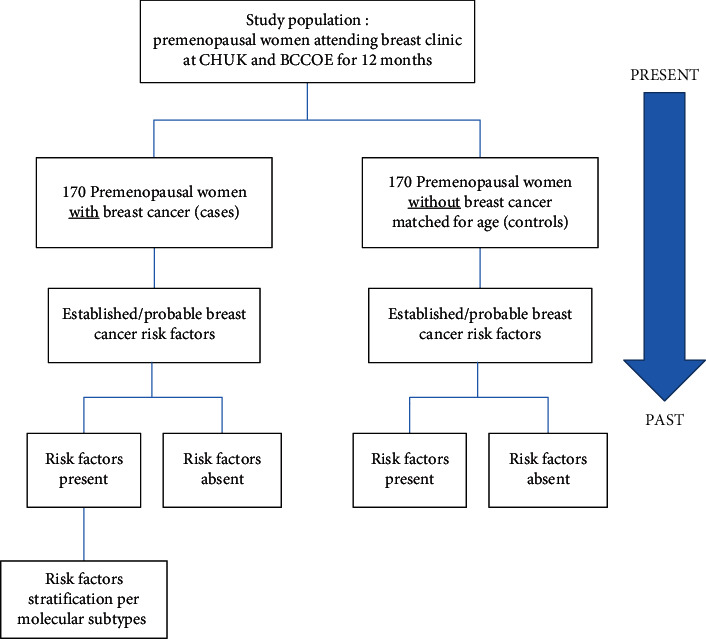
Methods: This was a case-control study. Premenopausal women with histological confirmation of BC and frequency-matched for age controls were recruited. A preestablished questionnaire was administered to both cases and controls for sociodemographics, BC probable risk factors, and clinical and pathological characteristics. BC was classified into luminal A, luminal B, HER2-type, basal-like (triple negative), and unclassified molecular subtypes by immunohistochemistry (IHC). Odds ratio (OR) and 95% confidence interval (CI) were estimated using multivariate logistic regression analysis.
Results: 340 participants were recruited into the study (170 cases vs. 170 controls). The median age was 39 years. The majority of cases presented at advanced stages of the disease (51.2% in stages III and IV) and had invasive ductal carcinoma (98.2%). 60.6% had subtypes of poor prognosis (HER2 enriched 14.7%, triple negative 12.9%, and unclassified 32.9%). Alcohol intake (AOR = 3.73, 95%CI 2.19 - 6.32, p < 0.001), obesity/overweight in adolescence or early adulthood (AOR = 10.86, 95%CI 4.82 - 24.4, p < 0.001), history of primary infertility (AOR = 33.8, 95%CI 3.5 - 321.5, p = 0.002), nulliparity (AOR = 3.75, 95%CI 1.61 - 8.75, p = 0.002), and a history of benign breast disease (AOR = 6.06, 95%CI 1.19 - 30.73, p = 0.03) were associated with the occurrence of premenopausal breast cancer. There was no significant difference between risk factor stratification per molecular subtype.
Conclusion: Several reproductive, environmental, and lifestyle risk factors have been identified to be associated with premenopausal BC. Among them, alcohol intake and obesity/overweight during adolescence/early adulthood can be modified. Interventions targeting alcohol consumption and obesity/overweight in adolescents and young adults may decrease the incidence of premenopausal breast cancer.
Copyright © 2021 Faustin Ntirenganya et al.
Conflict of interest statement
The authors declare that they have no conflict of interests.
References
-
- Globocan. Estimated cancer incidence: mortality and prevalence worldwide in 2012 . The International Agency for Research on Cancer (IARC), World Heal Organ; 2013.
-
- World Health Organization. Monitoring health for the sustainable development goals . World Health Organization; 2017. World Health Statistics 2017. http://apps.who.int/iris/bitstream/10665/255336/1/9789241565486-eng.pdf?... .
LinkOut - more resources
Full Text Sources
Research Materials
Miscellaneous
