


The Chemical Complexity of e-Cigarette Aerosols Compared With the Smoke From a Tobacco Burning Cigarette
- PMID: 34660535
- PMCID: PMC8514950
- DOI: 10.3389/fchem.2021.743060
The Chemical Complexity of e-Cigarette Aerosols Compared With the Smoke From a Tobacco Burning Cigarette
Abstract
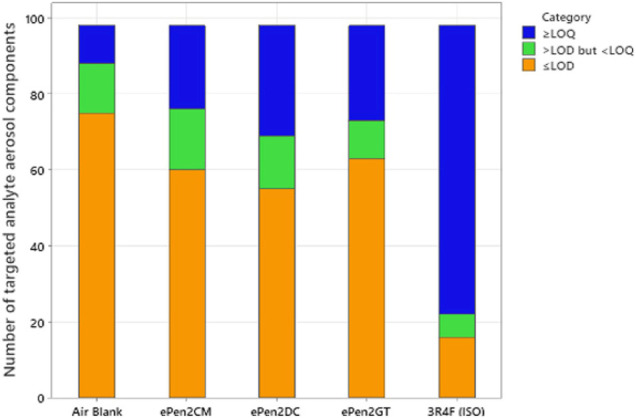
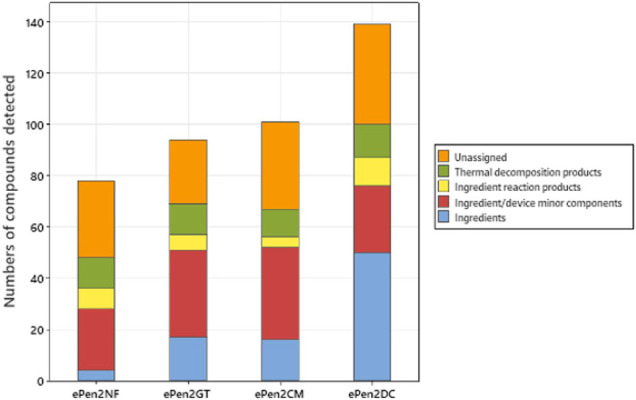
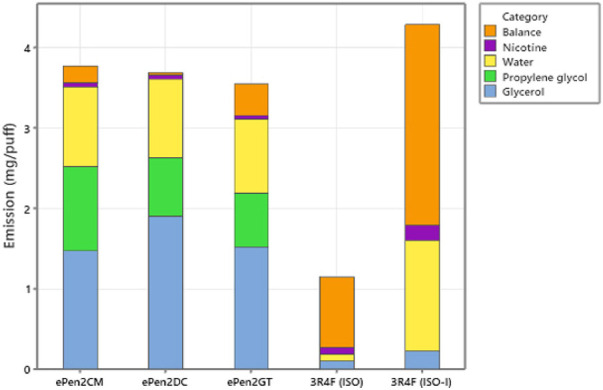
Background: As e-cigarette popularity has increased, there is growing evidence to suggest that while they are highly likely to be considerably less harmful than cigarettes, their use is not free of risk to the user. There is therefore an ongoing need to characterise the chemical composition of e-cigarette aerosols, as a starting point in characterising risks associated with their use. This study examined the chemical complexity of aerosols generated by an e-cigarette containing one unflavored and three flavored e-liquids. A combination of targeted and untargeted chemical analysis approaches was used to examine the number of compounds comprising the aerosol. Contributions of e-liquid flavors to aerosol complexity were investigated, and the sources of other aerosol constituents sought. Emissions of 98 aerosol toxicants were quantified and compared to those in smoke from a reference tobacco cigarette generated under two different smoking regimes. Results: Combined untargeted and targeted aerosol analyses identified between 94 and 139 compounds in the flavored aerosols, compared with an estimated 72-79 in the unflavored aerosol. This is significantly less complex (by 1-2 orders of magnitude) than the reported composition of cigarette smoke. Combining both types of analysis identified 5-12 compounds over and above those found by untargeted analysis alone. Gravimetrically, 89-99% of the e-cigarette aerosol composition was composed of glycerol, propylene glycol, water and nicotine, and around 3% comprised other, more minor, constituents. Comparable data for the Ky3R4F reference tobacco cigarette pointed to 58-76% of cigarette smoke "tar" being composed of minor constituents. Levels of the targeted toxicants in the e-cigarette aerosols were significantly lower than those in cigarette smoke, with 68.5->99% reductions under ISO 3308 puffing conditions and 88.4->99% reductions under ISO 20778 (intense) conditions; reductions against the WHO TobReg 9 priority list were around 99%. Conclusion: These analyses showed that the e-cigarette aerosols contain fewer compounds and at significantly lower concentrations than cigarette smoke. The chemical diversity of an e-cigarette aerosol is strongly impacted by the choice of e-liquid ingredients.
Keywords: aerosol chemistry; e-cigarette; flavor; targeted; untargeted.
Copyright © 2021 Margham, McAdam, Cunningham, Porter, Fiebelkorn, Mariner, Digard and Proctor.
Conflict of interest statement
British American Tobacco (BAT) funded the study. At the time of the study, all authors except AP were employees of BAT. Currently, AP, CP, DM, and KM are paid consultants to BAT, and AC, JM, SF, and HD are employees of BAT. KM was also employed by McAdam Scientific Ltd. DM was also employed by Mariner Science Ltd. CP was also employed by DoctorProctorScience Ltd.
Figures
References
-
- Allen J. G., Flanigan S. S., LeBlanc M., Vallarino J., MacNaughton P., Stewart J. H., et al. (2016). Flavoring Chemicals in E-Cigarettes: Diacetyl, 2,3-pentanedione, and Acetoin in a Sample of 51 Products, Including Fruit-, Candy-, and Cocktail-Flavored E-Cigarettes. Environ. Health Perspect. 124, 733–739. 10.1289/ehp.1510185 - DOI - PMC - PubMed
-
- Bao M. (2015). Analysis of Selected Carbonyl Compounds in E-Liquids and E-Aerosols by Using Pentafluorobenzylhydroxylamine Derivatization and Gas Chromatography-Mass Spectrometry. CORESTA SSPT Meeting.
LinkOut - more resources
Full Text Sources
