


Dependence of COVID-19 Policies on End-of-Year Holiday Contacts in Mexico City Metropolitan Area: A Modeling Study
- PMID: 34660906
- PMCID: PMC8512280
- DOI: 10.1177/23814683211049249
Dependence of COVID-19 Policies on End-of-Year Holiday Contacts in Mexico City Metropolitan Area: A Modeling Study
Abstract
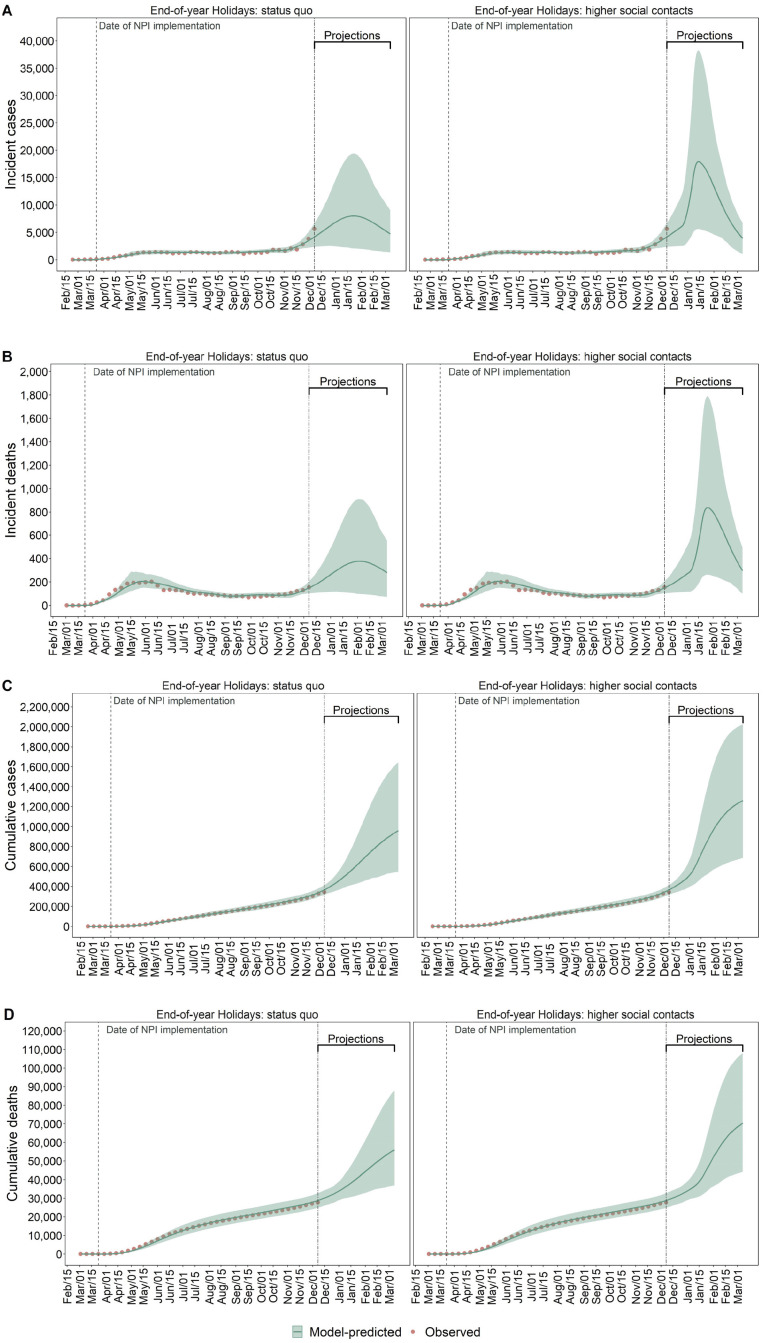
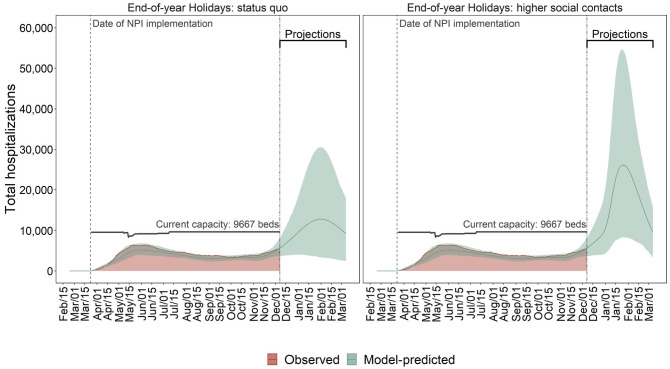
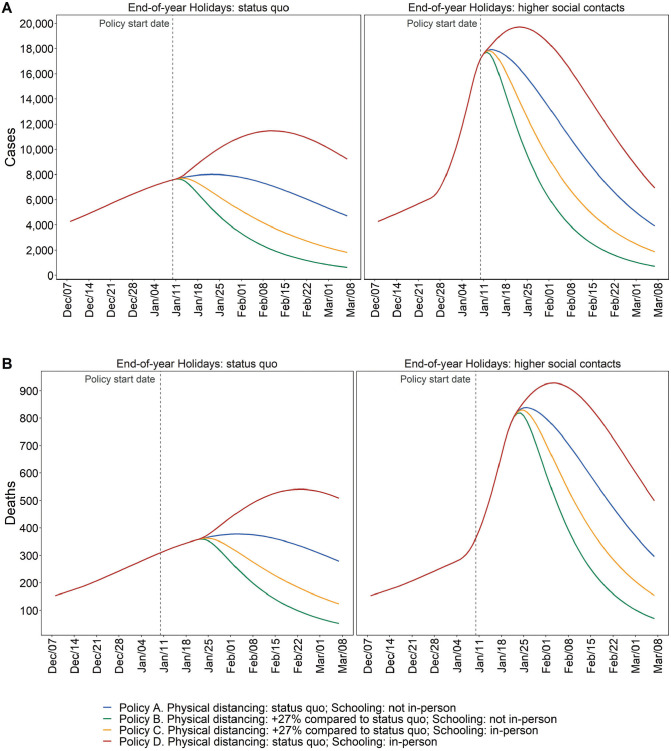
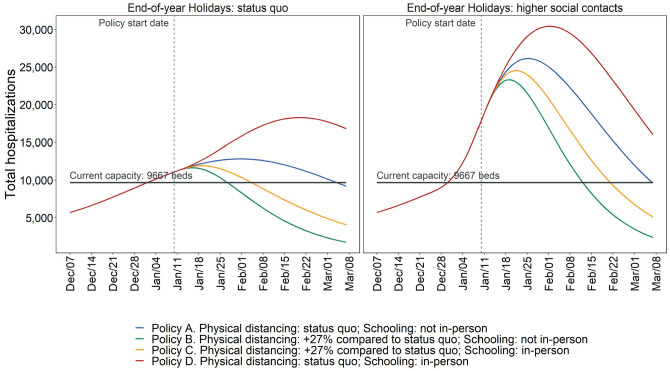
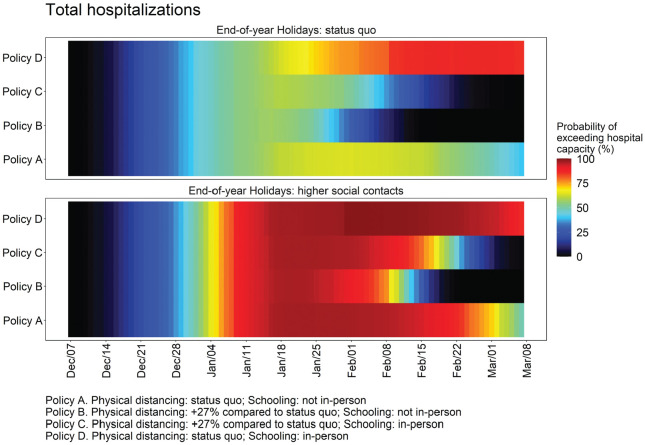
Background. Mexico City Metropolitan Area (MCMA) has the largest number of COVID-19 (coronavirus disease 2019) cases in Mexico and is at risk of exceeding its hospital capacity in early 2021. Methods. We used the Stanford-CIDE Coronavirus Simulation Model (SC-COSMO), a dynamic transmission model of COVID-19, to evaluate the effect of policies considering increased contacts during the end-of-year holidays, intensification of physical distancing, and school reopening on projected confirmed cases and deaths, hospital demand, and hospital capacity exceedance. Model parameters were derived from primary data, literature, and calibrated. Results. Following high levels of holiday contacts even with no in-person schooling, MCMA will have 0.9 million (95% prediction interval 0.3-1.6) additional COVID-19 cases between December 7, 2020, and March 7, 2021, and hospitalizations will peak at 26,000 (8,300-54,500) on January 25, 2021, with a 97% chance of exceeding COVID-19-specific capacity (9,667 beds). If MCMA were to control holiday contacts, the city could reopen in-person schools, provided they increase physical distancing with 0.5 million (0.2-0.9) additional cases and hospitalizations peaking at 12,000 (3,700-27,000) on January 19, 2021 (60% chance of exceedance). Conclusion. MCMA must increase COVID-19 hospital capacity under all scenarios considered. MCMA's ability to reopen schools in early 2021 depends on sustaining physical distancing and on controlling contacts during the end-of-year holiday.
Keywords: COVID-19; Mexico; dynamic transmission model; hospital capacity; non-pharmaceutical interventions.
© The Author(s) 2021.
Conflict of interest statement
The author(s) declared no potential conflicts of interest with respect to the research, authorship, and/or publication of this article.
Figures
Update of
-
How do Covid-19 policy options depend on end-of-year holiday contacts in Mexico City Metropolitan Area? A Modeling Study.medRxiv [Preprint]. 2020 Dec 22:2020.12.21.20248597. doi: 10.1101/2020.12.21.20248597. medRxiv. 2020. Update in: MDM Policy Pract. 2021 Oct 11;6(2):23814683211049249. doi: 10.1177/23814683211049249. PMID: 33398301 Free PMC article. Updated. Preprint.
References
-
- World Health Organization. WHO coronavirus (COVID-19) dashboard. Available from: https://covid19.who.int
-
- Robert R, Reignier J, Tournoux-Facon C, et al. Refusal of intensive care unit admission due to a full unit: impact on mortality. Am J Respir Crit Care Med. 2012;185(10):1081–7. - PubMed
-
- Ritchie H, Mathieu E, Rodés-Guirao L, et al. Coronavirus pandemic (COVID-19). Available from: https://ourworldindata.org/coronavirus
Grants and funding
LinkOut - more resources
Full Text Sources
