Modeling the epidemiological impact of the UNAIDS 2025 targets to end AIDS as a public health threat by 2030
- PMID: 34662333
- PMCID: PMC8559943
- DOI: 10.1371/journal.pmed.1003831
Modeling the epidemiological impact of the UNAIDS 2025 targets to end AIDS as a public health threat by 2030
Abstract
Background: UNAIDS has established new program targets for 2025 to achieve the goal of eliminating AIDS as a public health threat by 2030. This study reports on efforts to use mathematical models to estimate the impact of achieving those targets.
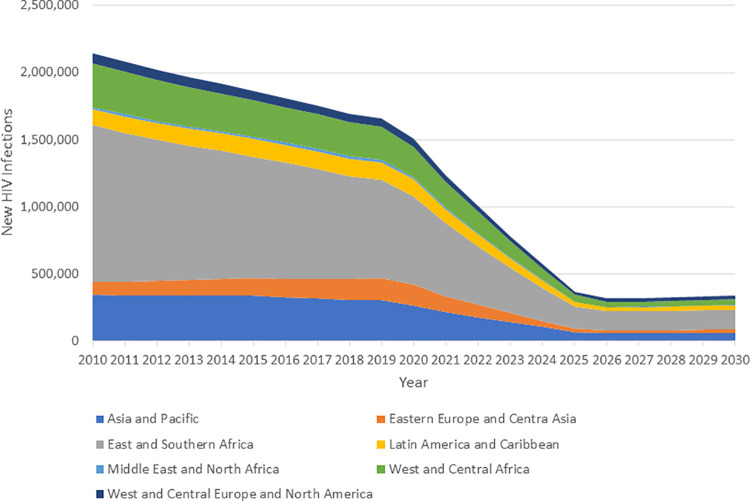
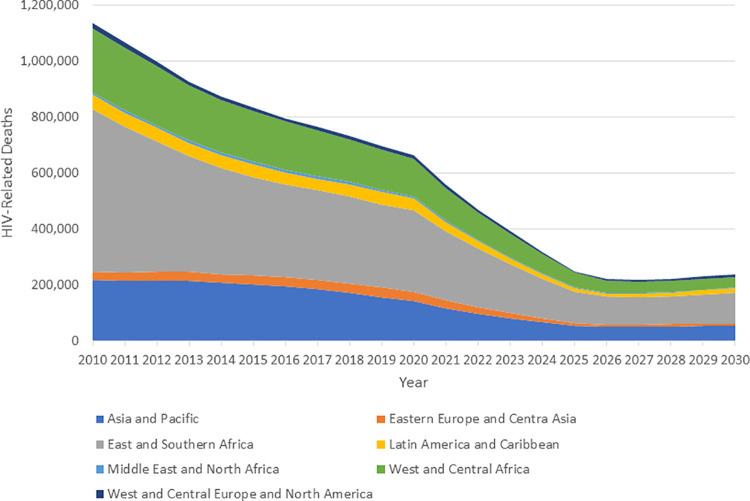
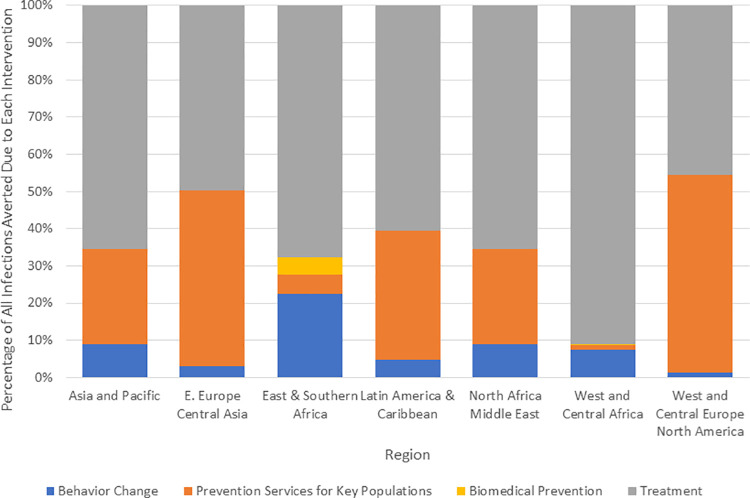
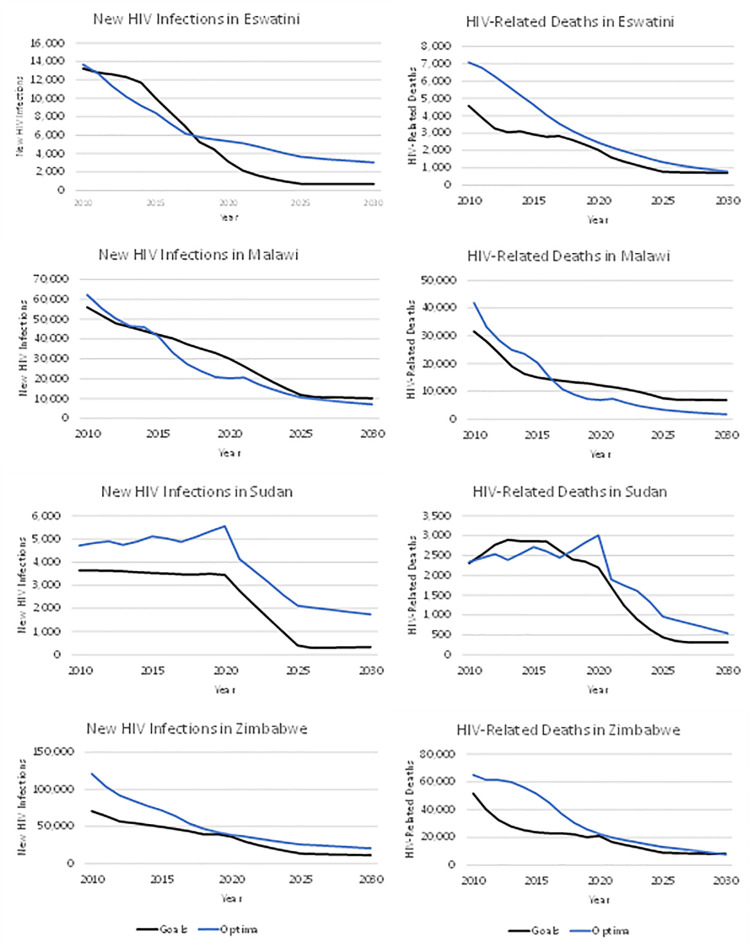
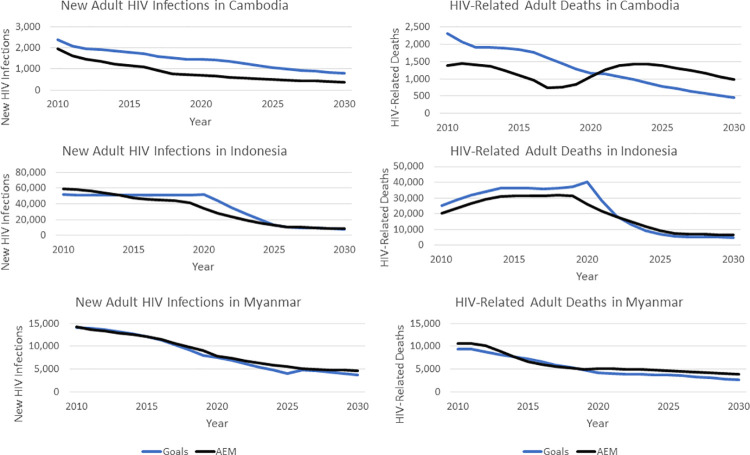
Methods and findings: We simulated the impact of achieving the targets at country level using the Goals model, a mathematical simulation model of HIV epidemic dynamics that includes the impact of prevention and treatment interventions. For 77 high-burden countries, we fit the model to surveillance and survey data for 1970 to 2020 and then projected the impact of achieving the targets for the period 2019 to 2030. Results from these 77 countries were extrapolated to produce estimates for 96 others. Goals model results were checked by comparing against projections done with the Optima HIV model and the AIDS Epidemic Model (AEM) for selected countries. We included estimates of the impact of societal enablers (access to justice and law reform, stigma and discrimination elimination, and gender equality) and the impact of Coronavirus Disease 2019 (COVID-19). Results show that achieving the 2025 targets would reduce new annual infections by 83% (71% to 86% across regions) and AIDS-related deaths by 78% (67% to 81% across regions) by 2025 compared to 2010. Lack of progress on societal enablers could endanger these achievements and result in as many as 2.6 million (44%) cumulative additional new HIV infections and 440,000 (54%) more AIDS-related deaths between 2020 and 2030 compared to full achievement of all targets. COVID-19-related disruptions could increase new HIV infections and AIDS-related deaths by 10% in the next 2 years, but targets could still be achieved by 2025. Study limitations include the reliance on self-reports for most data on behaviors, the use of intervention effect sizes from published studies that may overstate intervention impacts outside of controlled study settings, and the use of proxy countries to estimate the impact in countries with fewer than 4,000 annual HIV infections.
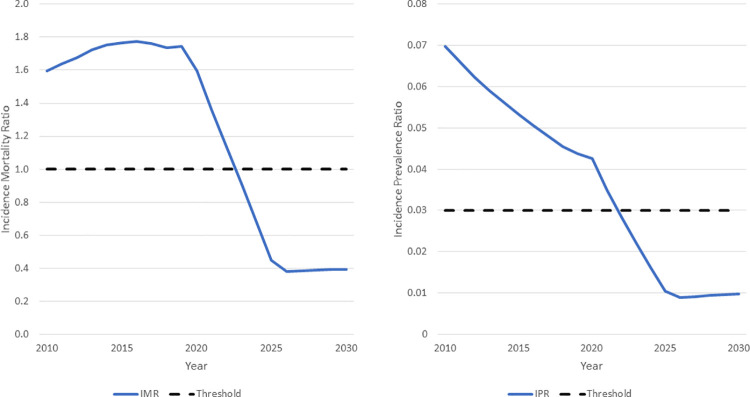
Conclusions: The new targets for 2025 build on the progress made since 2010 and represent ambitious short-term goals. Achieving these targets would bring us close to the goals of reducing new HIV infections and AIDS-related deaths by 90% between 2010 and 2030. By 2025, global new infections and AIDS deaths would drop to 4.4 and 3.9 per 100,000 population, and the number of people living with HIV (PLHIV) would be declining. There would be 32 million people on treatment, and they would need continuing support for their lifetime. Incidence for the total global population would be below 0.15% everywhere. The number of PLHIV would start declining by 2023.
Conflict of interest statement
The authors have declared that no competing interests exist.
Figures
References
-
- UNAIDS. [cited 2021 Jul 2]. Available from: https://www.unaids.org/en/AIDS_SDGs
-
- UNAIDS. Fast-Track Ending the AIDS Epidemic by 2030. 2014. Joint United Nations Programme on HIV/AIDS. Available from: https://www.unaids.org/en/resources/documents/2014/JC2686_WAD2014report
-
- UNAIDS. Confronting Inequalities. Lessons for the pandemic responses from 40 years of AIDS. Global AIDS Update, 2021. Joint United Nations Programme on HIV/AIDS. Available from: https://www.unaids.org/en/resources/documents/2021/2021-global-aids-update
Publication types
MeSH terms
Grants and funding
LinkOut - more resources
Full Text Sources
Medical