


Diagnostic accuracy and clinical applicability of the Swedish version of the 4AT assessment test for delirium detection, in a mixed patient population and setting
- PMID: 34663229
- PMCID: PMC8522056
- DOI: 10.1186/s12877-021-02493-3
Diagnostic accuracy and clinical applicability of the Swedish version of the 4AT assessment test for delirium detection, in a mixed patient population and setting
Abstract
Background: Delirium is common in older hospitalized patients. It has serious consequences e.g., poor health outcomes, mortality and increased costs. Despite that, many cases are undetected. Early detection of delirium is important in improving outcomes and use of assessment tools improves detection rates. The 4AT is a brief screening tool for delirium detection, which has not previously been translated into Swedish. The study aim was to evaluate diagnostic accuracy and clinical applicability of a Swedish version of the screening tool 4AT for delirium detection.
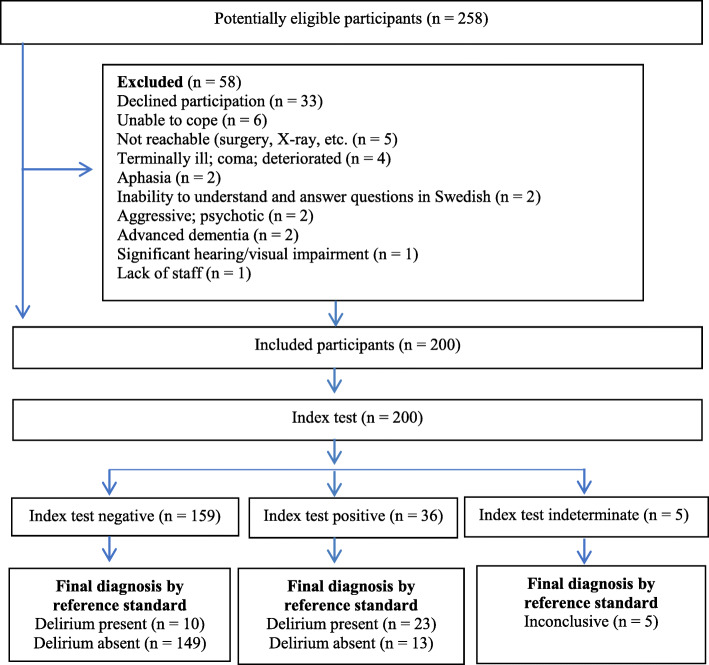
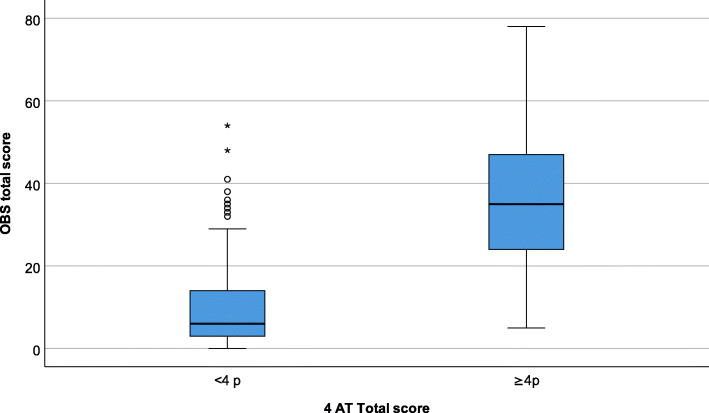
Method: This diagnostic test accuracy study used a quantitative and a qualitative approach and evaluated the patients' and the health care professionals' experiences of the tool. Study included 200 patients ≥65 years from a university hospital and a county hospital in two Swedish regions. Medical specialties were geriatric stroke/neurology, geriatric multimorbidity, severe cognitive impairment, orthopaedic, and urology. The translated 4AT was tested against the reference standard DSM-IV-TR criteria, based on the Organic Brain Syndrome scale and patient records. The 4AT was assessed simultaneously and independently by two assessors. Additionally, data was collected through patient record reviews, and questions about applicability to the patients (n = 200) and the assessors (n = 37). Statistical analyses, and qualitative content analyses were conducted.
Results: By reference standard 18% had delirium, and by 4AT 19%. The overall percent agreement was 88%, AUROC 0.808, sensitivity 0.70 (95% CI 0.51-0.84) and specificity 0.92 (95% CI 0.87-0.96). In the ward for severe cognitive impairment (n = 63) the 4AT was less sensitive and less specific. In the other wards (n = 132) sensitivity was 0.77 (95% CI 0.50-0.93), specificity 0.93 (95% CI 0.87-0.97), and AUROC 0.848. Interrater reliability (Kappa) was 0.918, p = < 0.001 (n = 144). The 4AT was well tolerated by patients, easy to use for health care professionals, and took a few minutes to conduct.
Conclusion: The Swedish version of 4AT is an accurate and applicable tool to use in clinical practice for detecting delirium in hospitalized patients across different medical specialities, and to use by different professionals and levels of seniority. To improve patient outcomes, we recommend the 4AT to be incorporated in clinical practice in health care settings in Sweden.
Keywords: 4AT; Applicability; Delirium; Diagnostic accuracy; Qualitative content analysis; Validation study.
© 2021. The Author(s).
Conflict of interest statement
The authors declare that they have no competing interests.
Figures
References
-
- Welch C, McCluskey L, Wilson D, Chapman GE, Jackson TA, Treml J, Davis D, Cunningham E, Copeland C, Quinn T, et al. Delirium is prevalent in older hospital inpatients and associated with adverse outcomes: results of a prospective multi-Centre study on world delirium awareness day. BMC Med. 2019;17(1):229. doi: 10.1186/s12916-019-1458-7. - DOI - PMC - PubMed
Publication types
MeSH terms
LinkOut - more resources
Full Text Sources
Medical
