. 2021 Oct 18;11(1):20571.
doi: 10.1038/s41598-021-98986-7.

Diurnal changes in the murine small intestine are disrupted by obesogenic Western Diet feeding and microbial dysbiosis

Affiliations

Diurnal changes in the murine small intestine are disrupted by obesogenic Western Diet feeding and microbial dysbiosis

Sarah E Martchenko et al. Sci Rep. .

Abstract

Intestinal functions demonstrate circadian rhythms thought to be entrained, in part, by an organisms' intrinsic feeding and fasting periods as well as by the intestinal microbiome. Circadian disruption as a result of ill-timed nutrient exposure and obesogenic feeding poses an increased risk to disease. As such, the aim of this study was to assess the relationships between dietary timing, composition, and the microbiome with regard to rhythmic small intestinal structure and mucosal immunity. Rodent chow (RC)-mice exhibited time-dependent increases in small intestinal weight, villus height, and crypt depth as well as an increased proportion of CD8αα+ cells and concomitant decrease in CD8αβ+ cells at the onset of the feeding period (p < 0.05-0.001). Western diet (WD)-animals displayed disrupted time-dependent patterns in intestinal structure and lymphocyte populations (p < 0.05-0.01). Antibiotic-induced microbial depletion abrogated the time- and diet-dependent patterns in both RC- and WD-mice (p < 0.05-0.001). However, although germ-free-mice displayed altered rhythms, fecal microbial transfer from RC-mice was generally unsuccessful in restoring structural and immune changes in these animals. This study shows that adaptive changes in the small intestine at the onset of the feeding and fasting periods are disrupted by WD-feeding, and that these changes are dependent, in part, on the intestinal microbiome.


Conflict of interest statement

The authors declare no competing interests.

Figures

Figure 1
Figure 1
WD-feeding and microbial disruption alter time-dependent patterns in SI gravimetric and morphometric parameters. (a) SI weight, (b) SI length, (c) ileal villus height, and (d) ileal crypt depth in RC- and WD-fed animals with and without AIMD measured at ZT2 and ZT14. n = 3–6 male and 3–6 female mice. *p < 0.05 **p < 0.01 ***p < 0.001.
Figure 2
Figure 2
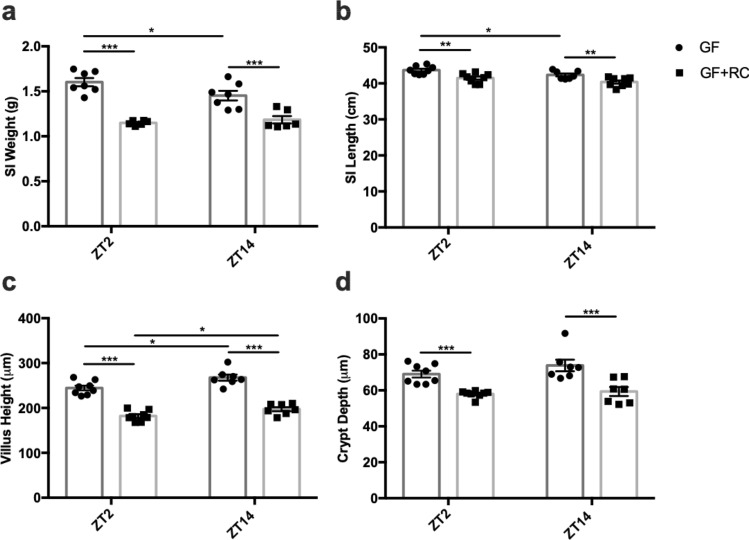
FMT reduces SI gravimetric and morphometric parameters independent of time. (a) SI weight, (b) SI length, (c) ileal villus height, and (d) ileal crypt depth in GF and GF-mice following FMT with RC-microbiome (GF + RC) measured at ZT2 and ZT14. n = 3–4 male and 3–4 female mice. *p < 0.05 **p < 0.01 ***p < 0.001.
Figure 3
Figure 3
Intestinal mucosal gene expression is altered by WD-feeding and microbial disruption. (a) Arntl, (b) Per2, (c) Tnf, (d) Ifng, (e) Il6, (f) Il10, and (g) Tgfb mRNA expression measured from SI mucosa isolated at ZT2 and ZT14 from RC- and WD-fed animals with and without AIMD. n = 2–6 male and 2–6 female mice. *p < 0.05 **p < 0.01 ***p < 0.001.
Figure 4
Figure 4
Intestinal mucosal gene expression is partially restored following FMT. (a) Arntl, (b) Per2, (c) Tnf, (d) Ifng, (e) Il6, (f) Il10, and (g) Tgfb mRNA expression measured from SI mucosa isolated at ZT2 and ZT14 from GF and GF-mice following FMT with RC-microbiome (GF + RC) measured at ZT2 and ZT14. n = 3–4 male and 3–4 female mice. *p < 0.05 **p < 0.01 ***p < 0.001.
Figure 5
Figure 5
Time, diet, and microbial disruption alter proportions of SI IEL cell populations. Proportions of (a) CD8αβ+, (b) CD8αα+, and (c) CD4+ on TCRβ+ cells acquired from the SI epithelium at ZT2 and ZT14 from RC- and WD-fed animals with and without AIMD. n = 3–6 male and 3–6 female mice. *p < 0.05 **p < 0.01 ***p < 0.001.
Figure 6
Figure 6
Time-dependent changes in SI IEL cell populations are partially restored following FMT in GF-mice. Proportions of (a) CD8αβ+, (b) CD8αα+, and (c) CD4+ on TCRβ+ cells acquired from the SI epithelium at ZT2 and ZT14 from GF and GF-mice following FMT with RC-microbiome. n = 2–3 male and 2–3 female mice. *p < 0.05 **p < 0.01.
Figure 7
Figure 7
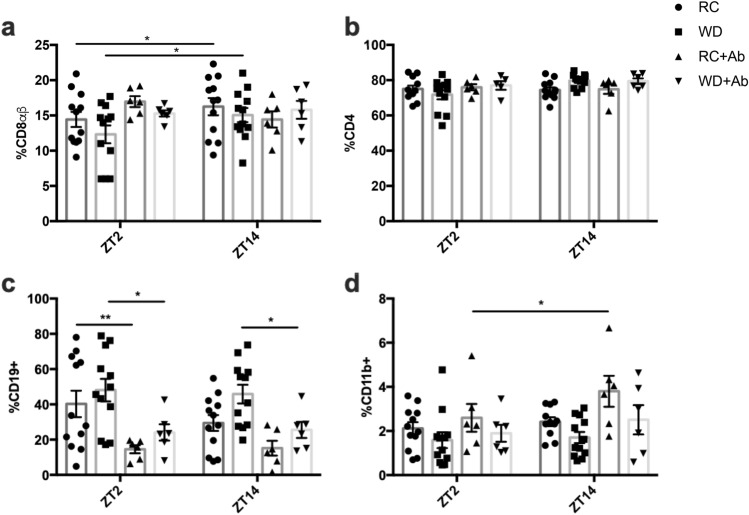
Time-dependent changes are lost in LPL %CD8αβ+ cells following microbial disruption. Proportions of (a) CD8αβ+and (b) CD4+ on TCRβ+ cells, as well as (c) CD19 + B-cells and (d) CD11b + myeloid cells acquired from the SI lamina propria at ZT2 and ZT14 from RC- and WD-fed animals with and without AIMD. n = 3–6 male and 3–6 female mice. * p < 0.05.
Figure 8
Figure 8
FMT in GF-mice alters proportion of CD8αβ+ but not CD4+ SI LPL cell populations. Proportions of (a) CD8αβ+and (b) CD4+ on TCRβ+ cells, as well as (c) CD19 + B-cells and (d) CD11b + myeloid cells acquired from the SI lamina propria at ZT2 and ZT14 from GF and GF-mice following FMT with RC-microbiome. n = 2–3 male and 2–3 female mice. *p < 0.05.

References

    1. Bass J, Lazar MA. Circadian time signatures of fitness and disease. Science. 2016;354:994–999. doi: 10.1126/science.aah4965. - DOI - PubMed
    1. Gachon F, Loizides-Mangold U, Petrenko V, Dibner C. Glucose homeostasis: Regulation by peripheral circadian clocks in rodents and humans. Endocrinology. 2017;158:1074–1084. doi: 10.1210/en.2017-00218. - DOI - PubMed
    1. Hoogerwerf WA, Hellmich HL, Cornelissen G, Halberg F, Shahinian VB, Bostwick J, Savidge TC, Cassone VM. Clock gene expression in the murine gastrointestinal tract: Endogenous rhythmicity and effects of a feeding regimen. Gastroenterology. 2007;133:1250–1260. doi: 10.1053/j.gastro.2007.07.009. - DOI - PubMed
    1. Mukherji A, Kobiita A, Ye T, Chambon P. Homeostasis in intestinal epithelium is orchestrated by the circadian clock and microbiota cues transduced by TLRs. Cell. 2013;153:812–827. doi: 10.1016/j.cell.2013.04.020. - DOI - PubMed
    1. Thaiss CA, Zeevi D, Maayan L, Zilberman-Schapira G, Suez J, Tengeler AC, Abramson L, Katz MN, Korem T, Zmora N, Kuperman Y, Biton I, Gilad S, Harmelin A, Shapiro H, Halpern Z, Segal E, Elinav E. Transkingdom control of microbiota diurnal oscillations promotes metabolic homeostasis. Cell. 2014;159:514–529. doi: 10.1016/j.cell.2014.09.048. - DOI - PubMed

Publication types

Grants and funding