Review
. 2021 Dec;17(12):747-758.
doi: 10.1038/s41582-021-00565-x. Epub 2021 Oct 18.

Changing demography and the challenge of dementia in India

Affiliations
Review

Changing demography and the challenge of dementia in India

Vijayalakshmi Ravindranath et al. Nat Rev Neurol. 2021 Dec.

Abstract

In India, increasing lifespan and decreasing fertility rates have resulted in a growing number of older persons. By 2050, people over 60 years of age are predicted to constitute 19.1% of the total population. This ageing of the population is expected to be accompanied by a dramatic increase in the prevalence of dementia. The aetiopathogenesis of dementia has been the subject of a number of prospective longitudinal studies in North America and Europe; however, the findings from these studies cannot simply be translated to the Indian population. The population of India is extremely diverse in terms of socio-economic, cultural, linguistic, geographical, lifestyle-related and genetic factors. Indeed, preliminary data from recently initiated longitudinal studies in India indicate that the prevalence of vascular and metabolic risk factors, as well as white matter hyperintensities, differs between urban and rural cohorts. More information on the complex role of vascular risk factors, gender and genetic influences on dementia prevalence and progression in Indian populations is urgently needed. Low-cost, culturally appropriate and scalable interventions need to be developed expeditiously and implemented through public health measures to reduce the growing burden of dementia. Here, we review the literature concerning dementia epidemiology and risk factors in the Indian population and discuss the future work that needs to be performed to put in place public health interventions to mitigate the burden of dementia.


Conflict of interest statement

The authors declare no competing interests.

Figures

Fig. 1
Fig. 1. Changing demographic trends in the South Asian region.
a | Average life expectancy at birth for eight South Asian countries from 2000, including projections for 2020, 2030, 2040 and 2050. b | Percentage of the population ≥65 years of age. c | Total fertility rate. Data from https://data.worldbank.org/.
Fig. 2
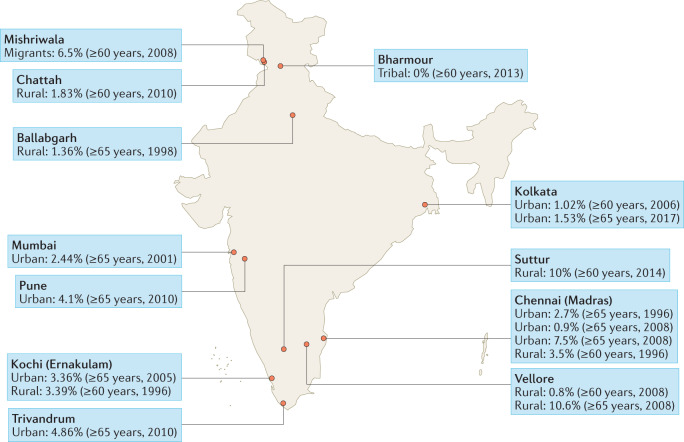
Fig. 2. Varying prevalence of dementia according to geographical location in India.
This figure shows the prevalence of dementia in different geographical locations in India. Also provided is the age range of the population studied and the year of publication.
Fig. 3
Fig. 3. Increasing burden of cardiovascular diseases and metabolic risk factors in India.
a | Deaths caused by cardiovascular disease as a percentage of total deaths. b | Percentage of total disability-adjusted life years (DALYs) resulting from cardiovascular disease. c | Prevalence of cardiovascular disease. d | Percentage of total DALYs resulting from metabolic risk factors such as diabetes, hypertension and obesity. These data come from the Global Burden of Disease study. Adapted from: https://vizhub.healthdata.org/gbd-compare/.
Fig. 4
Fig. 4. Factors that influence dementia prevalence in India.
Although factors such as changing demography, increasing cardiovascular burden, low levels of literacy and disadvantages in women are common to many low-income and middle-income countries, the vast sociocultural and genetic diversity and disintegrating joint family system are unique to India.

References

    1. Cantarero-Prieto D, Leon PL, Blazquez-Fernandez C, Juan PS, Cobo CS. The economic cost of dementia: a systematic review. Dementia. 2019;19:2637–2657. doi: 10.1177/1471301219837776. - DOI - PubMed
    1. World Health Organization. Dementia (WHO, 2021). Provides basic facts on dementia, including prevalence, symptoms, forms, treatment and impact.
    1. Leroi I, et al. A roadmap to develop dementia research capacity and capability in Pakistan: a model for low- and middle-income countries. Alzheimers Dement. 2019;5:939–952. doi: 10.1016/j.trci.2019.11.005. - DOI - PMC - PubMed
    1. Kalaria RN, et al. Alzheimer’s disease and vascular dementia in developing countries: prevalence, management, and risk factors. Lancet Neurol. 2008;7:812–826. doi: 10.1016/S1474-4422(08)70169-8. - DOI - PMC - PubMed
    1. Hunter DJ, Reddy KS. Noncommunicable diseases. N. Engl. J. Med. 2013;369:1336–1343. doi: 10.1056/NEJMra1109345. - DOI - PubMed

Publication types