Review
. 2021 Dec;78(23):7219-7235.
doi: 10.1007/s00018-021-03961-0. Epub 2021 Oct 19.

Developmentally regulated GTPases: structure, function and roles in disease

Affiliations
Review

Developmentally regulated GTPases: structure, function and roles in disease

Christian A E Westrip et al. Cell Mol Life Sci. 2021 Dec.

Abstract

GTPases are a large superfamily of evolutionarily conserved proteins involved in a variety of fundamental cellular processes. The developmentally regulated GTP-binding protein (DRG) subfamily of GTPases consists of two highly conserved paralogs, DRG1 and DRG2, both of which have been implicated in the regulation of cell proliferation, translation and microtubules. Furthermore, DRG1 and 2 proteins both have a conserved binding partner, DRG family regulatory protein 1 and 2 (DFRP1 and DFRP2), respectively, that prevents them from being degraded. Similar to DRGs, the DFRP proteins have also been studied in the context of cell growth control and translation. Despite these proteins having been implicated in several fundamental cellular processes they remain relatively poorly characterized, however. In this review, we provide an overview of the structural biology and biochemistry of DRG GTPases and discuss current understanding of DRGs and DFRPs in normal physiology, as well as their emerging roles in diseases such as cancer.

Keywords: GTPase; Gir2; Rbg1; Rbg2; Ribosome; Tma46; Translation.


Conflict of interest statement

The authors report no competing interests.

Figures
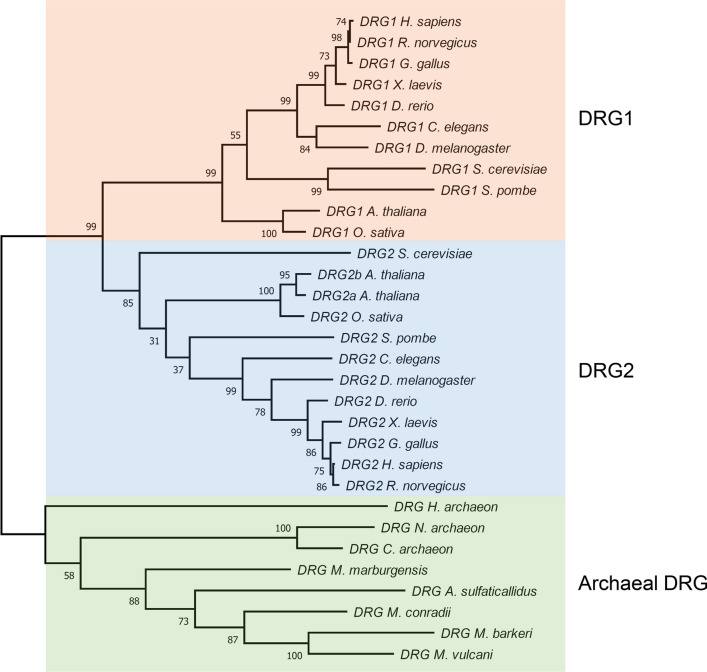
Fig. 1
Fig. 1
Phylogenetic tree of DRG proteins showing their evolutionary relationships. Sequences were downloaded from NCBI and aligned using the MUSCLE algorithm (a copy of the alignment used can be found in the supplementary file). The phylogenetic tree was estimated using the Maximum Likelihood method, with 500 bootstrap replicates. Bootstrap values are indicated. All analysis was performed in MEGA7. H. sapiens: Homo sapiens, R. norvegicus: Rattus norvegicus, G. gallus: Gallus gallus, X. leavis: Xenopus leavis, D. rerio: Danio rerio, D. melanogaster: Drosophila melanogaster, C. elegans: Caenorhabditis elegans, O. sativa: Oryza sativa, A. thaliana: Arabidopsis thaliana, S. pombe: Schizosaccharomyces pombe, S. cerevisiae: Saccharomyces cerevisiae, H. archaeon: Heimdallarchaeota archaeon, N. archaeon: Nanoarchaeota archaeon, C. archaeon: Crenarchaeota archaeon, M. marburgensis: Methanothermobacter marburgensis, A. sulfaticallidus: Archaeoglobus sulfaticallidus, M. conradii: Methanocella conradii, M. barkerii: Methanosarcina barkerii, M. vulcani: Methanolobus vulcani
Fig. 2
Fig. 2
The canonical GTPase cycle. GTPases cycle between an active GTP bound “on” state and an inactive GDP bound “off” state with the help of GAPs and GEFs. GAP: GTPase Activating Protein. GEF: guanine nucleotide exchange factor, Pi: phosphate
Fig. 3
Fig. 3
Domain organization of DRG GTPases, conserved members of the OBG-HflX superfamily. a Phylogenetic tree of example proteins from the OBG, NOG1, DRG, OLA1, Ygr210 and HflX families. Protein sequences were downloaded from NCBI and aligned using the MUSCLE algorithm. The phylogenetic tree was estimated using the minimal evolution method in MEGA7. b Domain organization of some of the GTPases shown in part (a). HTH helix turn helix, S5D2L ribosomal protein S5 domain 2-like domain, TGS ThrRS, GTPase, and SpoT domain, CTD C-terminal domain, NTD N-terminal domain, CTT C-terminal tail, CC coiled-coil. In both (a) and (b) Hs: Homo sapiens, Sc: Saccharomyces cerevisiae, Ec: Escherichia coli. c Crystal structure of Rbg1 on its own and d in complex with the DFRP domain of Tma46. The DFRP domain is the region of DFRPs that interacts with DRG proteins. Structure from Francis et al., PDB:4A9A [25]. Images created in Chimera
Fig. 4
Fig. 4
DFRP1/2 domain architecture and regulation of DRGs. a Domain architecture of human DFRP1 and 2. The only region conserved between the two proteins is the DFRP domain, the region required for interaction with DRGs. b DFRP proteins bind to their respective DRG and prevent it from being degraded, likely via the proteasome. DRG1 has also shown weak binding to DFRP2 when overexpressed (indicated by dashed arrow)
Fig. 5
Fig. 5
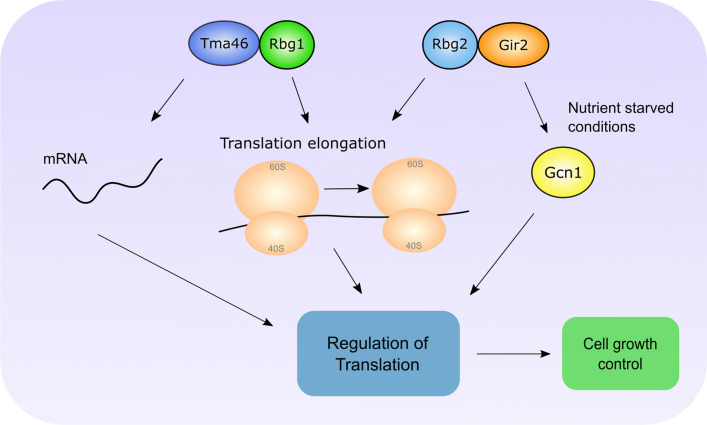
Roles of Rbg1/2 and Tma46/Gir2 in yeast. The Rbg1/Tma46 complex has been implicated in the regulation of translation elongation and mRNA. Rbg2 and Gir2 have been reported to interact with Gcn1, and may regulate translation in response to nutrient starved conditions
Fig. 6
Fig. 6
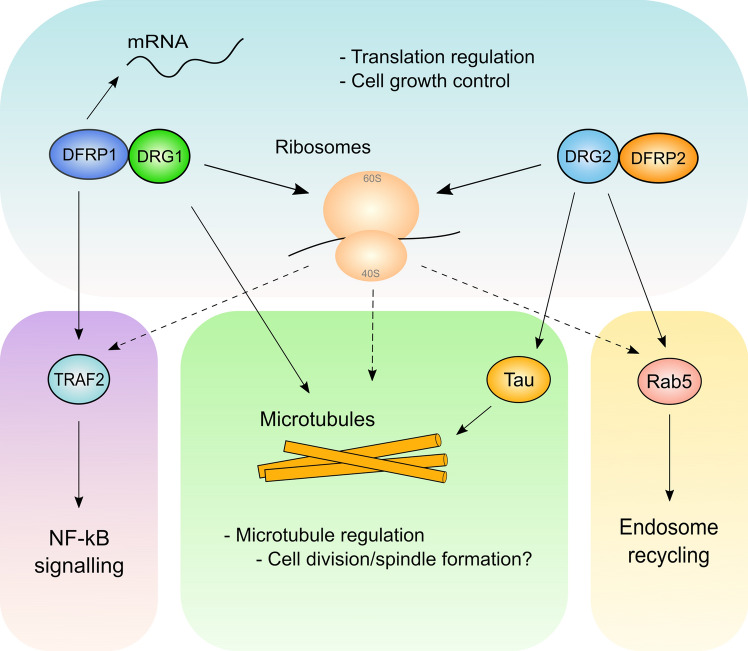
DRGs and DFRPs in mammalian cell biology. The DRG1/DFRP1 complex has been reported to interact with ribosomes in mammalian cells, suggesting its role in translational regulation may be conserved between orthologues. DFRP1 has also been reported to interact with TRAF2 and may have a role in NF-κβ signalling. Both DRGs have been suggested to regulate microtubules through either direct association as in the case of DRG1 or through regulation of Tau by DRG2. Whilst it has not been conclusively confirmed, mammalian DRG2 and DFRP2 also likely interact with and regulate ribosomes given the high sequence conservation with their yeast counterparts. Furthermore, DRG2 has also been implicated in the regulation of endosome recycling, via its interaction with Rab5. Given that DRGs and DFRPs are involved in translation, it is possible that deregulated protein synthesis could be contributing indirectly to the other reported functions. This potential regulation has been indicated using dashed arrows

References

    1. Li B, Trueb B. DRG represents a family of two closely related GTP-binding proteins. Biochim Biophys Acta. 2000;1491:196–204. - PubMed
    1. Ishikawa K, Azuma S, Ikawa S, Semba K, Inoue J. Identification of DRG family regulatory proteins (DFRPs): specific regulation of DRG1 and DRG2. Genes Cells. 2005;10:139–150. - PubMed
    1. Daugeron MC, Prouteau M, Lacroute F, Seraphin B. The highly conserved eukaryotic DRG factors are required for efficient translation in a manner redundant with the putative RNA helicase Slh1. Nucleic Acids Res. 2011;39:2221–2233. - PMC - PubMed
    1. Leipe DD, Wolf YI, Koonin EV, Aravind L. Classification and evolution of P-loop GTPases and related ATPases1. J Mol Biol. 2002;317:41–72. - PubMed
    1. Wittinghofer A, Vetter IR. Structure-function relationships of the G domain, a canonical switch motif. Annu Rev Biochem. 2011;80:943–971. - PubMed

MeSH terms

Substances