


Impact of App-Delivered Mindfulness Meditation on Functional Connectivity, Mental Health, and Sleep Disturbances Among Physician Assistant Students: Randomized, Wait-list Controlled Pilot Study
- PMID: 34665153
- PMCID: PMC8564666
- DOI: 10.2196/24208
Impact of App-Delivered Mindfulness Meditation on Functional Connectivity, Mental Health, and Sleep Disturbances Among Physician Assistant Students: Randomized, Wait-list Controlled Pilot Study
Abstract
Background: Health care provider and trainee burnout results in substantial national and institutional costs and profound social effects. Identifying effective solutions and interventions to cultivate resilience among health care trainees is critical. Although less is known about the mental health needs of physician assistants (PAs) or PA students, accumulating research indicates that they experience similarly alarming rates of burnout, depression, and emotional exhaustion. Mobile app-delivered mindfulness meditation may be an effective part of salubrious programming to bolster long-term resilience and health among PA students.
Objective: This study aims to examine the impact of app-delivered mindfulness meditation on self-reported mental health symptoms among PA students. A secondary aim is to investigate changes in brain connectivity to identify neurobiological changes related to changes in mental health symptoms.
Methods: We recruited PA students enrolled in their third semester of PA school and used a longitudinal, randomized, wait-list-controlled design. Participants randomized to the mindfulness group were provided 1-year subscriptions to the 10% Happier app, a consumer-based meditation app, and asked to practice every day for 8 weeks. Before randomization and again after completion of the 8-week program, all participants completed resting-state functional magnetic resonance imaging as well as self-report assessments of burnout, depression, anxiety, and sleep impairment. App use was acquired as a measure of mindfulness practice time.
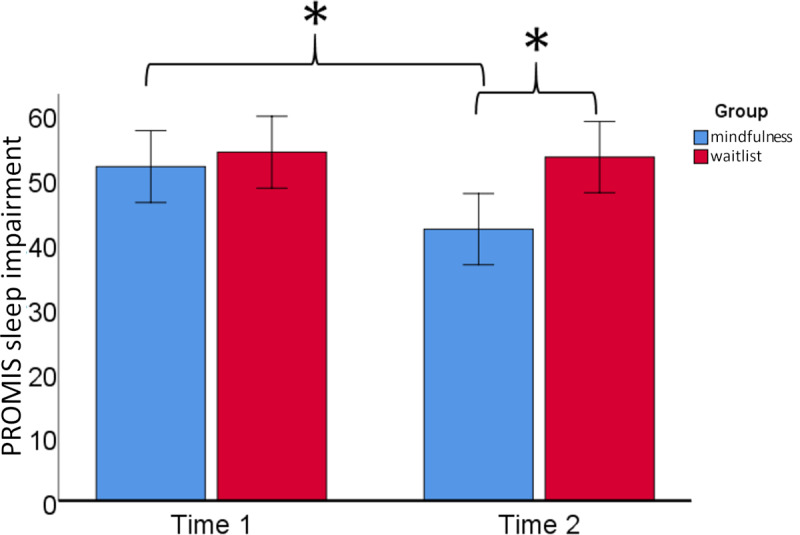
Results: PA students randomized to the mindfulness group reported improvements in sleep impairment compared with those randomized to the wait-list control group (ηp2=0.42; P=.01). Sleep impairment decreased significantly in the mindfulness group (19% reduction; P=.006) but not in the control group (1% reduction; P=.71). There were no other significant changes in mental health for those randomized to app-delivered mindfulness. Across all students, changes in sleep impairment were associated with increased resting-state functional connectivity between the medial prefrontal cortex (a component of the default mode network) and the superior temporal gyrus, as well as between areas important for working memory. Changes in connectivity predicted categorical conversion from impaired to nonimpaired sleep in the mindfulness group.
Conclusions: This pilot study is the first to examine app-based mindfulness for PA students' mental health and investigate the impact of mindfulness on PA students' brain function. These findings suggest that app-delivered mindfulness may be an effective tool to improve sleep dysfunction and that it may be an important part of the programming necessary to reduce the epidemic of suffering among health profession trainees.
Keywords: connectivity; fMRI; meditation; mindfulness; mobile phone; resting state.
©Jeremy L Smith, Jason W Allen, Carla I Haack, Kathryn L Wehrmeyer, Kayley G Alden, Maha B Lund, Jennifer S Mascaro. Originally published in JMIR Formative Research (https://formative.jmir.org), 19.10.2021.
Conflict of interest statement
Conflicts of Interest: None declared.
Figures
References
-
- Mata DA, Ramos MA, Bansal N, Khan R, Guille C, Di Angelantonio E, Sen S. Prevalence of depression and depressive symptoms among resident physicians: a systematic review and meta-analysis. JAMA. 2015 Dec 08;314(22):2373–83. doi: 10.1001/jama.2015.15845. http://europepmc.org/abstract/MED/26647259 2474424 - DOI - PMC - PubMed
-
- Rotenstein LS, Ramos MA, Torre M, Segal JB, Peluso MJ, Guille C, Sen S, Mata DA. Prevalence of depression, depressive symptoms, and suicidal ideation among medical students: a systematic review and meta-analysis. JAMA. 2016 Dec 06;316(21):2214–36. doi: 10.1001/jama.2016.17324. http://europepmc.org/abstract/MED/27923088 2589340 - DOI - PMC - PubMed
-
- Dyrbye LN, Shanafelt TD, Sinsky CA, Cipriano PF, Bhatt J, Ommaya A, West CP, Meyers D. Burnout among health care professionals: a call to explore and address this underrecognized threat to safe, high-quality care. National Academy of Medicine. 2017. [2021-09-10]. https://nam.edu/burnout-among-health-care-professionals-a-call-to-explor...
-
- Essary AC, Bernard KS, Coplan B, Dehn R, Forister JG, Smith NE, Valentin VL. Burnout and job and career satisfaction in the physician assistant profession: a review of the literature. National Academy of Medicine. 2018. [2021-09-10]. https://nam.edu/burnout-and-job-and-career-satisfaction-in-the-physician...
-
- Tetzlaff ED, Hylton HM, DeMora L, Ruth K, Wong Y. National study of burnout and career satisfaction among physician assistants in oncology: implications for team-based care. J Oncol Pract. 2018 Jan;14(1):e11–22. doi: 10.1200/JOP.2017.025544. http://europepmc.org/abstract/MED/29190209 - DOI - PMC - PubMed
LinkOut - more resources
Full Text Sources
