. 2021 Oct 19;11(1):20633.
doi: 10.1038/s41598-021-00076-1.

Biocompatible artificial synapses based on a zein active layer obtained from maize for neuromorphic computing

Affiliations

Biocompatible artificial synapses based on a zein active layer obtained from maize for neuromorphic computing

Youngjin Kim et al. Sci Rep. .

Abstract

Artificial synaptic devices based on natural organic materials are becoming the most desirable for extending their fields of applications to include wearable and implantable devices due to their biocompatibility, flexibility, lightweight, and scalability. Herein, we proposed a zein material, extracted from natural maize, as an active layer in an artificial synapse. The synaptic device exhibited notable digital-data storage and analog data processing capabilities. Remarkably, the zein-based synaptic device achieved recognition accuracy of up to 87% and exhibited clear digit-classification results on the learning and inference test. Moreover, the recognition accuracy of the zein-based artificial synapse was maintained within a difference of less than 2%, regardless of mechanically stressed conditions. We believe that this work will be an important asset toward the realization of wearable and implantable devices utilizing artificial synapses.


Conflict of interest statement

The authors declare no competing interests.

Figures
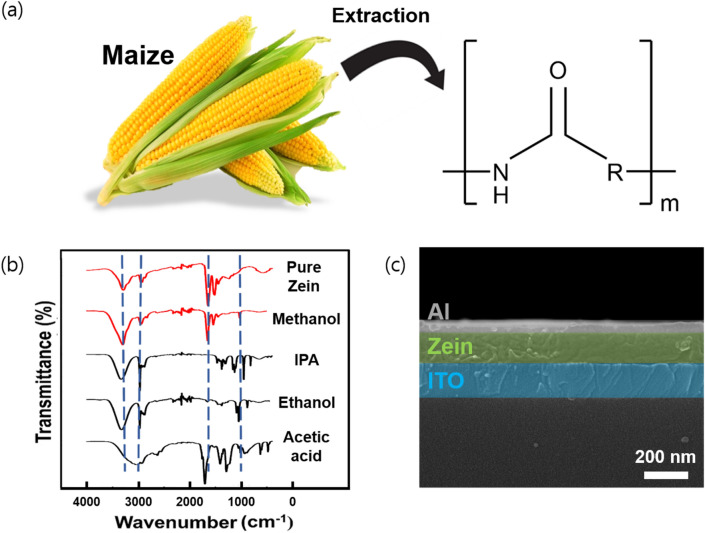
Figure 1
Figure 1
(a) Optical images of the maize and the zein powders, and chemical structure of zein. (b) FT-IR spectra for the pure zein and the zein films prepared using the indicated solvents. (c) Cross-sectional SEM image of the Al/zein/ITO structure.
Figure 2
Figure 2
Biocompatibility results for zein and anti-proliferative abilities of zein organics for normal (a) HS27 and (b) Detroit551 skin cells. Note that the CellTiter-Glo assay demonstrated up to a 100-μM concentration of zein after 72 h of cell growth. (c) The relative growth results for normal HS27 and Detroit551 skin cells in the DMSO solvent and in zein at a 100-μM concentration after 72 h.
Figure 3
Figure 3
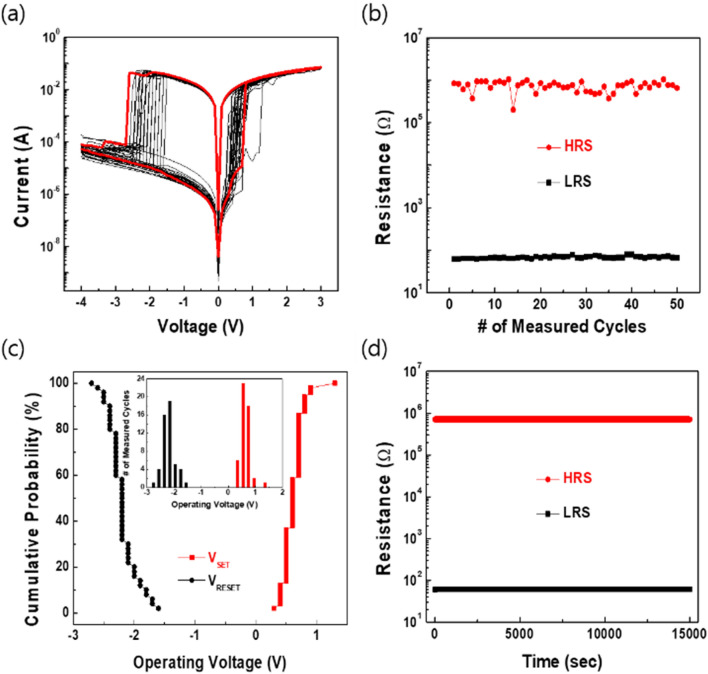
(a) Current–voltage curves on a semi-logarithmic scale for the Al/zein/ITO device for 50 cycles. The thick red line shows the result after the first sweep. (b) Endurance performance in the DC sweep mode for 50 cycles. (c) Cumulative probabilities for the SET and the RESET voltages in the DC sweep mode. (d) Retention test result over 104 s at 295 K.
Figure 4
Figure 4
(a) Electrode-area dependence of the zein-based device. (b) Variation in the resistance with temperature for the zein-based device. The inset shows the temperature coefficient of resistance in the LRS. (c) Double logarithmic plot in a positive sweep region from the high resistance state to the low resistance state. (d) Schematic illustration of the switching mechanism for the device with the Al/zein/ITO structure. When an external bias is applied to the device, pyrolysis in the zein active layer begins due to Joule heating. Consequently, a conductive carbon-rich filament is formed between the Al top electrode and the ITO bottom electrode. The carbon-rich filament can be ruptured by thermal driving due to an applied negative bias.
Figure 5
Figure 5
(a) Photographs of the zein-based device subjected to bending from the flat state. (b) Comparison of I–V curves under mechanical deformation from the flat state to 3.5 mm of bending radius and (c) bending cycles up to ~ 2000 cycles.
Figure 6
Figure 6
(a) Potentiation and depression characteristics for 10 cycles in the direct current sweep mode. (b) Average potentiation and depression results over 10 consecutive cycles. (c) Characteristics of the memory transition from STM to LTM caused by the programming pulses (N = 1, 5, 10, 15, and 20). (d) Schematic diagram of a single-layer network for the “0” pattern recognition process. The input pattern “0” (28 × 28), input neurons (28 × 28, gray), and output neurons (2 × 5, blue) are fully connected. (e) Recognition accuracy as a function of the number of epochs (learning phases). (f) Weight-mapping images at zero, the 1st, and the 30th training epoch.
Figure 7
Figure 7
(a) Potentiation and depression characteristics corresponding to consecutive pulse trainings against mechanical stress from a flat state to 3.5-mm bending state. (b) Comparison of the recognition accuracies under different mechanical stresses. (c)-(e) Classifications for the learning and the inference test in different bending states [(c) flat, (d) r = 5 mm, and (e) r = 3.5 mm]. Note that the classifications were visualized by using confusion matrices (10 × 10) between the target classes (input digit) and the output classes (learning phases).

References

    1. Yao P, Wu H, Gao B, Eryilmaz SB, Huang X, Zhang W, Zhang Q, Deng N, Shi L, Wong HSP, Qian H. Face classification using electronic synapses. Nat. Commun. 2017;8:1–8. doi: 10.1038/s41467-016-0009-6. - DOI - PMC - PubMed
    1. Hamid E, Michael M, Inna K, Arave G, Ali G, Bowman T, Suri VR, Tsou A, Scott WCRS. Big data, bigger dilemmas: A critical review. J. Am. Soc. Inf. Sci. Technol. 2015;66:1523–1545. doi: 10.1002/asi.23294. - DOI
    1. Ghoddusi H, Creamer GG, Rafizadeh N. Machine learning in energy economics and finance: A review. Energy Econ. 2019;81:709–727. doi: 10.1016/j.eneco.2019.05.006. - DOI
    1. Torrejon J, Riou M, Araujo FA, Tsunegi S, Khalsa G, Querlioz D, Bortolotti P, Cros V, Yakushiji K, Fukushima A, Kubota H, Yuasa S, Stiles MD, Grollier J. Neuromorphic computing with nanoscale spintronic oscillators. Nature. 2017;547:428–431. doi: 10.1038/nature23011. - DOI - PMC - PubMed
    1. Van DBY, Melianas A, Keene ST, Malliaras G, Salleo A. Organic electronics for neuromorphic computing. Nat. Electron. 2018;1:386–397. doi: 10.1038/s41928-018-0103-3. - DOI

Publication types