. 2021 Dec;99(12):1171-1175.
doi: 10.1002/cyto.a.24509. Epub 2021 Oct 19.

OMIP-079: Cell cycle of CD4+ and CD8+ naïve/memory T cell subsets, and of Treg cells from mouse spleen

Affiliations

OMIP-079: Cell cycle of CD4+ and CD8+ naïve/memory T cell subsets, and of Treg cells from mouse spleen

Ambra Natalini et al. Cytometry A. 2021 Dec.

Abstract

A multicolor flow cytometry panel was designed and optimized to define the following nine mouse T cell subsets: Treg (CD3+ CD4+ CD8- FoxP3+ ), CD4+ T naïve (CD3+ CD4+ CD8- FoxP3- CD44int/low CD62L+ ), CD4+ T central memory (CD3+ CD4+ CD8- FoxP3- CD44high CD62L+ ), CD4+ T effector memory (CD3+ CD4+ CD8- FoxP3- CD44high CD62L- ), CD4+ T EMRA (CD3+ CD4+ CD8- FoxP3- CD44int/low CD62L- ), CD8+ T naïve (CD3+ CD8+ CD4- CD44int/low CD62L+ ), CD8+ T central memory (CD3+ CD8+ CD4- CD44high CD62L+ ), CD8+ T effector memory (CD3+ CD8+ CD4- CD44high CD62L- ), and CD8+ T EMRA (CD3+ CD8+ CD4- CD44int/low CD62L- ). In each T cell subset, a dual staining for Ki-67 expression and DNA content was employed to distinguish the following cell cycle phases: G0 (Ki67- , with 2n DNA), G1 (Ki67+ , with 2n DNA), and S-G2 /M (Ki67+ , with 2n < DNA ≤ 4n). This panel was established for the analysis of mouse (C57BL/6J) spleen.

Keywords: DNA content; Ki-67; cell cycle; flow cytometry; mouse T cells; spleen.


Conflict of interest statement

A.C.H. is a board member and equity holder in ImmunoQure, AG., and Gamma Delta Therapeutics, and is an equity holder in Adaptate Biotherapeutics.

Figures
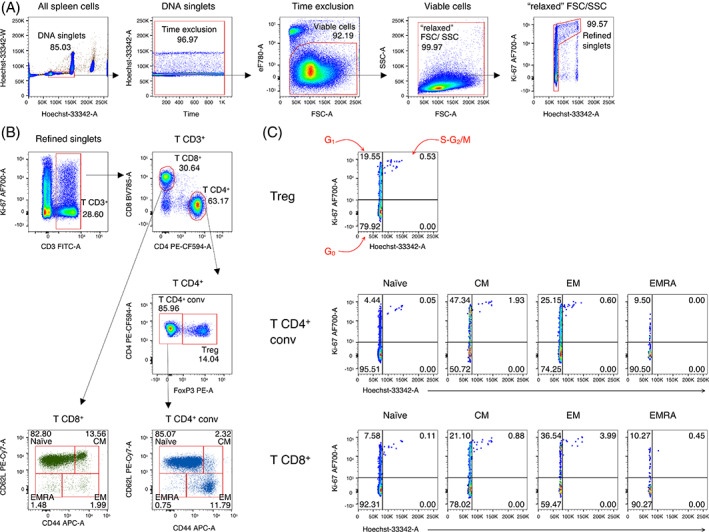
FIGURE 1
FIGURE 1
Cell cycle analysis of mouse T cell subsets. Example of analysis of spleen cells from a 3‐months old C57BL/6J mouse, using manual gating strategy. (A) Refined gating of viable single cells from the spleen in five steps: (1) DNA singlets. Single cells having 2n ≤ DNA content ≤4n were selected on the Hoechst‐33342 area (A) versus (vs) Hoechst‐33342 width (W) plot; (2) time exclusion. Stable acquisition over time (seconds) was monitored on the time vs Hoechst‐33342‐A plot and any events collected in case of pressure fluctuations were excluded; (3) viable cells. Live cells were selected using FSC‐A vs eFluor 780 (eF780) viability dye; (4) FSC/SSC “relaxed” gate. A “relaxed” gate was used on the FSC‐A vs SSC‐A plot, to include highly activated and cycling lymphocytes [19]; (5) refined singlets. A few remaining doublets composed by one cell sitting on top of another (so called “shadow” doublets) were excluded as Ki‐67int/ events having >2n DNA content [20]. This gating strategy was used as a base for the subsequent gates. (B) CD3+ T cells were gated on CD3‐A vs Ki‐67‐A plot, then CD4+ and CD8+ T cells on CD4‐A vs CD8‐A plot. CD4+ Treg cells were distinguished based on their FoxP3 expression from conventional FoxP3 CD4+ T cells. Subsequently, the following naïve/memory subsets of conventional CD4+ T cells were identified: CD44int/lowCD62L+ naïve, CD44highCD62L+ central memory (CM), CD44highCD62L effector memory (EM), and CD44int/lowCD62L EMRA. Similarly, naïve/memory subsets were identified among CD8+ T cells. (C) Cell cycle phases of Treg cells and of naïve/memory CD4+ and CD8+ T cell subsets were defined on Hoechst‐33342‐A vs Ki67‐A plot as follows: Cells in G0 were identified as DNA 2n/ Ki67 (bottom left quadrant); cells in G1 as DNA 2n/ Ki67+ (upper left quadrant); cells in S‐G2/M as DNA > 2n/ Ki67+ (top right quadrant) [Color figure can be viewed at wileyonlinelibrary.com]

References

    1. Farber DL, Netea MG, Radbruch A, Rajewsky K, Zinkernagel RM. Immunological memory: lessons from the past and a look to the future. Nat Rev Immunol. 2016;16:124–8. - PubMed
    1. Di Rosa F. Two niches in the bone marrow: a hypothesis on life‐long T cell memory. Trends Immunol. 2016;37:503–12. - PubMed
    1. Tough DF, Sprent J. Turnover of naive‐ and memory‐phenotype T cells. J Exp Med. 1994;179:1127–35. - PMC - PubMed
    1. Lahl K, Loddenkemper C, Drouin C, Freyer J, Arnason J, Eberl G, et al. Selective depletion of Foxp3+ regulatory T cells induces a scurfy‐like disease. J Exp Med. 2007;204:57–63. - PMC - PubMed
    1. Rubtsov YP, Niec RE, Josefowicz S, Li L, Darce J, Mathis D, et al. Stability of the regulatory T cell lineage in vivo. Science. 2010;329:1667–71. - PMC - PubMed

Publication types
