. 2021 Dec 6;14(23):5328-5335.
doi: 10.1002/cssc.202101238. Epub 2021 Oct 28.

Bifunctional Janus Silica Spheres for Pickering Interfacial Tandem Catalysis

Affiliations

Bifunctional Janus Silica Spheres for Pickering Interfacial Tandem Catalysis

Fuqiang Chang et al. ChemSusChem. .

Abstract

Nature provides much inspiration for the design of multistep conversion processes, with numerous reactions running simultaneously and without interference in cells, for example. A key challenge in mimicking nature's strategies is to compartmentalize incompatible reagents and catalysts, for example, for tandem catalysis. Here, we present a new strategy for antagonistic catalyst compartmentalization. The synthesis of bifunctional Janus catalyst particles carrying acid and base groups on the particle's opposite patches is reported as is their application as acid-base catalysts in oil/water emulsions. The synthesis strategy involved the use of monodisperse, hydrophobic and amine-functionalized silica particles (SiO2 -NH2 -OSi(CH3 )3 ) to prepare an oil-in-water Pickering emulsion (PE) with molten paraffin wax. After solidification, the exposed patch of the silica particles was selectively etched and refunctionalized with acid groups to yield acid-base Janus particles (Janus A-B). These materials were successfully applied in biphasic Pickering interfacial catalysis for the tandem dehydration-Knoevenagel condensation of fructose to 5-(hydroxymethyl)furfural-2-diethylmalonate (5-HMF-DEM) in a water/4-propylguaiacol PE. The results demonstrate the advantage of rapid extraction of 5-hydroxymethylfurfural (5-HMF), a prominent platform molecule prone to side product formation in acidic media. A simple strategy to tune the acid/base balance using PE with both Janus A-B and monofunctional SiO2 -NH2 -OSi(CH3 )3 base catalysts proved effective for antagonistic tandem catalysis.

Keywords: Janus spheres; acid-base catalysts; biomass; emulsions; heterogeneous catalysis.


Conflict of interest statement

The authors declare no conflict of interest.

Figures

Scheme 1
Scheme 1
Schematic representation of the use of bifunctional Janus A–B spheres for tandem PE catalysis. Left: Janus A–B particlesget pinned at the oil/water interface, spatially localizing the two catalyst functionalities in the polar (acid) and nonpolar (base) phases. Right: The dehydration‐Knoevenagel condensation reaction of fructose. Blue: water droplet; yellow: continuous organic phase.
Scheme 2
Scheme 2
a) Schematic representation of the synthesis of the monofunctional base‐loaded and, hydrophobic particles synthesized from Stöber silica (SiO2). APS=(3‐aminopropyl)triethoxysilane; HMDS=hexamethyldisilazane. b) Schematic representation of the synthesis of acid‐base functionalized Janus particles using the solidified wax procedure. HF=hydrofluoric acid; CSPTMS=2‐(4‐chlorosulfonylphenyl)ethyltrimethoxysilane.
Figure 1
Figure 1
a, b) TEM images of SiO2 particles synthesized via the Stöber method, (a; scale bar=1 μm) and partially etched SiO2−NH2−OSi(CH3)3 particles (b; scale bar=500 nm). Zoom shows the etched area of the particles; the black circle corresponds to the original diameter of the particle; the red circle highlights the diameter of the etched part of the particle. c) Schematic representation of etching procedure of SiO2−NH2−OSi(CH3)3 by solidified wax method. d, e) TEM images of hydrophobic aminated silica spheres homogeneously covered with Ag nanoparticles (d) and amphiphilic Janus silica spheres with only the amine‐grafted patches labeled with Ag nanoparticles (e).
Figure 2
Figure 2
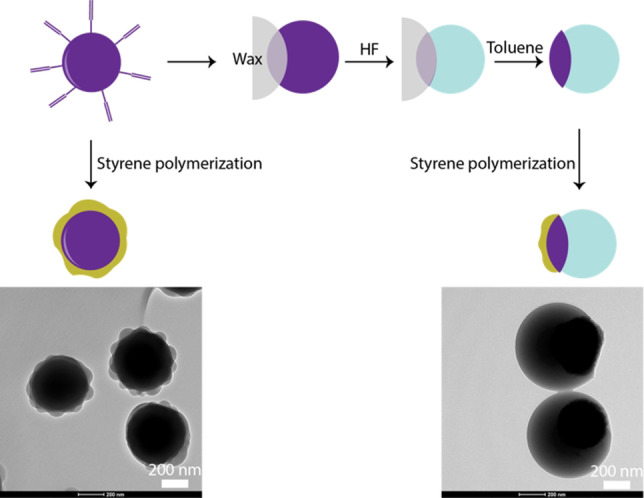
Schematic representation of styrene polymerization on vinyl‐terminated SiO2 particles on homogeneous functionalized particles (left) and etched Janus particles (right) with corresponding TEM images after polymerization.
Figure 3
Figure 3
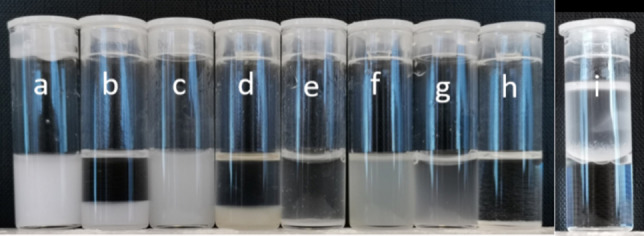
Unmodified SiO2 in water (a) and toluene (b); SiO2−NH2 in water (c) and toluene (d); SiO2−NH2−OSi(CH3)3 in water (e) and toluene (f); Janus A–B in water (g) and toluene (h). Amphiphilic Janus A–B particles quickly adsorbed at the water/toluene interface (i).
Figure 4
Figure 4
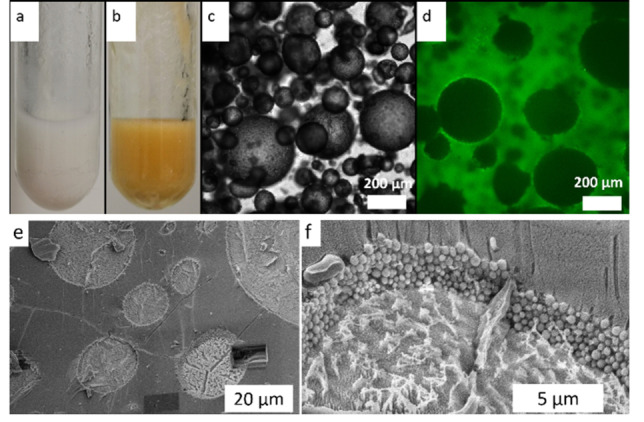
a, b) Physical appearance of the water/PG PE stabilized with 3.5 wt.% Janus A–B immediately after preparation (a) and after 24 h tandem catalysis (b). c) Optical microscopy image of the PE. d) Confocal fluorescence microscopy (CFM) image of the PE with the oil phase stained with Nile red. Scale bars of panels c and d=200 μm. e, f) Low‐ and high‐magnification cryo‐SEM image of water/PG PE stabilized with Janus A–B.
Figure 5
Figure 5
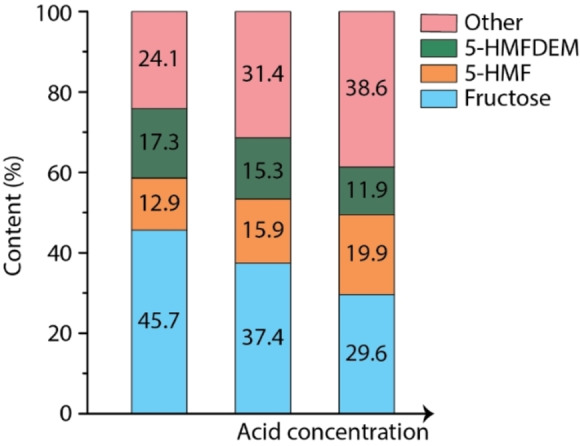
Product distribution of the fructose dehydration‐Knoevenagel condensation tandem reaction in PEs stabilized with acid‐base Janus particles with increasing acid concentration. Reaction conditions: 2 mL PG, 3.5 wt.% particles, 2 mL H2O (30 % NaCl), 0.5 mmol fructose, 1.25 mmol diethylmalonate 100 °C; left and middle: 24 h, right: 7 h.
Figure 6
Figure 6
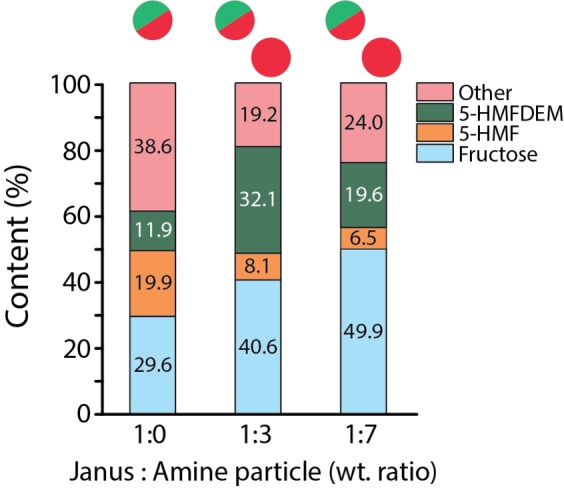
Product distribution of the fructose dehydration‐Knoevenagel condensation tandem reaction in PEs stabilized with Janus A–B and SiO2−NH2−OSi(CH3)3 (red circle). Reaction conditions: 2 mL PG, 3.5 wt.% particles, 2 mL H2O (30 % NaCl), 0.5 mmol fructose, 1.25 mmol diethylmalonate, 100 °C; left: 7 h, middle and right 24 h.

References

    1. Wasilke J.-C., Obrey S. J., Baker R. T., Bazan G. C., Chem. Rev. 2005, 105, 1001–1020. - PubMed
    1. Lohr T. L., Marks T. J., Nat. Chem. 2015, 7, 477–482. - PubMed
    1. Luo W., Cao W., Bruijnincx P. C. A., Lin L., Wang A., Zhang T., Green Chem. 2019, 21, 3744–3768.
    1. Luo S., Zeng Z., Zeng G., Liu Z., Xiao R., Chen M., Tang L., Tang W., Lai C., Cheng M., Shao B., Liang Q., Wang H., Jiang D., ACS Appl. Mater. Interfaces 2019, 11, 32579–32598. - PubMed
    1. Han C., Meng P., Waclawik E. R., Zhang C., Li X.-H., Yang H., Antonietti M., Xu J., Angew. Chem. Int. Ed. 2018, 57, 14857–14861; - PubMed
    2. Angew. Chem. 2018, 130, 15073–15077. - PubMed

LinkOut - more resources