. 2022 Jan 1;50(1):2-13.
doi: 10.1249/JES.0000000000000272.

Skeletal Muscle Nitrate as a Regulator of Systemic Nitric Oxide Homeostasis

Affiliations

Skeletal Muscle Nitrate as a Regulator of Systemic Nitric Oxide Homeostasis

Barbora Piknova et al. Exerc Sport Sci Rev. .

Abstract

Nonenzymatic nitric oxide (NO) generation via the reduction of nitrate and nitrite ions, along with remarkably high levels of nitrate ions in skeletal muscle, have been described recently. Skeletal muscle nitrate storage may be critical for maintenance of NO homeostasis in healthy aging, and nitrate supplementation may be useful for the treatment of specific pathophysiologies and for enhancing normal functions.


Figures

Figure 1
Figure 1
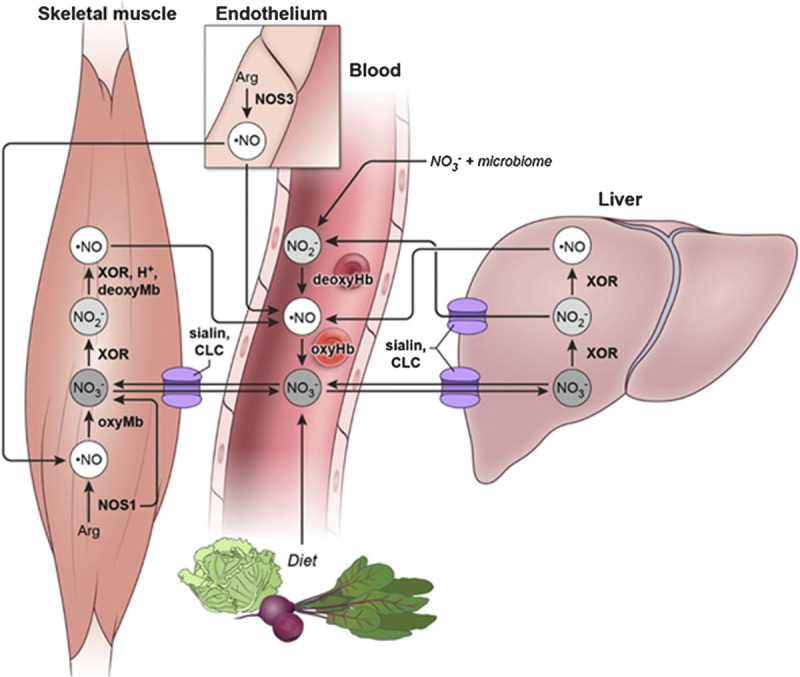
Schematic representation of steady-state spatial fluxes of nitrate, nitrite, and nitric oxide (NO) among different mammalian organs. Arrows represent fluxes between compartments, either via active transport of nitrate and nitrite (via sialin or CLC channel family) or via diffusion through the cell membrane (NO). For simplicity, we have included only skeletal muscle (because of its function as a nitrate reservoir and also an endogenous source of nitrate), the vascular bed, composed of endothelium (the direct source of NO via NOS3) and blood (with special emphasis on the red blood cell as a possible source of NO), and the liver (representative of organs, with the special function as a known nitrate reduction site). Nitrate also is absorbed into the bloodstream directly from the diet, and the oral microbiota is a source of nitrite via its important nitrate reductase activities.
Figure 2
Figure 2
Schematic flowchart of the nitrate-nitrite-nitric oxide (NO) interconversions in mammals. The nitrate reservoir is generated from dietary sources, oxidation of endogenous NO, and futile nitric oxide synthesis (NOS) cycle. The major part of nitrate circulating in blood is excreted by the kidneys, but a substantial part is taken up by saliva and reduced to nitrite by bacteria in the oral cavity. Most of the circulating nitrite is oxidized back into nitrate by oxy-heme proteins, mainly by oxyhemoglobin in blood or oxymyoglobin in muscle. Mammalian nitrate reductases (molybdenum cofactor proteins) also are able to reduce nitrate stored within cells into nitrite, which could be further reduced into NO by the same molybdenum proteins or FeII-deoxy-heme (five-coordinated FeII heme) proteins (deoxyhemoglobin, deoxymyoglobin, and cytochromes). NO also is synthetized from arginine by a family of NOS enzymes and either used in situ, exhaled via the lungs, or oxidized to nitrite by ceruloplasmin or oxygen (in bloodstream) or to nitrate by oxyFeII proteins (oxyhemoglobin in blood, oxymyoglobin in muscle). The concentration of nitrate in organ reservoirs is in the micromolar range (with the highest amounts found in some skeletal muscles); the concentration of the direct NO precursor, nitrite, is maintained in the nanomolar range; and NO is thought to occur in high femto- to low nanomolar concentrations necessary for its many physiological roles.
Figure 3
Figure 3
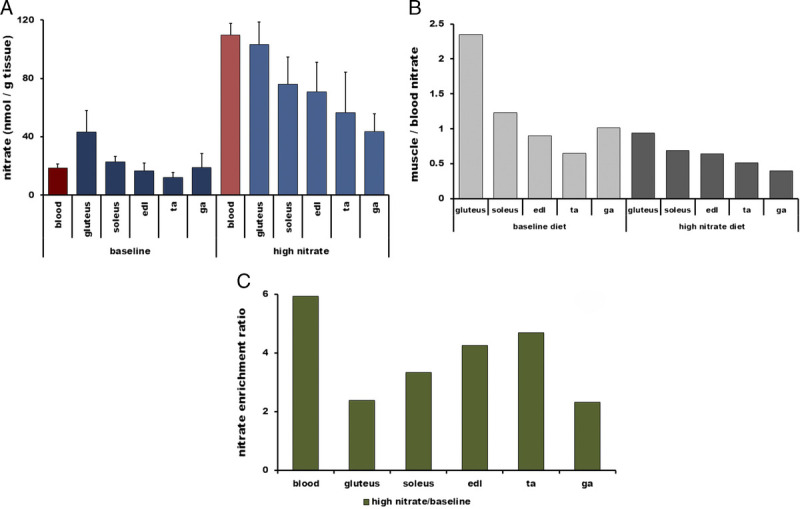
A. Nitrate concentrations in rat blood and five different muscles [gluteus, soleus, extensor digitorum longus (EDL), tibialis anterior (TA), and gastrocnemius] at baseline diet and 5 d after consuming a high-nitrate diet [water containing 1 g·L−1 nitrate salts (NaNO3)]. Bars in darker colors on the left (dark red and dark blue) are for baseline data, and those on the right in lighter color (light red and light blue) are for results from a high-nitrate diet. Based on data from (40). B. Ratios of muscle-to-blood nitrate for all five muscles before and after dietary intervention. Light gray bars on the left represent ratios at baseline diet, and dark gray bars on the right represent ratios at high nitrate diet. C. Nitrate enrichment in blood and organs caused by high-nitrate diet. Nitrate enrichment was calculated as the ratio of (nitrate concentration at high nitrate diet)/(nitrate concentration at baseline diet) for each muscle.
Figure 4
Figure 4
A. Partial pressure of oxygen (PO2) in air and organs, expressed in mm Hg, percentage of oxygen in air, and concentration of oxygen dissolved at the respective PO2. Values collated from Carreau et al. (72) and Hirai et al. (73). Notice that PO2 in all organs is significantly lower than in ambient air. B. Michaelis-Menten constants for O2 (KmO2) for neuronal nitric oxide synthesis (nNOS) in bovine brain and endothelial nitric oxide synthase (eNOS) in bovine arterial endothelial cells (BAEC) (red bars), and dissolved O2 concentrations in various organs (blue bars). KmO2 values for NOS are from Rengasamy and Johns (74), and organ O2 concentrations are from Carreau et al. (72) and Hirai et al. (73). The O2 concentration in organs significantly exceeds KmO2 for NOS1 and NOS3.

References

    1. Moncada S, Radomski MW, Palmer RM. Endothelium-derived relaxing factor. Identification as nitric oxide and role in the control of vascular tone and platelet function. Biochem. Pharmacol. 1988; 37(13):2495–501. - PubMed
    1. Wink DA Hines HB Cheng RY, et al. . Nitric oxide and redox mechanisms in the immune response. J. Leukoc. Biol. 2011; 89(6):873–91. - PMC - PubMed
    1. Lundberg JO, Weitzberg E, Gladwin MT. The nitrate-nitrite-nitric oxide pathway in physiology and therapeutics. Nat. Rev. Drug Discov. 2008; 7(2):156–67. - PubMed
    1. Doel JJ, Benjamin N, Hector MP, Rogers M, Allaker RP. Evaluation of bacterial nitrate reduction in the human oral cavity. Eur. J. Oral Sci. 2005; 113(1):14–9. - PubMed
    1. Jansson EA Huang L Malkey R, et al. . A mammalian functional nitrate reductase that regulates nitrite and nitric oxide homeostasis. Nat. Chem. Biol. 2008; 4(7):411–7. - PubMed

Publication types