


Causes and Consequences of Polycystic Ovary Syndrome: Insights From Mendelian Randomization
- PMID: 34669940
- PMCID: PMC8852214
- DOI: 10.1210/clinem/dgab757
Causes and Consequences of Polycystic Ovary Syndrome: Insights From Mendelian Randomization
Abstract
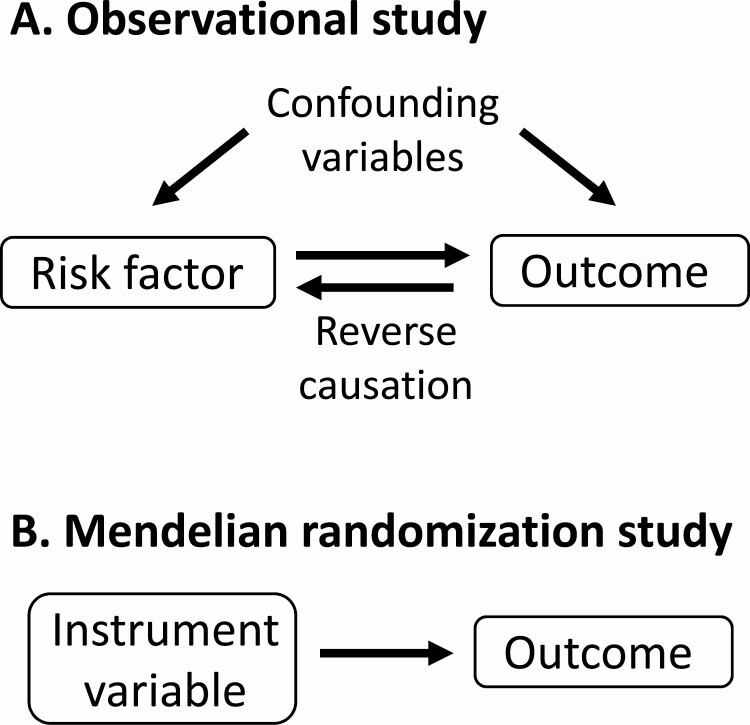
Context: Although polycystic ovary syndrome (PCOS) is the most common endocrinopathy affecting women of reproductive age, risk factors that may cause the syndrome are poorly understood. Based on epidemiologic studies, PCOS is thought to cause several adverse outcomes such as cardiovascular disease; however, the common presence of comorbidities such as obesity may be responsible for such associations, rather than PCOS in and of itself. To overcome the limitations of observational studies, investigators have employed Mendelian randomization (MR), which uses genetic variants to interrogate causality between exposures and outcomes.
Evidence acquisition: To clarify causes and consequences of PCOS, this review will describe MR studies involving PCOS, both as an exposure and as an outcome. The literature was searched using the terms "Mendelian randomization," "polycystic ovary syndrome," "polycystic ovarian syndrome," and "PCOS" (to May 2021).
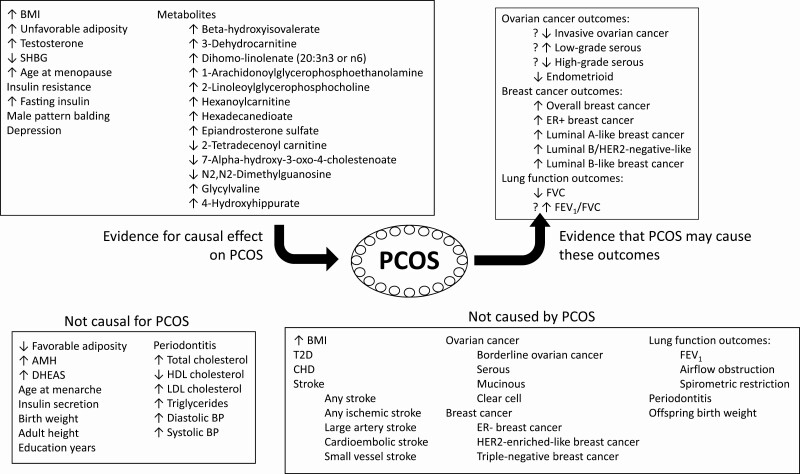
Evidence synthesis: MR studies have suggested that obesity, testosterone levels, fasting insulin, serum sex hormone-binding globulin concentrations, menopause timing, male-pattern balding, and depression may play a causal role in PCOS. In turn, PCOS may increase the risk of estrogen receptor-positive breast cancer, decrease the risk of endometrioid ovarian cancer, and have no direct causal effect on type 2 diabetes, coronary heart disease, or stroke.
Conclusions: The accumulation of genome-wide association studies in PCOS has enabled multiple MR analyses identifying factors that may cause PCOS or be caused by PCOS. This knowledge will be critical to future development of measures to prevent PCOS in girls at risk as well as prevent complications in those who have PCOS.
Keywords: Mendelian randomization; genome-wide association study; polycystic ovary syndrome.
© The Author(s) 2021. Published by Oxford University Press on behalf of the Endocrine Society. All rights reserved. For permissions, please e-mail: journals.permissions@oup.com.
Figures
Comment in
-
PCOS and Mendelian Randomization: Too Soon?J Clin Endocrinol Metab. 2022 Apr 19;107(5):e2195-e2196. doi: 10.1210/clinem/dgab827. J Clin Endocrinol Metab. 2022. PMID: 34788850 No abstract available.
References
-
- Goodarzi MO, Dumesic DA, Chazenbalk G, Azziz R. Polycystic ovary syndrome: etiology, pathogenesis and diagnosis. Nat Rev Endocrinol. 2011;7(4):219-231. - PubMed
-
- Frayling TM, Stoneman CE. Mendelian randomisation in type 2 diabetes and coronary artery disease. Curr Opin Genet Dev. 2018;50:111-120. - PubMed
-
- Linsel-Nitschke P, Götz A, Erdmann J, et al. ; Wellcome Trust Case Control Consortium (WTCCC); Cardiogenics Consortium. Lifelong reduction of LDL-cholesterol related to a common variant in the LDL-receptor gene decreases the risk of coronary artery disease-a Mendelian Randomisation study. PLoS One. 2008;3(8):e2986. - PMC - PubMed
-
- Landray MJ, Haynes R, Hopewell JC, et al. . Effects of extended-release niacin with laropiprant in high-risk patients. N Engl J Med. 2014;371(3):203-212. - PubMed
Publication types
MeSH terms
Grants and funding
LinkOut - more resources
Full Text Sources
Other Literature Sources
Medical
