


Estimating intervention effectiveness in trials of malaria interventions with contamination
- PMID: 34670558
- PMCID: PMC8527711
- DOI: 10.1186/s12936-021-03924-7
Estimating intervention effectiveness in trials of malaria interventions with contamination
Abstract
Background: In cluster randomized trials (CRTs) or stepped wedge cluster randomized trials (SWCRTs) of malaria interventions, mosquito movement leads to contamination between trial arms unless buffer zones separate the clusters. Contamination can be accounted for in the analysis, yielding an estimate of the contamination range, the distance over which contamination measurably biases the effectiveness.
Methods: A previously described analysis for CRTs is extended to SWCRTs and estimates of effectiveness are provided as a function of intervention coverage. The methods are applied to two SWCRTs of malaria interventions, the SolarMal trial on the impact of mass trapping of mosquitoes with odor-baited traps and the AvecNet trial on the effect of adding pyriproxyfen to long-lasting insecticidal nets.
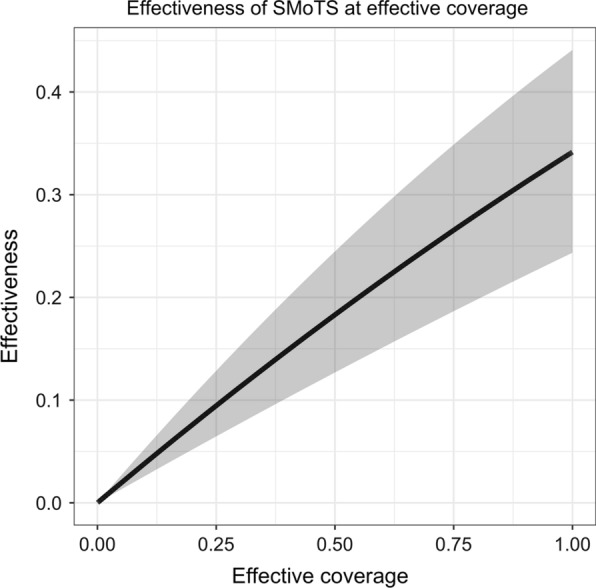
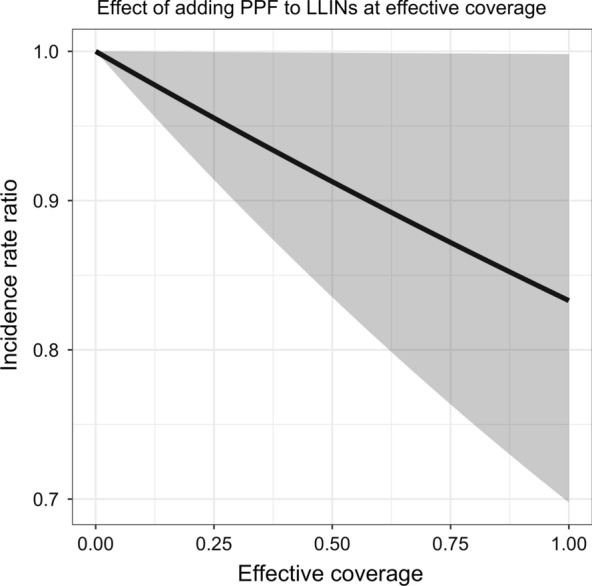
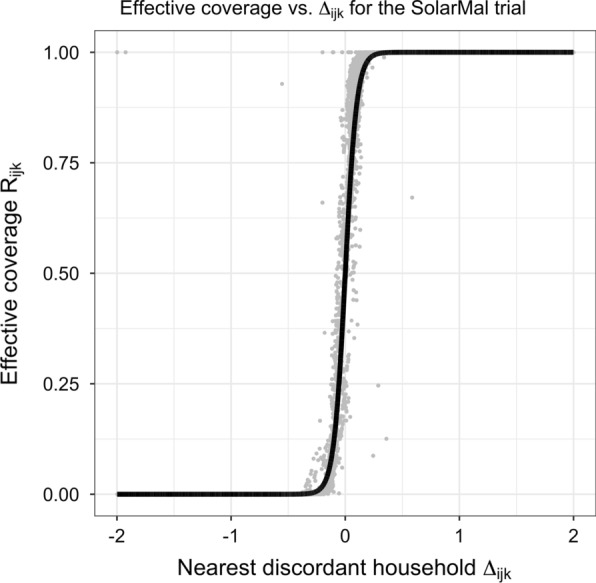
Results: For the SolarMal trial, the contamination range was estimated to be 146 m ([Formula: see text] credible interval [Formula: see text] km), together with a [Formula: see text] ([Formula: see text] credible interval [Formula: see text]) reduction of Plasmodium infection, compared to the [Formula: see text] reduction estimated without accounting for contamination. The estimated effectiveness had an approximately linear relationship with coverage. For the AvecNet trial, estimated contamination effects were minimal, with insufficient data from the cluster boundary regions to estimate the effectiveness as a function of coverage.
Conclusions: The contamination range in these trials of malaria interventions is much less than the distances Anopheles mosquitoes can fly. An appropriate analysis makes buffer zones unnecessary, enabling the design of more cost-efficient trials. Estimation of the contamination range requires information from the cluster boundary regions and trials should be designed to collect this.
Keywords: Contamination; Contamination range; Effective coverage; Malaria; Sigmoid random effects model; Stepped wedge cluster randomized trial.
© 2021. The Author(s).
Conflict of interest statement
The authors declare that they have no competing interests.
Figures
References
-
- Hayes R, Moulton L. Cluster randomised trials. Biostatistics series. Boca Raton: Chapman & Hall/CRC, Taylor & Francis Group; 2009.
-
- Protopopoff N, Wright A, West P, Tigererwa R, Mosha F, Kisinza W, et al. Combination of insecticide treated nets and indoor residual spraying in northern Tanzania provides additional reduction in vector population density and malaria transmission rates compared to insecticide treated nets alone: a randomised control trial. PLoS ONE. 2015;10:e0146629. doi: 10.1371/journal.pone.0142671. - DOI - PMC - PubMed
-
- Protopopoff N, Mosha J, Lukole E, Charlwood J, Wright A, Mwalimu C, et al. Effectiveness of a long-lasting piperonyl butoxide-treated insecticidal net and indoor residual spray interventions, separately and together, against malaria transmitted by pyrethroid-resistant mosquitoes: a cluster, randomised controlled, two-by-two factorial design trial. Lancet. 2018;391:1577–88. doi: 10.1016/S0140-6736(18)30427-6. - DOI - PMC - PubMed
MeSH terms
Substances
Grants and funding
LinkOut - more resources
Full Text Sources
Medical
