


Direct cardiovascular complications and indirect collateral damage during the COVID-19 pandemic : A review
- PMID: 34671829
- PMCID: PMC8527966
- DOI: 10.1007/s00508-021-01956-2
Direct cardiovascular complications and indirect collateral damage during the COVID-19 pandemic : A review
Abstract
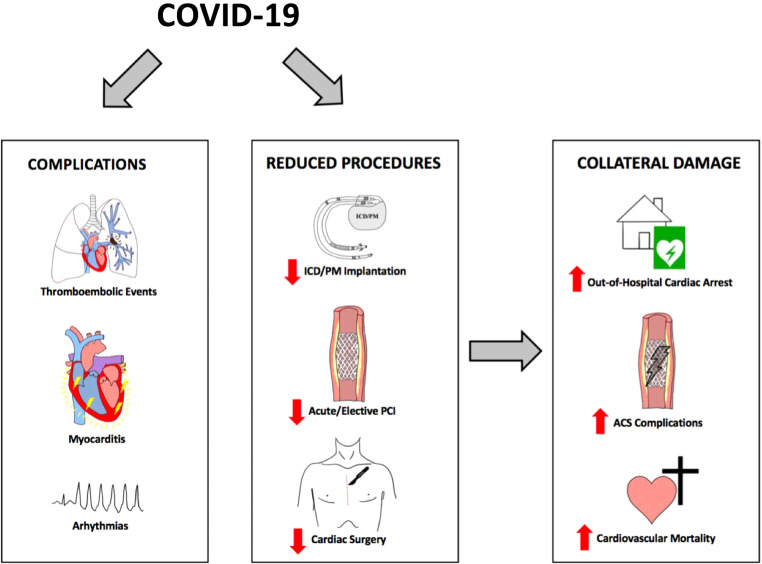
The coronavirus disease 2019 (COVID-19) pandemic, caused by the severe acute respiratory syndrome coronavirus 2 (SARS-CoV-2), puts a heavy strain on healthcare systems around the globe with high numbers of infected patients. Pre-existing cardiovascular disease is a major risk factor for a severe clinical course of COVID-19 and is associated with adverse outcome. COVID-19 may directly exacerbate underlying heart disease and is frequently aggravated by cardiovascular complications, including arterial and venous thromboembolic events, malignant arrhythmia and myocardial injury. In addition to these direct cardiac manifestations of COVID-19, patients with cardiovascular disease face further indirect consequences of the pandemic, as the respective resources in the healthcare systems need to be redirected to cope with the high numbers of infected patients. Consecutively, a substantial decrease in cardiac procedures was reported during the pandemic with lower numbers of coronary angiographies and device implantations worldwide. As a consequence an increased number of out-of-hospital cardiac arrests, late-comers with subacute myocardial infarction and of patients presenting in cardiogenic shock or preshock were observed. Maintenance of high-quality cardiac care by avoiding a reduction of cardiac services is of utmost importance, especially in times of a pandemic.
Keywords: Acute coronary syndrome; Arrhythmia; Interventional procedure; Myocarditis; Venous thromboembolism.
© 2021. Springer-Verlag GmbH Austria, part of Springer Nature.
Conflict of interest statement
A.L. Burger, C.C. Kaufmann, B. Jäger, E. Pogran, A. Ahmed, J. Wojta, S. Farhan and K. Huber declare that they have no competing interests.
Figures
References
-
- Johns Hopkins Coronavirus Resource Center. COVID-19 dashboard. 2021. https://coronavirus.jhu.edu/map.html. Accessed 1 Sept 2021.
-
- Klok FA, Kruip M, van der Meer NJM, Arbous MS, Gommers D, Kant KM, Kaptein FHJ, van Paassen J, Stals MAM, Huisman MV, Endeman H. Incidence of thrombotic complications in critically ill ICU patients with COVID-19. Thromb Res. 2020;191:145–147. doi: 10.1016/j.thromres.2020.04.013. - DOI - PMC - PubMed
Publication types
MeSH terms
LinkOut - more resources
Full Text Sources
Medical
Research Materials
Miscellaneous
