Review
. 2021 Dec;101(Pt A):108232.
doi: 10.1016/j.intimp.2021.108232. Epub 2021 Oct 16.

SARS-CoV-2: Current trends in emerging variants, pathogenesis, immune responses, potential therapeutic, and vaccine development strategies

Affiliations
Review

SARS-CoV-2: Current trends in emerging variants, pathogenesis, immune responses, potential therapeutic, and vaccine development strategies

Ali Salimi-Jeda et al. Int Immunopharmacol. 2021 Dec.

Abstract

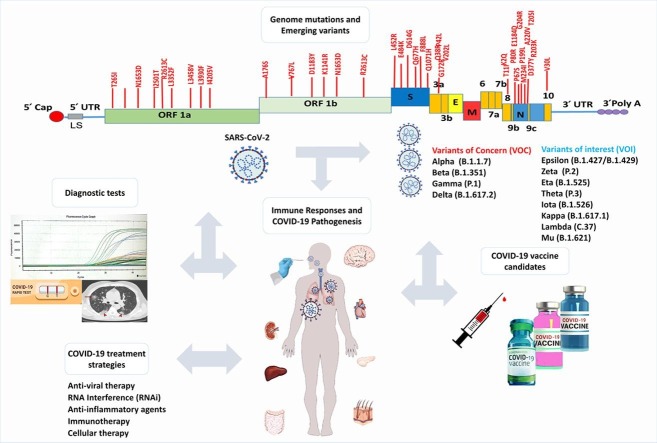
More than a year after the SARS-CoV-2 pandemic, the Coronavirus disease 19 (COVID-19) is still a major global challenge for scientists to understand the different dimensions of infection and find ways to prevent, treat, and develop a vaccine. On January 30, 2020, the world health organization (WHO) officially announced this new virus as an international health emergency. While many biological and mechanisms of pathogenicity of this virus are still unclear, it seems that cytokine storm resulting from an immune response against the virus is considered the main culprit of the severity of the disease. Despite many global efforts to control the SARS-CoV-2, several problems and challenges have been posed in controlling the COVID-19 infection. These problems include the various mutations, the emergence of variants with high transmissibility, the short period of immunity against the virus, the possibility of reinfection in people improved, lack of specific drugs, and problems in the development of highly sensitive and specific vaccines. In this review, we summarized the results of the current trend and the latest research studies on the characteristics of the structure and genome of the SARS-CoV- 2, new mutations and variants of SARS-CoV-2, pathogenicity, immune response, virus diagnostic tests, potential treatment, and vaccine candidate.

Keywords: COVID-19; Emerging Variants; Immune Responses; Pathogenesis; SARS-CoV-2; Therapy; Vaccine.


Conflict of interest statement

The authors declare that they have no known competing financial interests or personal relationships that could have appeared to influence the work reported in this paper.

Figures
None
Graphical abstract
Fig. 1
Fig. 1
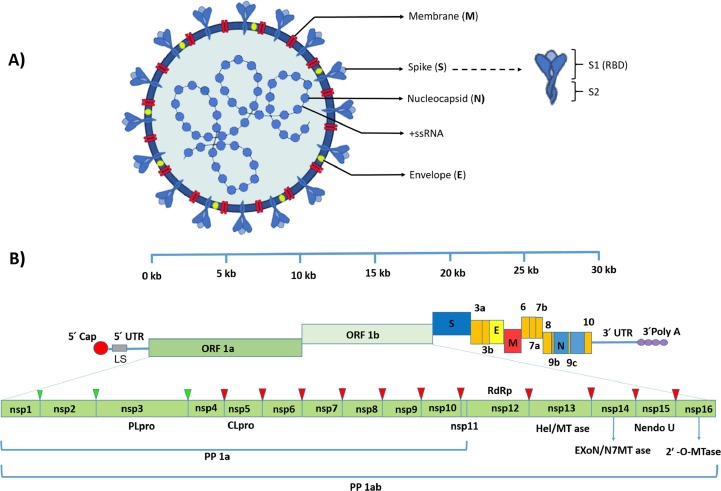
Schematic diagram of SARS-CoV-2 structure and genomic organization. A. SARS-CoV-2 virion structure consists of four structural proteins, including spike (S), envelope (E), membrane (M) in the envelope, and nucleocapsid (N) protein that encapsulates the virus positive-sense single-stranded RNA (+ssRNA) genome. Spike protein contains two subunits including S1 and S2, which act as a receptor-binding and cell fusion domain. B. The positive single-stranded mRNA from 5′ to 3′ contain 5′ cap, leader sequence (LS), 5′ UTR, ORF1a, ORF1b, Spike (S), ORF3a, ORF3b, Envelope (E), Membrane (M), ORF6, ORF7a, ORF7b, ORF8, Nucleocapsid (N), ORF9, ORF10, 3′ UTR and poly-A tail respectively. Two-thirds of the 5′ end of the genome, including ORF1a and ORF1b, encodes two large polyproteins comprising pp1a and pp1ab that are cleaved into 16 non-structural proteins at the nsp1 to nsp3 cleavage sites by papain-like cysteine protease (PLpro) and nsp4 to nsp16 cleavage sites by a 3C-like serine protease (3CLpro) (showed by the green and red triangles respectively). Nsp12 to nsp16 encodes the RNA-dependent RNA polymerase (RdRp), Helicase (Hel/MTase) and Exonuclease (ExonN), Endonuclease (Nendo U) and 2′ -O-RNA methyltransferase (2‘-O-MTase) respectively. The 3′ one-third end of the SARS-CoV-2 genome encodes the structural (S, E, M, and N) and accessory proteins. Accessory proteins sequences are displayed in orange color. (For interpretation of the references to color in this figure legend, the reader is referred to the web version of this article.)
Fig. 2
Fig. 2
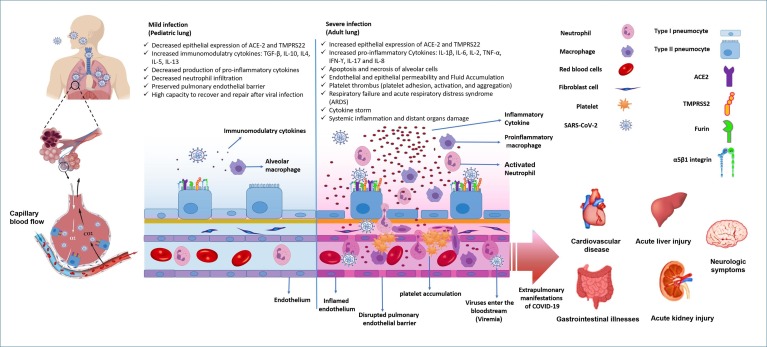
The Immunopathogenesis of SARS-CoV-2 (COVID-19) in pediatric and adults lung that causes mild or asymptotic infection in children, and severe lung injury and extracellular manifestation in adult and elderly patients. Due to having a low level of SARS-Cov-2 receptors, decreased proinflammatory cytokines in respiratory epithelial cells, increased level of type I interferons and strong innate immune response, children have shown a mild or asymptomatic COVID-19 infection. By comparison, adults due to increased level of SARS-Cov-2 receptors and proinflammatory cytokines in respiratory epithelial cells, following the damage to epithelial cells, fluid accumulation, respiratory failure, cytokine storm, viremia, and systemic infection experience severe respiratory infection and extra pulmonary manifestations.

References

    1. WHO, WHO Coronavirus (COVID-19) Dashboard, 2021. https://covid19.who.int/.
    1. Zhang L., Liu Y. Potential interventions for novel coronavirus in China: A systematic review. J. Med. Virol. 2020;92(5):479–490. - PMC - PubMed
    1. Brian D.A., Baric R.S. Coronavirus genome structure and replication. Curr. Top. Microbiol. Immunol. 2005;287:1–30. - PMC - PubMed
    1. Ou X., Liu Y., Lei X., Li P., Mi D., Ren L., Guo L., Guo R., Chen T., Hu J. Characterization of spike glycoprotein of SARS-CoV-2 on virus entry and its immune cross-reactivity with SARS-CoV. Nat. Commun. 2020;11(1):1–12. - PMC - PubMed
    1. Cucinotta D., Vanelli M. WHO declares COVID-19 a pandemic. Acta bio-medica: Atenei Parmensis. 2020;91(1):157–160. - PMC - PubMed

Substances

Supplementary concepts