Review
. 2021 Oct 4:12:735446.
doi: 10.3389/fphar.2021.735446. eCollection 2021.

A Review on Drug Delivery System for Tumor Therapy

Affiliations
Review

A Review on Drug Delivery System for Tumor Therapy

Guoxiang Liu et al. Front Pharmacol. .

Abstract

In recent years, with the development of nanomaterials, the research of drug delivery systems has become a new field of cancer therapy. Compared with conventional antitumor drugs, drug delivery systems such as drug nanoparticles (NPs) are expected to have more advantages in antineoplastic effects, including easy preparation, high efficiency, low toxicity, especially active tumor-targeting ability. Drug delivery systems are usually composed of delivery carriers, antitumor drugs, and even target molecules. At present, there are few comprehensive reports on a summary of drug delivery systems applied for tumor therapy. This review introduces the preparation, characteristics, and applications of several common delivery carriers and expounds the antitumor mechanism of different antitumor drugs in delivery carriers in detail which provides a more theoretical basis for clinical application of personalized cancer nanomedicine in the future.

Keywords: antitumor drug; delivery carriers; drug delivery system; targeting; tumor therapy.


Conflict of interest statement

The authors declare that the research was conducted in the absence of any commercial or financial relationships that could be construed as a potential conflict of interest.

Figures
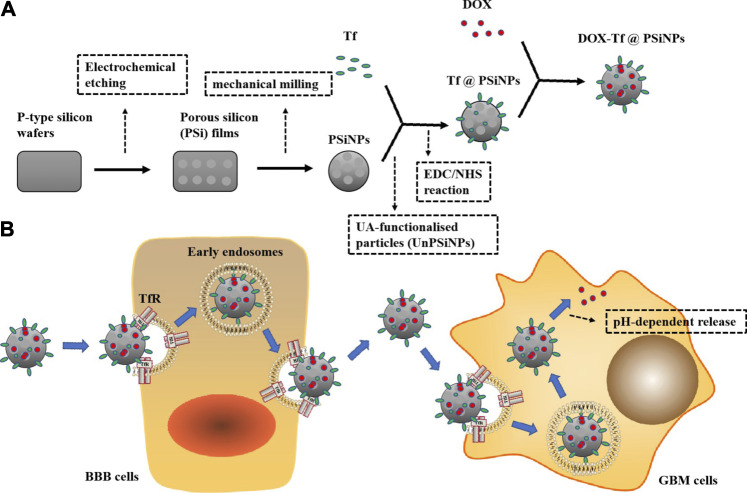
FIGURE 1
FIGURE 1
Construction, uptake, release, and efficacy of DOX-Tf@PSiNPs. (A) P-type silicon wafers are used to prepare porous silicon (PSi) films by electrochemical etching, and PSiNPs are formed by mechanical milling. UA-functionalized PSiNPs (UnPSiNPs) conjugate Tf through a two-step EDC/NHS reaction, and further loading DOX to form DOX-Tf@PSiNPs. (B) Nanoparticles can be combined with TfR through Tf to achieve targeting ability across the BBB into GBM cells, and release DOX in a pH-dependent way.
FIGURE 2
FIGURE 2
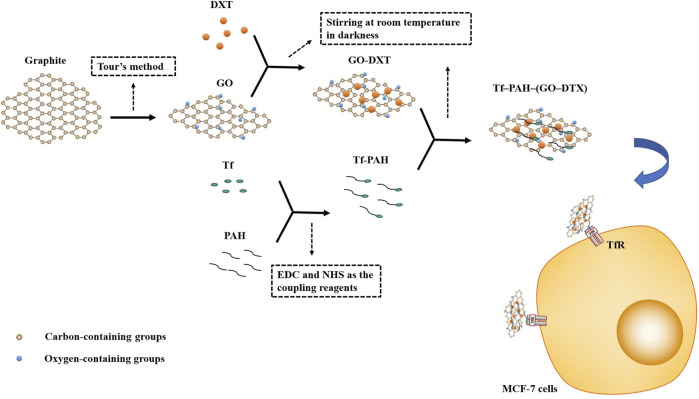
Preparation of targeted GO. GO is prepared from graphite through the tour method. The mixture of GO and DXT was stirred for 24 h at room temperature in darkness to prepare GO-DXT. Tf-PAH is synthesized through the formation of amide linkages between COOH groups of Tf and NH2 groups of PAH through EDC and NHS as the coupling reagents. Tf-PAH-(GO-DTX) is prepared by stirring the mixture of GO-DXT and Tf-PAH for 10 h at room temperature in darkness. Tf-PAH-(GO-DTX) could be taken up into MCF-7 cells by targeting TfR which would exert toxic effects.
FIGURE 3
FIGURE 3
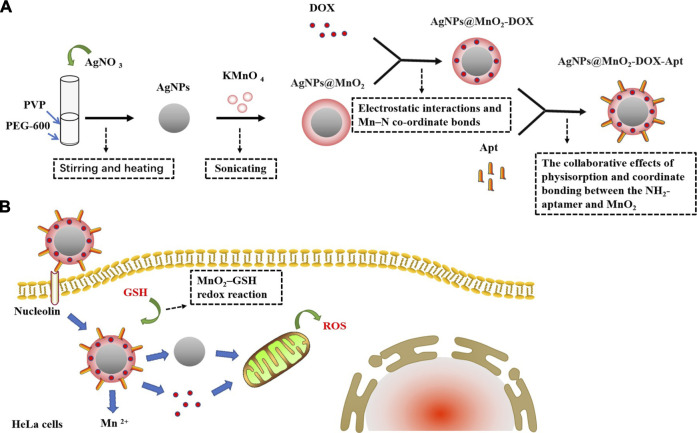
The synthesis of AgNPs@MnO2-DOX-Apt and pro-apoptotic mechanism. (A) AgNO3 aqueous solution is added into the mixed liquor of PEG-600 and PVP, and then AgNPs are synthesized under the conditions of stirring and heating. The AgNPs mixture added with KMnO4 is sonicated to synthesize AgNPs@MnO2 core–shell nanostructure for MnO2-modified AgNPs, and the MnO2 nanosheets can load DOX via electrostatic interactions and Mn–N co-ordinate bonds. Finally, AgNPs@MnO2-DOX-Apt is synthesized by functionalizing the Apt onto the MnO2 nanosheets via the collaborative effects of physisorption and coordinates bonding between the NH2-Apt and MnO2. (B) AgNPs@MnO2-DOX-Apt can enter HeLa cells through nucleolin receptor-mediated endocytosis, and release AgNPs and DOX under the response of MnO2–GSH redox reaction which could induce ROS-mediated apoptosis.
FIGURE 4
FIGURE 4
Synthesis of MET-H-AuNPs and targeted antitumor pathway. H-AuNPs are synthesized with the mixture of HAuCl4, HA, and eggplant extract irradiated under natural sunlight. After being modified by EDC/NHS reaction, H-AuNPs connect MET with the amide bond formed by stirring overnight between carboxyl groups of HA and amine group of MET to generate MET-H-AuNPs. MET-H-AuNPs are taken up into HepG2 cells through HA receptor–mediated endocytosis and release MET in a pH-dependent way which could induce cell cycle arrest significantly at the G2/M phase and apoptosis.
FIGURE 5
FIGURE 5
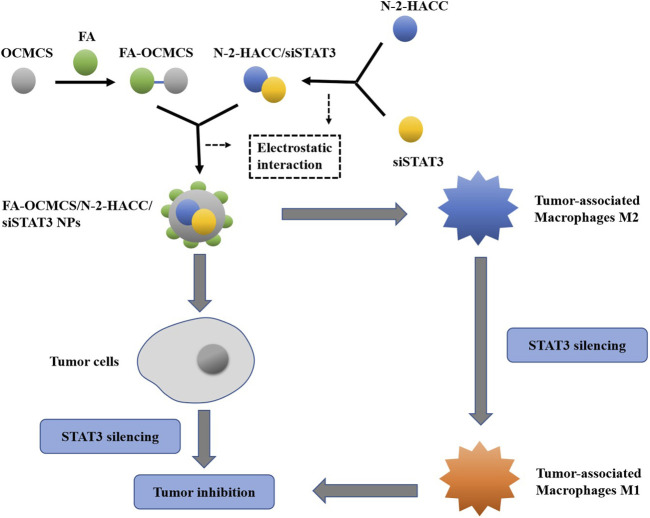
The construction of the NPs and dual-targeting pathways. With FA as the target ligand and OCMCS as the delivery carriers, NPs can be constructed by electrostatic interaction to achieve the targeted delivery of siSTAT3 to tumor-associated macrophages M2. By inhibiting the expression of STAT3, the NPs can transform M2 into M1 phenotype to inhibit tumor cells or directly deliver to tumor cells to induce apoptosis.
FIGURE 6
FIGURE 6
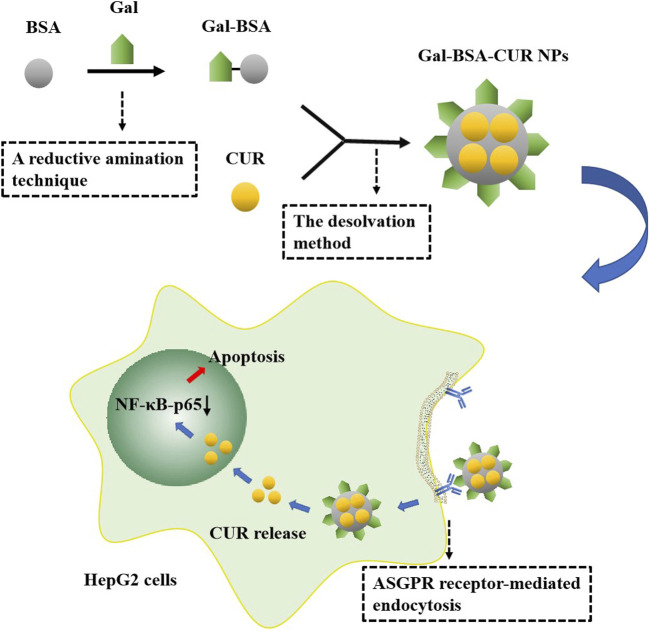
Synthesis of Gal-BSA-CUR NPs and antitumor effect. Gal-BSA was prepared by a reductive animation technique. Then, Gal-BSA-CUR NPs were synthesized by the desolvation method. The NPs taken up into cells through ASGPR receptor–mediated endocytosis releases CUR, which can inhibit the expression of NF-κB-p65 in the nucleus and induce cell apoptosis.
FIGURE 7
FIGURE 7
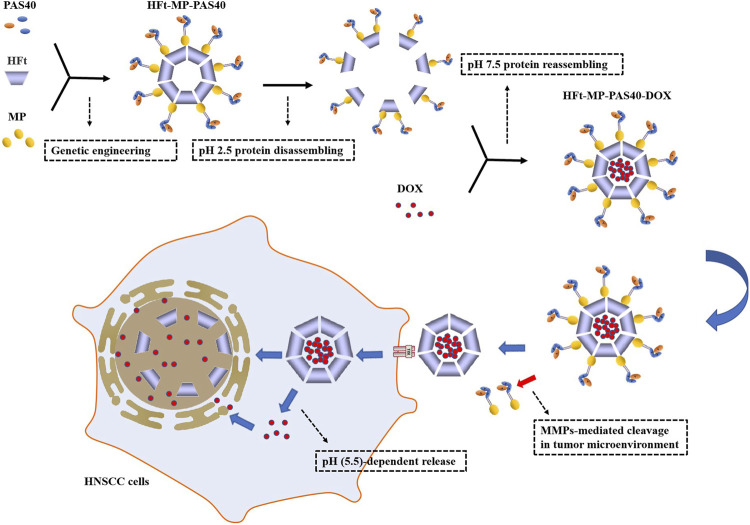
Assembly of HFt-based constructs, DOX encapsulation, and specific tumor suppression. PAS40: a polypeptide sequence of 40 residues rich in proline (P), alanine (A), and serine (S) residues; MP: a short motif sequence for responding to proteolytic cleavage by tumor matrix metalloproteases (MMPs). HFt-MP-PAS40 is assembled from PAS40, MP, and HFt through genetic engineering. The protein disassembling at pH 2.5 and then reassembling at pH 7.5 is to encapsulate DOX at the same time. PAS40 can hamper the interaction of DOX-loaded HFt with TfR1 on the surface of normal cells. MP between HFt subunit and the outer PAS polypeptide is processed by MMPs–mediated cleavage in the tumor microenvironment to remove PAS so that unmasked HFt can be specifically taken up by TfR1 overexpressed in tumor cells. In addition to a part of DOX that is pH (5.5)-dependent released/translocated in the cytoplasm and then diffuses to the nucleus, most of it is released by degradation of HFt in the nucleus, which ultimately leads to HNSCC damage.
FIGURE 8
FIGURE 8
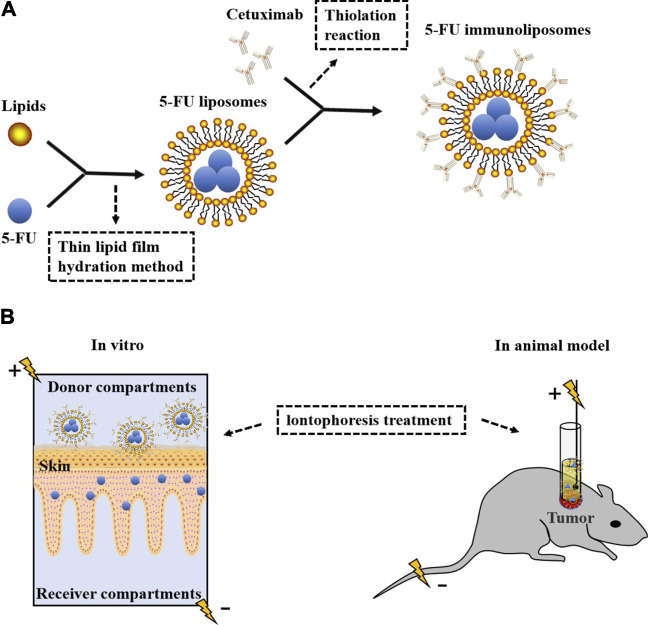
Preparation of ILs and iontophoresis treatment in vitro and in vivo. (A) 5-FU liposomes were prepared by coating 5-FU with lipids according to the drug-to-lipid ratio of 0.1 by the thin lipid film hydration method and then connected with thiolated cetuximab to form 5-FU ILs. (B) In vitro, iontophoresis with ILs increased the penetration rate of 5-FU into the skin and accumulated in the living epidermis but did not enter the receiver components. Immunoliposome ion delivery is more effective in treating tumors in animal models.
FIGURE 9
FIGURE 9
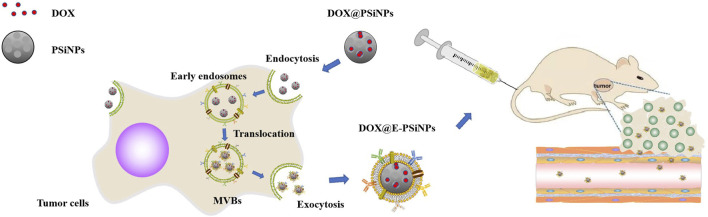
Preparation and efficacy of DOX@E-PSiNPs as tumor-targeted drugs. DOX@PSiNPs are taken up into tumor cells through endocytosis and localized in multivesicular bodies (MVBs) to prepare DOX@E-PSiNPs. With the fusion of MVBs and cell membrane, DOX@E-PSiNPs are released into the extracellular space through exocytosis. After intravenous injection, DOX@E-PSiNPs efficiently accumulate in tumor tissues and penetrate deeply into tumor parenchyma.
FIGURE 10
FIGURE 10
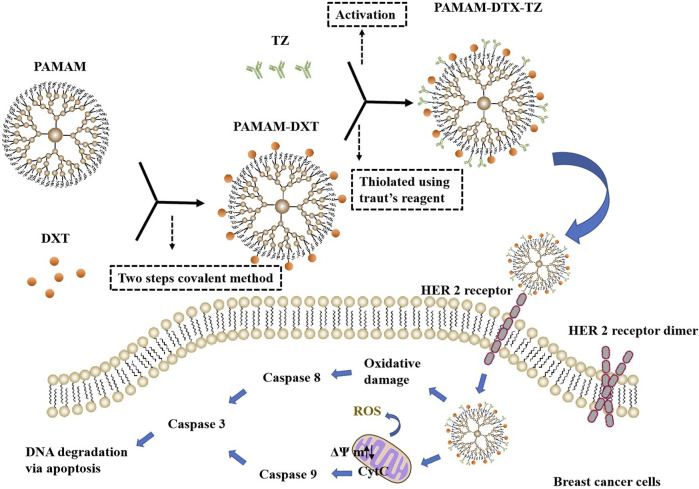
The synthesis of PAMAM-DTX-TZ and three main modes of action. The linking of DTX to PAMAM dendrimers was done using a two-steps covalent method. Then, PAMAM-DTX thiolated using Traut's reagent reacted with activated TZ to synthesize PAMAM-DTX-TZ. PAMAM-DTX-TZ showed the different potential mechanisms of cytotoxic action for breast cancer cells. The mechanism is not only associated with the blocking of the HER 2 receptor but also achieved through ROS generation (oxidative damage → caspases 8 → caspases 3 → DNA degradation via apoptosis) or changes in mitochondrial membrane potential (mitochondria damage → CytC → caspases 9 → caspases 3 → DNA degradation via apoptosis).
FIGURE 11
FIGURE 11
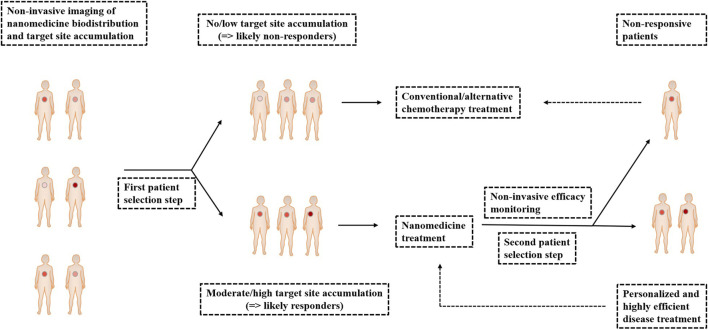
Personalized cancer nanomedicine. The nanomedicine biodistribution and target site accumulation of nanomedicine formulations labeled with contrast agents can preselect patients on the basis of noninvasive imaging (first patient selection step). And, then, the responders of moderate/high target site accumulation can either be assigned to nanomedicine treatment (second patient selection step). For the above two steps, the nonresponders of no/low target site accumulation and the nonresponsive patients of reasonable target site accumulation can be allocated to treatment with conventional/alternative chemotherapy to assure individualized and improved interventions: personalized and highly efficient disease treatment. Finally, nanomedicine treatment is repeatedly used for personalized and highly efficient disease treatment.

References

    1. Ahmad N., Sharma S., Alam M. K., Singh V. N., Shamsi S. F., Mehta B. R., et al. (2010). Rapid Synthesis of Silver Nanoparticles Using Dried Medicinal Plant of Basil. Colloids Surf. B. Biointerfaces 81, 81–86. 10.1016/j.colsurfb.2010.06.029 - DOI - PubMed
    1. Alomrani A., Badran M., Harisa G. I., ALshehry M., Alshamsan A., Alkholief M., et al. (2019). The Use of Chitosan-Coated Flexible Liposomes as a Remarkable Carrier to Enhance the Antitumor Efficacy of 5-fluorouracil against Colorectal Cancer. Saudi Pharm. J. 27, 603–611. 10.1016/j.jsps.2019.02.008 - DOI - PMC - PubMed
    1. Anitha A., Chennazhi K. P., Nair S. V., Jayakumar R. (2012a). 5-flourouracil Loaded N,O-carboxymethyl Chitosan Nanoparticles as an Anticancer Nanomedicine for Breast Cancer. J. Biomed. Nanotechnol 8, 29–42. 10.1166/jbn.2012.1365 - DOI - PubMed
    1. Anitha A., Maya S., Deepa N., Chennazhi K. P., Nair S. V., Jayakumar R. (2012b). Curcumin-loaded N,O-carboxymethyl Chitosan Nanoparticles for Cancer Drug Delivery. J. Biomater. Sci. Polym. Ed. 23, 1381–1400. 10.1163/092050611x581534 - DOI - PubMed
    1. Anitha A., Sreeranganathan M., Chennazhi K. P., Lakshmanan V. K., Jayakumar R. (2014). In Vitro combinatorial Anticancer Effects of 5-fluorouracil and Curcumin Loaded N,O-carboxymethyl Chitosan Nanoparticles toward colon Cancer and In Vivo Pharmacokinetic Studies. Eur. J. Pharm. Biopharm. 88, 238–251. 10.1016/j.ejpb.2014.04.017 - DOI - PubMed

LinkOut - more resources