


Rapid, dose-dependent and efficient inactivation of surface dried SARS-CoV-2 by 254 nm UV-C irradiation
- PMID: 34676820
- PMCID: PMC8532508
- DOI: 10.2807/1560-7917.ES.2021.26.42.2001718
Rapid, dose-dependent and efficient inactivation of surface dried SARS-CoV-2 by 254 nm UV-C irradiation
Erratum in
-
Erratum for Euro Surveill. 2021;26(42).Euro Surveill. 2021 Nov;26(47):211125e. doi: 10.2807/1560-7917.ES.2021.26.47.211125e. Euro Surveill. 2021. PMID: 34823638 Free PMC article. No abstract available.
Abstract
Background: The COVID-19 pandemic urges for cheap, reliable, and rapid technologies for disinfection and decontamination. One frequently proposed method is ultraviolet (UV)-C irradiation. UV-C doses necessary to achieve inactivation of high-titre SARS-CoV-2 are poorly defined.
Aim: We investigated whether short exposure of SARS-CoV-2 to UV-C irradiation sufficiently reduces viral infectivity and doses necessary to achieve an at least 6-log reduction in viral titres.
Methods: Using a box and two handheld systems designed to decontaminate objects and surfaces, we evaluated the efficacy of 254 nm UV-C treatment to inactivate surface dried high-titre SARS-CoV-2.
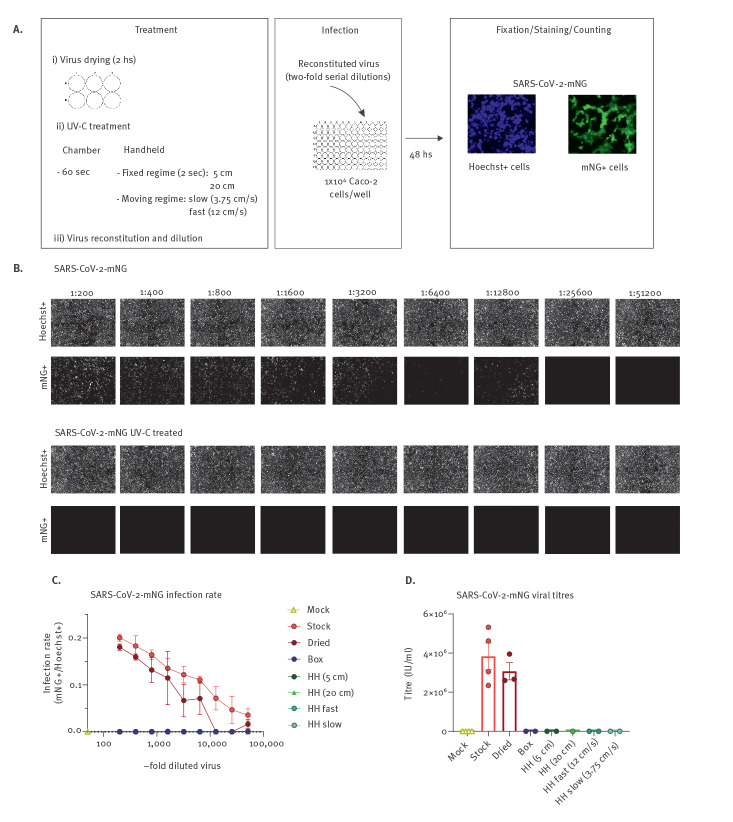
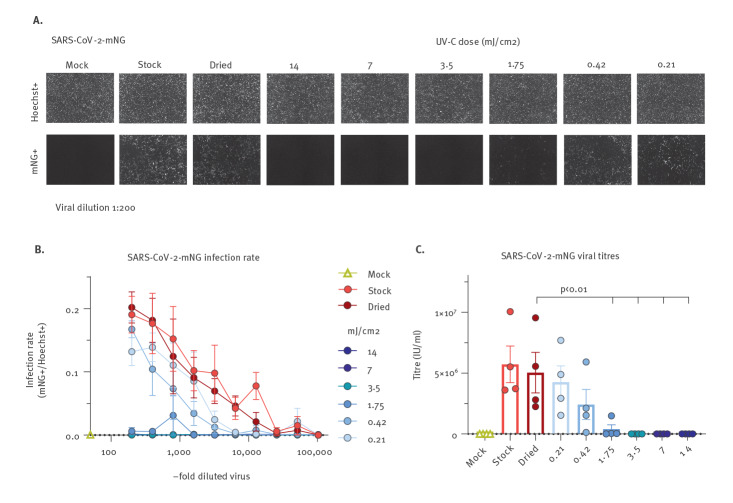
Results: Drying for 2 hours did not have a major impact on the infectivity of SARS-CoV-2, indicating that exhaled virus in droplets or aerosols stays infectious on surfaces for at least a certain amount of time. Short exposure of high titre surface dried virus (3-5*10^6 IU/ml) with UV-C light (16 mJ/cm2) resulted in a total inactivation of SARS-CoV-2. Dose-dependency experiments revealed that 3.5 mJ/cm2 were still effective to achieve a > 6-log reduction in viral titres, whereas 1.75 mJ/cm2 lowered infectivity only by one order of magnitude.
Conclusions: SARS-CoV-2 is rapidly inactivated by relatively low doses of UV-C irradiation and the relationship between UV-C dose and log-viral titre reduction of surface residing SARS-CoV-2 is nonlinear. Our findings emphasize that it is necessary to assure sufficient and complete exposure of all relevant areas by integrated UV-C doses of at least 3.5 mJ/cm2 at 254 nm. Altogether, UV-C treatment is an effective non-chemical option to decontaminate surfaces from high-titre infectious SARS-CoV-2.
Keywords: COVID-19; SARS-CoV-2; UV-C irradiation; decontamination; disinfection; infection control.
Conflict of interest statement
Figures
References
-
- Duan SM, Zhao XS, Wen RF, Huang JJ, Pi GH, Zhang SX, et al. Stability of SARS coronavirus in human specimens and environment and its sensitivity to heating and UV irradiation. Biomed Environ Sci. 2003;16(3):246-55. - PubMed
MeSH terms
LinkOut - more resources
Full Text Sources
Medical
Miscellaneous