


Lie to my face: An electromyography approach to the study of deceptive behavior
- PMID: 34677007
- PMCID: PMC8671780
- DOI: 10.1002/brb3.2386
Lie to my face: An electromyography approach to the study of deceptive behavior
Abstract
Background: Deception is present in all walks of life, from social interactions to matters of homeland security. Nevertheless, reliable indicators of deceptive behavior in real-life scenarios remain elusive.
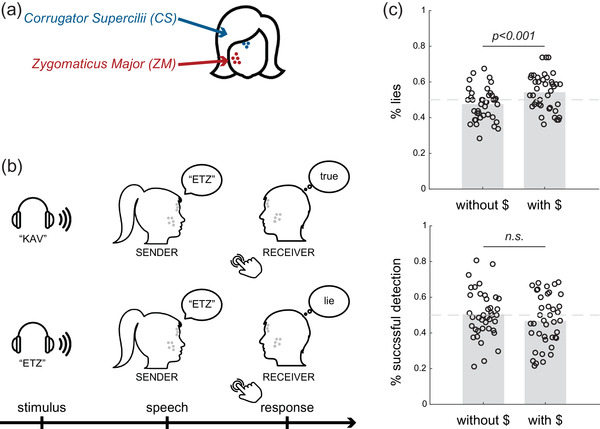
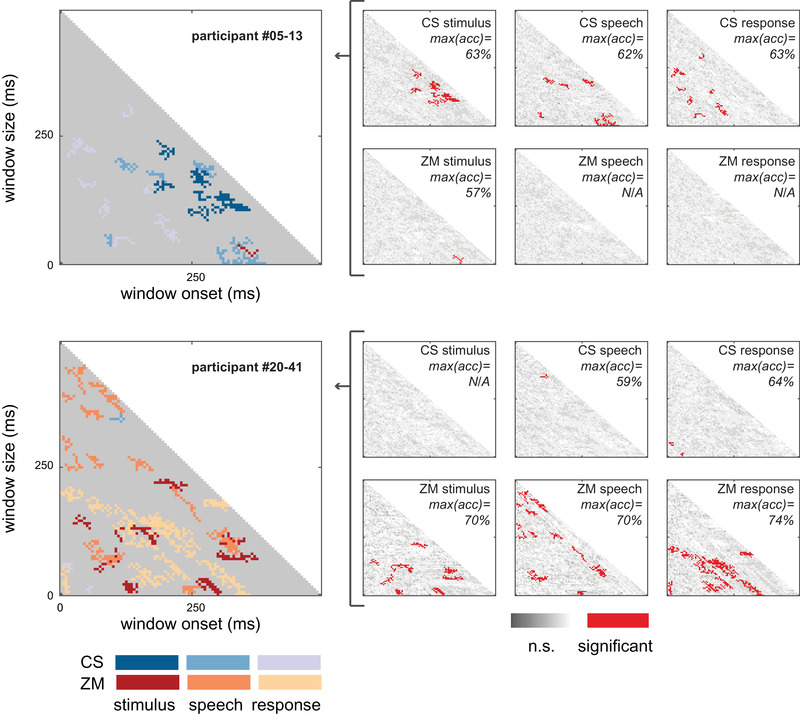
Methods: By integrating electrophysiological and communicative approaches, we demonstrate a new and objective detection approach to identify participant-specific indicators of deceptive behavior in an interactive scenario of a two-person deception task. We recorded participants' facial muscle activity using novel dry screen-printed electrode arrays and applied machine-learning algorithms to identify lies based on brief facial responses.
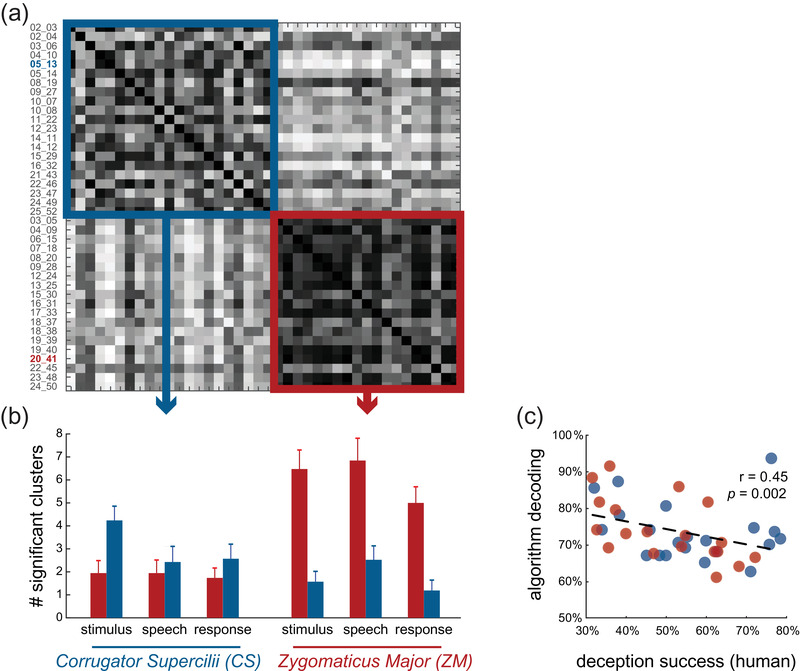
Results: With an average accuracy of 73%, we identified two groups of participants: Those who revealed their lies by activating their cheek muscles and those who activated their eyebrows. We found that the participants lied more often with time, with some switching their telltale muscle groups. Moreover, while the automated classifier, reported here, outperformed untrained human detectors, their performance was correlated, suggesting reliance on shared features.
Conclusions: Our findings demonstrate the feasibility of using wearable electrode arrays in detecting human lies in a social setting and set the stage for future research on individual differences in deception expression.
Keywords: cognition; electrophysiology; experimental psychology; psychology.
© 2021 The Authors. Brain and Behavior published by Wiley Periodicals LLC.
Conflict of interest statement
Lilah Inzelberg and Yael Hanein declare a financial interest in X‐trodes Ltd, which holds the licensing rights of the screen‐printed electrode technology cited in this paper. Both authors have no other relevant financial involvement with any organization or entity with a financial interest in or financial conflict with the subject matter or materials discussed in the manuscript apart from those disclosed. The other authors declare no conflict of interest.
Figures
References
-
- Aamodt, M. , & Custer, H. (2006). Who can best catch a liar? A meta‐analysis of individual differences in detecting deception. The Forensic Examiner, 15, 611.
-
- Abou Elassad, Z. E. , Mousannif, H. , Al Moatassime, H. , & Karkouch, A. (2020). The application of machine learning techniques for driving behavior analysis: A conceptual framework and a systematic literature review. Engineering Applications of Artificial Intelligence, 87, 103312. 10.1016/j.engappai.2019.103312 - DOI
Publication types
MeSH terms
LinkOut - more resources
Full Text Sources
