Review
. 2021 Oct 15;11(10):396.
doi: 10.3390/bios11100396.

Malignancies and Biosensors: A Focus on Oral Cancer Detection through Salivary Biomarkers

Affiliations
Review

Malignancies and Biosensors: A Focus on Oral Cancer Detection through Salivary Biomarkers

Riccardo Goldoni et al. Biosensors (Basel). .

Abstract

Oral cancer is among the deadliest types of malignancy due to the late stage at which it is usually diagnosed, leaving the patient with an average five-year survival rate of less than 50%. The booming field of biosensing and point of care diagnostics can, in this regard, play a major role in the early detection of oral cancer. Saliva is gaining interest as an alternative biofluid for non-invasive diagnostics, and many salivary biomarkers of oral cancer have been proposed. While these findings are promising for the application of salivaomics tools in routine practice, studies on larger cohorts are still needed for clinical validation. This review aims to summarize the most recent development in the field of biosensing related to the detection of salivary biomarkers commonly associated with oral cancer. An introduction to oral cancer diagnosis, prognosis and treatment is given to define the clinical problem clearly, then saliva as an alternative biofluid is presented, along with its advantages, disadvantages, and collection procedures. Finally, a brief paragraph on the most promising salivary biomarkers introduces the sensing technologies commonly exploited to detect oral cancer markers in saliva. Hence this review provides a comprehensive overview of both the clinical and technological advantages and challenges associated with oral cancer detection through salivary biomarkers.

Keywords: biomarkers; biosensors; oral cancer; point of care diagnostics; saliva; wearable devices.


Conflict of interest statement

The authors declare no conflict of interest.

Figures
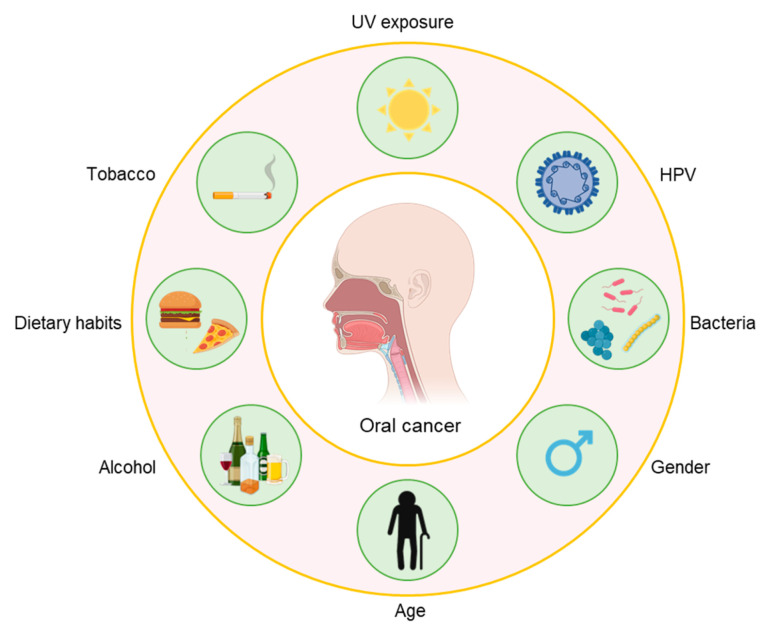
Figure 1
Figure 1
Oral cancer risk factors.
Figure 2
Figure 2
The most common sites of oral cancer.
Figure 3
Figure 3
The subfields of salivaomics.
Figure 4
Figure 4
Components of a biosensor and its working principle.
Figure 5
Figure 5
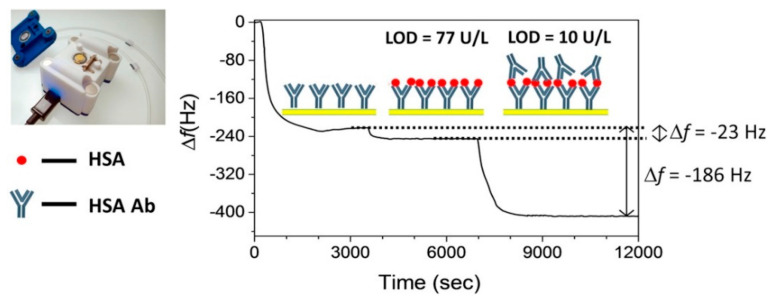
QCM-based biosensor for human salivary α-amylase determination. The immobilization of the various components and targets on the QCM surface is accompanied by characteristic shifts in frequency that are quantified by the readout system. Reprinted with permission from ref. [131]. Copyright 2017 Elsevier.
Figure 6
Figure 6
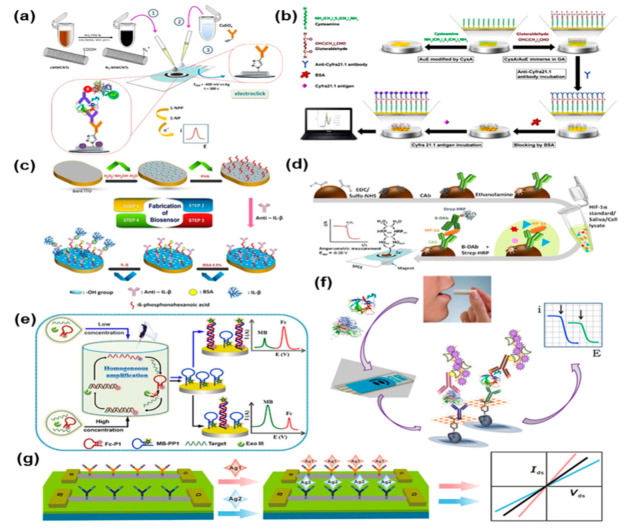
Summary of recently developed electrochemical biosensors for the detection of oral cancer biomarkers in saliva (a) Sandwich-type immunosensor for the detection of interleukin 1β (IL-1β) in saliva through DPV. Reprinted with permission from ref. [111]. Copyright 2020 Elsevier. (b) Immunosensor for Cyfra21.1 detection based on a cysteamine and glutaraldehyde modified gold electrode. Reprinted with permission from ref. [112]. Copyright 2020 Elsevier. (c) Label-free immunosensor based on a modified ITO electrode for EIS detection of oral cancer biomarker in both saliva and serum. Reprinted with permission from ref. [119]. Copyright 2018 Elsevier (d) Magnetic beads-based sandwich immunoassay for the ampero-metric detection of HIF-1α. Reprinted with permission from ref. [115]. Copyright 2020 Elsevier. (e) Ratio-metric electrochemical DNA biosensor for the detection of ORAOV1 in saliva. Reprinted with permission from ref. [102]. Copyright 2018 Elsevier. (f) Multiplexed immunosensor based on dual SPCEs for the simultaneous detection of IL-1β and TNF-α. Reprinted with permission from ref. [130]. Copyright 2017 Elsevier. (g) SiNW sensor array for the multiplexed detection of TNF-α and IL-8. Reprinted with permission from ref. [107]. Copyright 2015 The Japan Society for Analytical Chemistry.
Figure 7
Figure 7
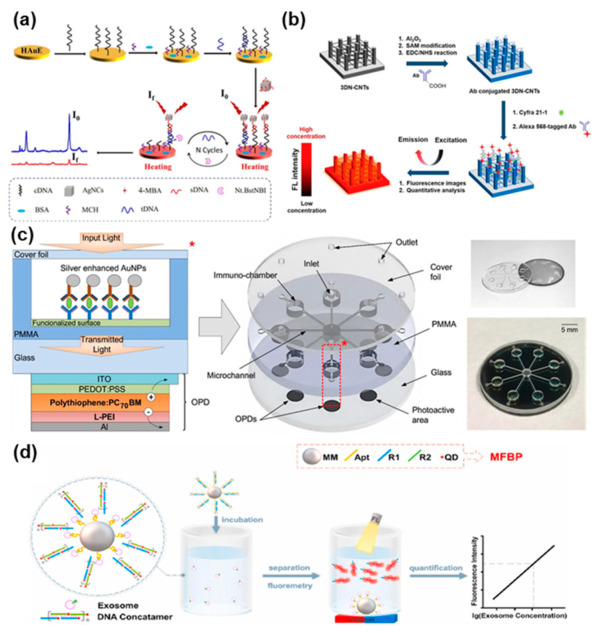
Summary of recently developed optical biosensors for the detection of oral cancer biomarkers in saliva (a) SERS-based optical DNA biosensor. Reprinted with permission from ref. [100]. Copyright 2021 Elsevier. (b) Fluorescence immunosensor based on 3DN-CNTs for the detection of Cyfra21.1. Reprinted with permission from ref. [124]. Copyright 2018 Elsevier. (c) Absorbance-based biosensor with integrated microfluidic channels and antibody-functionalized detection chambers. Reprinted with permission from ref. [127]. Copyright 2017 Elsevier. (d) Detection of salivary exosomes through magnetic and fluorescent bio-probes for the non-invasive diagnosis of oral cancer. Reprinted with permission from ref. [110]. Copyright 2021 Elsevier.
Figure 8
Figure 8
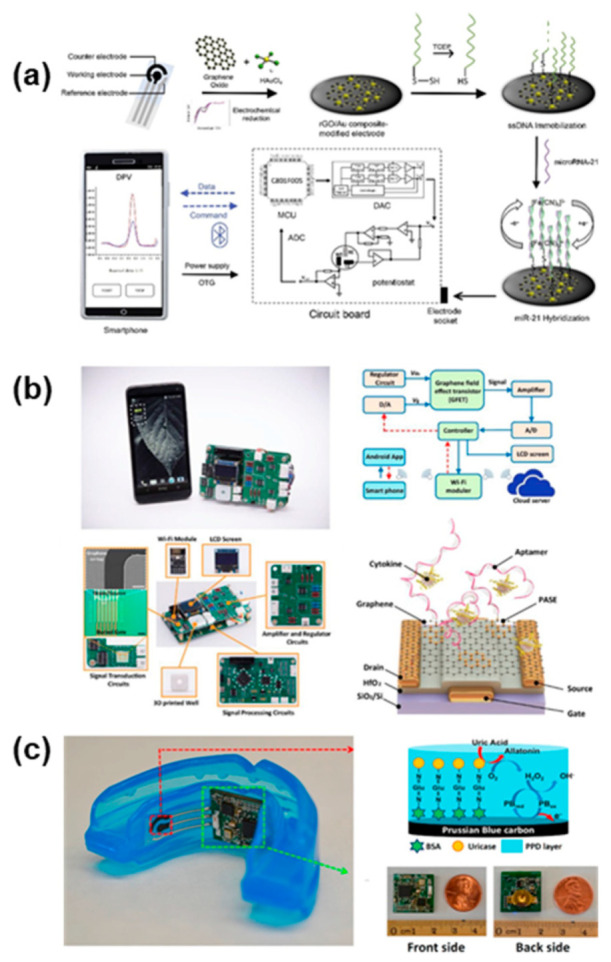
Integrated salivary biosensing systems as POC diagnostic tools for oral cancer biomarkers detection (a) Portable biosensing system for the rapid and accurate detection of miRNA in human saliva. Reprinted with permission from ref. [113]. Copyright 2020 Elsevier. (b) Handheld fully integrated nano biosensing device for ultrafast cytokine detection in human saliva samples. Reprinted with permission from ref. [101]. Copyright 2019 Elsevier. (c) Mouthguard-based biosensing systems with integrated electronics for selective intraoral detection of uric acid. Reprinted with permission from ref. [106]. Copyright 2015 Elsevier.
Figure 9
Figure 9
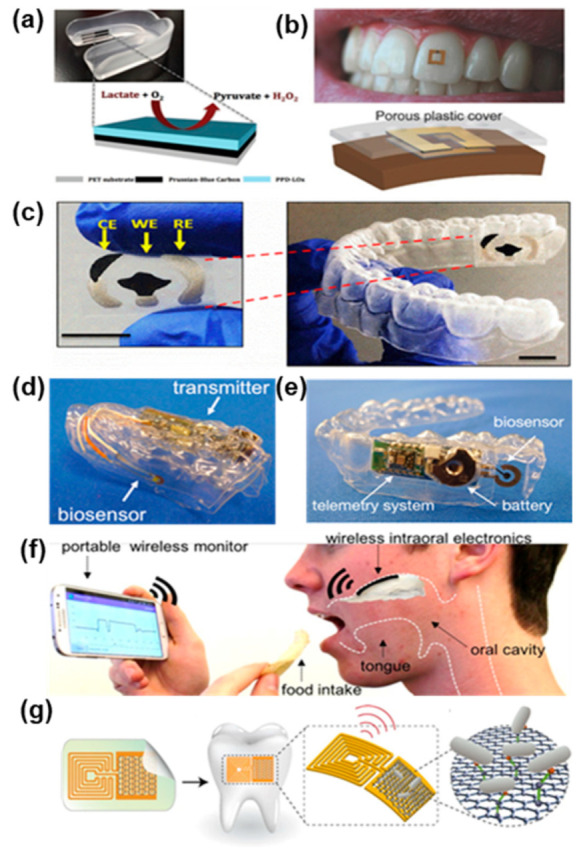
Wearable biosensing platforms for non-invasive salivary analysis (a) Lactate biosensor on a mouthguard. Reprinted with permission from ref. [153]. Copyright 2014 Elsevier. (b) Tooth mounted RF hydrogel biosensor. Reprinted with permission from ref. [154]. Copyright 2018 Wiley International Limited. (c) Mouthguard with screen printed electrodes for N-Carboxymethyl-lysine detection. Reprinted with permission from ref. [155]. Copyright 2019 Elsevier. (d,e) Glucose biosensing telemetry system. Reprinted with permission from ref. [156]. Copyright 2020 ACS. Reprinted with permission from ref. [157]. Copyright 2016 Elsevier. (f) Hybrid flexible bioelectronic platform for sodium monitoring. Reprinted with permission from ref. [160]. Copyright 2018 National Academy of Sciences. (g) Graphene-based biosensor for pathogen’s detection. Reprinted with permission from ref. [161]. Copyright 2012 Springer Nature Limited.

References

    1. World Health Organization Global Cancer Observatory. [(accessed on 14 June 2021)]. Available online: https://gco.iarc.fr/
    1. Seethala R.R. Update from the 4th edition of the World Health Organization classification of head and neck tumours: Preface. Head Neck Pathol. 2017;11:1–2. doi: 10.1007/s12105-017-0785-2. - DOI - PMC - PubMed
    1. Petti S., Masood M., Scully C. The magnitude of tobacco smoking-betel quid chewing-alcohol drinking interaction effect on oral cancer in South-East Asia. A meta-analysis of observational studies. PLoS ONE. 2013;8:e78999. doi: 10.1371/journal.pone.0078999. - DOI - PMC - PubMed
    1. Warnakulasuriya S. Global epidemiology of oral and oropharyngeal cancer. Oral Oncol. 2009;45:309–316. doi: 10.1016/j.oraloncology.2008.06.002. - DOI - PubMed
    1. Rivera C. Essentials of oral cancer. Int. J. Clin. Exp. Pathol. 2015;8:11884–11894. - PMC - PubMed

Substances