Review
. 2021 Oct 18;11(10):793.
doi: 10.3390/membranes11100793.

Recent Developments in Nanoporous Graphene Membranes for Organic Solvent Nanofiltration: A Short Review

Affiliations
Review

Recent Developments in Nanoporous Graphene Membranes for Organic Solvent Nanofiltration: A Short Review

Yoon-Tae Nam et al. Membranes (Basel). .

Abstract

Graphene-based membranes are promising candidates for efficient organic solvent nanofiltration (OSN) processes because of their unique structural characteristics, such as mechanical/chemical stability and precise molecular sieving. Recently, to improve organic solvent permeance and selectivity, nanopores have been fabricated on graphene planes via chemical and physical methods. The nanopores serve as an additional channel for facilitating ultrafast solvent permeation while filtering organic molecules by size exclusion. This review summarizes the recent developments in nanoporous graphene (NG)-based membranes for OSN applications. The membranes are categorized depending on the membrane structure: single-layer NG, multilayer NG, and graphene-based composite membranes hybridized with other porous materials. Techniques for nanopore generation on graphene, as well as the challenges faced and the perspectives required for the commercialization of NG membranes, are also discussed.

Keywords: graphene; membrane; nanopore; organic solvent nanofiltration; separation.


Conflict of interest statement

The authors declare no conflict of interest.

Figures

Figure 1
Figure 1
Three categories of graphene-based membrane used for OSN: (a) single-layer NG, (b) multilayer graphene laminates, and (c) multilayer NG laminates.
Figure 2
Figure 2
Membrane made of CVD-grown single layer graphene (a) Nanopore generation by ion bombardment followed by chemical oxidation. (b,c) TEM image of single layer graphene (b) and after (c) ion bombardment. Scale bars are 1 nm. (d,e) Raman spectra depending on chemical etching time and ion bombardment [25]. Copyright 2014 American Chemistry Society.
Figure 3
Figure 3
(a,b) Permeance–viscosity plot for nanoporous graphene membranes fabricated with various pore creation conditions and supported by PITEM (50 nm pore). (a) and PITEM (20 nm pore). (b,c) Dependence of the product of viscosity and permeance on the smallest permeable solvent diameter, Pd*, for PITEM (20)-supported membrane. (d) Selective solute diffusion for different-sized dye molecules depending on pore size [50]. Copyright 2021 Nature Publishing Group.
Figure 4
Figure 4
Graphene membrane comprised of small flake GO (SFGO). (a) Atomic force microscopy (AFM) topographies showing the height images of the small-flake GO and large-flake GO (LFGO) nanosheets. (b,c) Field-emission scanning electron microscopy (FESEM) images of the (b) surface and (c) cross-sectional morphologies of the SFGO-La3+ membrane (white scale bars, 1 μm; black scale bars, 200 nm). Inset of (b): FESEM image of the underlying nylon substrates (black scale bars, 1 μm). (d) Permeance of pure water and various pure organic solvents through the SFGO-La3+ and LFGO-La3+ membranes as a function of their viscosities. (e) Separation performances of the SFGO-La3+ membrane using various 10 ppm solutions containing organic dyes of different charges and molecular weights of methanol [76]. Copyright 2020 The American Association for the Advancement of Science.
Figure 5
Figure 5
Thermally activated NG for OSN. (a) Schematic of the rapid thermal treatment of GO nanosheets for pore generation. (b) TEM image of the basal plane of the activated GO and the corresponding FFT image. (c) Scanning electron microscopy (SEM) image of surface of the multilayer NG membrane. (d) Pure solvent permeance as a function of solvent viscosity. (e) Rejection rate of isopropyl alcohol (IPA). (f) Schematic of the molecular separation mechanism of the multilayer NG membrane [32]. Copyright 2020 Royal Society of Chemistry.
Figure 6
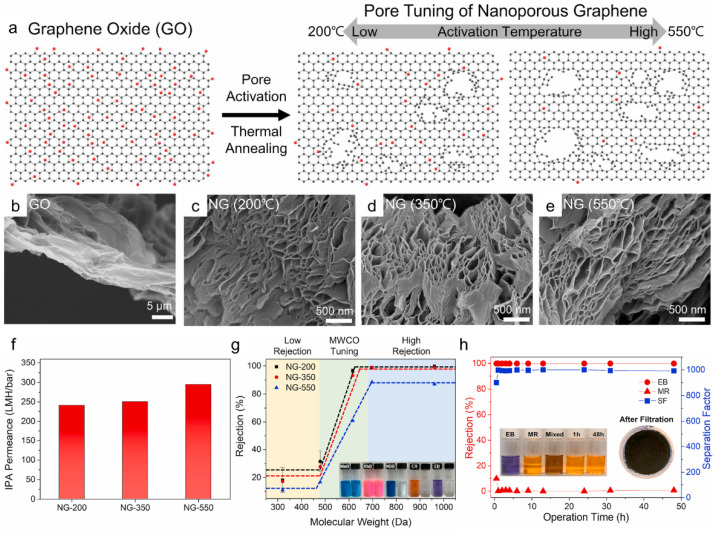
Figure 6
(a) Schematic illustration of the pore tuning of NG. (be) SEM images of the GO, NG-200, NG-350, and NG-550 particles, respectively. (f) Pure IPA permeance of the NG membranes. (g) IPA nanofiltration performance of NG membranes tested with dye molecules, including MnB, RhB, NBB, CR, and EB at 3 bar. (h) Long-term filtration performance of the NG-200 membrane under cross-flow filtration for 2 d [61]. Copyright 2021 Elsevier.
Figure 7
Figure 7
(a) Flux of pure water through the graphitic carbon membranes (GONR, rGONR, and GO) at different membrane thicknesses. (b) Relative flux of various solvents through the GONR and rGONR membranes of 100 nm thickness, normalized with water flux [78]. Copyright 2017 Royal Society of Chemistry. (c) Schematic of the GONR layer-coating procedure. (d) Top/cross-sectional SEM images of the GONR film after drying [8]. Copyright 2020 American Chemical Society.
Figure 8
Figure 8
Graphene-based hybrid membranes (ac) Schematics of the CW-GO microcomposite membrane structure and the working principle of the CW layer between GO layers and CW layer itself [53]. Copyright 2021 Wiley. (d) XRD patterns and (e) schematic of the GO-Si hybrid membranes, showing the different interlayer spacings [54]. Copyright 2019 Royal Society of Chemistry. XRD patterns of the rGO-m and rGO-TMPyPn-m membranes at (f) dry state and (g) solvated state in methanol. (h) Schematic of the fabrication of an rGO-TMPyPn-membrane with molecularly modulated nanochannels [56]. Copyright 2017 Elsevier.

References

    1. Marchetti P., Solomon M.F.J., Szekely G., Livingston A.G. Molecular Separation with Organic Solvent Nanofiltration: A Critical Review. Chem. Rev. 2014;114:10735–10806. doi: 10.1021/cr500006j. - DOI - PubMed
    1. Nie L.A., Chuah C.Y., Bae T.H., Lee J.M. Graphene-Based Advanced Membrane Applications in Organic Solvent Nanofiltration. Adv. Funct. Mater. 2021;31:2006949. doi: 10.1002/adfm.202006949. - DOI
    1. Frank O., Tsoukleri G., Parthenios J., Papagelis K., Riaz I., Jalil R., Novoselov K.S., Galiotis C. Compression Behavior of Single-Layer Graphenes. ACS. Nano. 2010;4:3131–3138. doi: 10.1021/nn100454w. - DOI - PubMed
    1. Hod O., Scuseria G.E. Electromechanical Properties of Suspended Graphene Nanoribbons. Nano Lett. 2009;9:2619–2622. doi: 10.1021/nl900913c. - DOI - PubMed
    1. Huang L., Zhang M., Li C., Shi G.Q. Graphene-Based Membranes for Molecular Separation. J. Phys. Chem. Lett. 2015;6:2806–2815. doi: 10.1021/acs.jpclett.5b00914. - DOI - PubMed

LinkOut - more resources