Review
. 2021 Nov;9(11):1328-1341.
doi: 10.1016/S2213-2600(21)00385-4. Epub 2021 Oct 19.

Addressing the post-acute sequelae of SARS-CoV-2 infection: a multidisciplinary model of care

Affiliations
Review

Addressing the post-acute sequelae of SARS-CoV-2 infection: a multidisciplinary model of care

Ann M Parker et al. Lancet Respir Med. 2021 Nov.

Abstract

As of July 31, 2021, SARS-CoV-2 had infected almost 200 million people worldwide. The growing burden of survivorship is substantial in terms of the complexity of long-term health effects and the number of people affected. Persistent symptoms have been reported in patients with both mild and severe acute COVID-19, including those admitted to the intensive care unit (ICU). Early reports on the post-acute sequelae of SARS-CoV-2 infection (PASC) indicate that fatigue, dyspnoea, cough, headache, loss of taste or smell, and cognitive or mental health impairments are among the most common symptoms. These complex, multifactorial impairments across the domains of physical, cognitive, and mental health require a coordinated, multidisciplinary approach to management. Decades of research on the multifaceted needs of and models of care for patients with post-intensive care syndrome provide a framework for the development of PASC clinics to address the immediate needs of both hospitalised and non-hospitalised survivors of COVID-19. Such clinics could also provide a platform for rigorous research into the natural history of PASC and the potential benefits of therapeutic interventions.


Conflict of interest statement

Declaration of interests JM reports payment from Springer for the book Improving Critical Care Survivorship. CMS also reports royalties from Springer for the book Improving Critical Care Survivorship. MBB reports payment for educational materials from MedBridge, outside of the submitted work. AET reports payment for consulting from Medical Science Affiliates, outside of the submitted work. AMP, EB, BC, AVA, MTK, KC, CR, KFRS, SYK, and AK declare no competing interests.

Figures
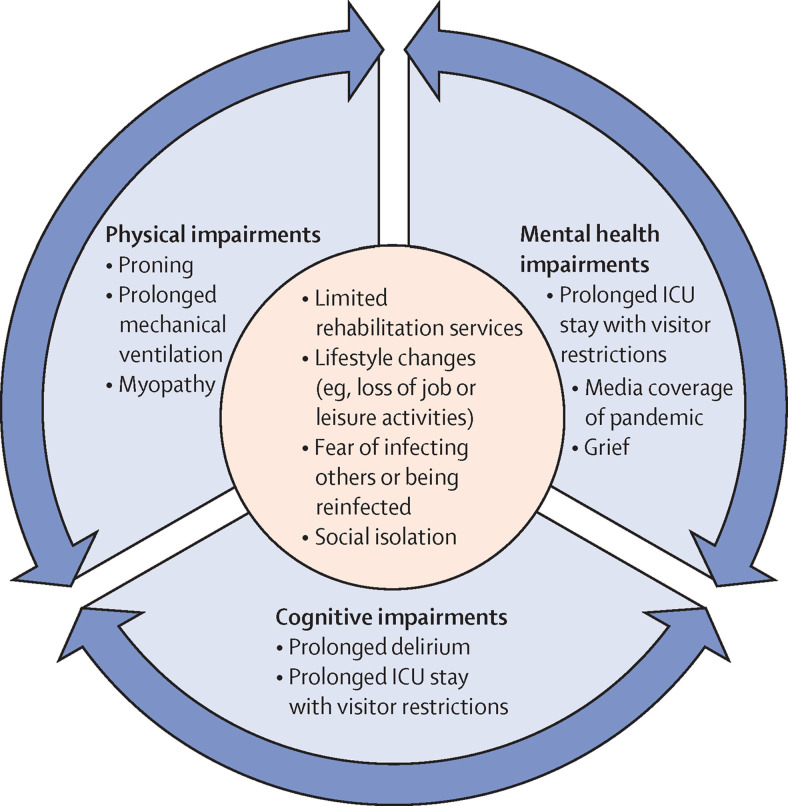
Figure 1
Figure 1
COVID-19 pandemic-related factors that could exacerbate physical, cognitive, or mental health impairments The COVID-19 pandemic could further complicate recovery across key domains of mental, physical, and cognitive health, which are intimately linked and commonly impaired in the setting of critical illness. For example, rehabilitation services could be limited because of infection control and prevention measures, and social isolation in the community and due to restrictions on family presence in hospitals could affect the recovery of patients with post-acute sequelae of SARS-CoV-2 infection. Awareness of these factors could help in the provision of holistic post-acute care.
Figure 2
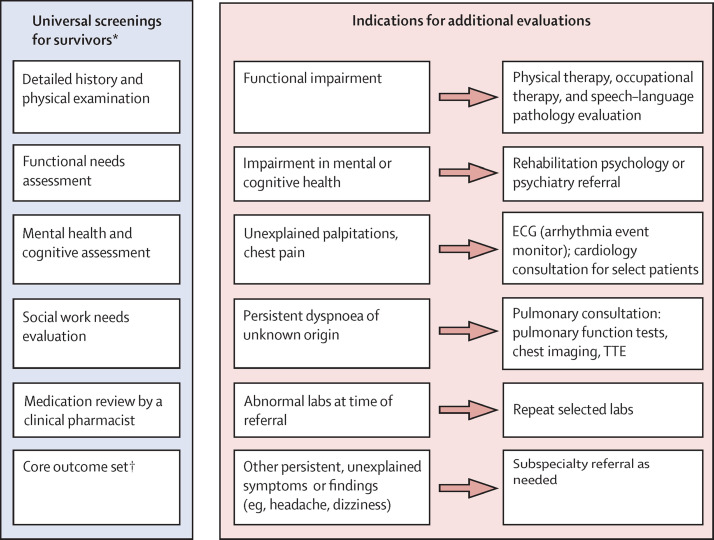
Figure 2
Core services and evaluations for survivors of COVID-19 in a PASC clinic Elements of the initial screening evaluation, done in person or remotely, for survivors of COVID-19 are shown, based on current guidelines, with recommendations for additional evaluations. ECG=electrocardiogram. TTE=transthoracic echocardiogram. *Core services recommended by the UK National Institute for Health and Care Excellence guidelines. †Core outcome set for acute respiratory failure and COVID-19.,
Figure 3
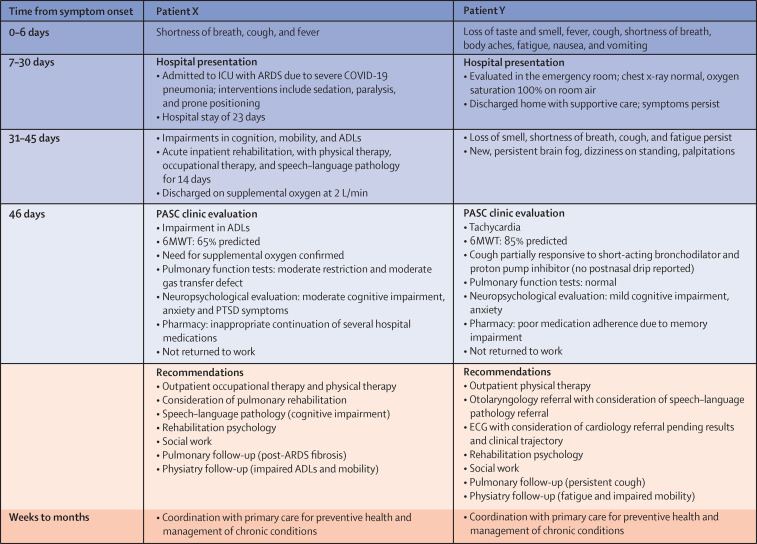
Figure 3
Potential evaluation and management in a PASC clinic of patients with initial mild or severe COVID-19 Details for patients X and Y, both about 50 years of age, represent common clinical manifestations and evaluations for patients presenting to a PASC clinic after COVID-19. Patients receiving care for PASC might have had acute COVID-19 ranging from mild (patient Y) to severe (patient X). 6MWT=6-min walk test. ADLs=activities of daily living. ARDS=acute respiratory distress syndrome. ECG=electrocardiogram. ICU=intensive care unit. PTSD=post-traumatic stress disorder.

References

    1. Johns Hopkins University & Medicine COVID-19 dashboard by the Center for Systems Science and Engineering (CSS) at Johns Hopkins University (JHU) https://coronavirus.jhu.edu/map.html
    1. Tenforde MW, Kim SS, Lindsell CJ, et al. Symptom duration and risk factors for delayed return to usual health among outpatients with COVID-19 in a multistate health care systems network — United States, March–June 2020. MMWR Morb Mortal Wkly Rep. 2020;2020:993–998. - PMC - PubMed
    1. Huang C, Huang L, Wang Y, et al. 6-month consequences of COVID-19 in patients discharged from hospital: a cohort study. Lancet. 2021;397:220–232. - PMC - PubMed
    1. Lopez-Leon S, Wegman-Ostrosky T, Perelman C, et al. More than 50 long-term effects of COVID-19: a systematic review and meta-analysis. Sci Rep. 2021;11:16144. - PMC - PubMed
    1. Nalbandian A, Sehgal K, Gupta A, et al. Post-acute COVID-19 syndrome. Nat Med. 2021;27:601–615. - PMC - PubMed

Publication types