Review
. 2021 Oct 14;11(10):2960.
doi: 10.3390/ani11102960.

Parturition in Mammals: Animal Models, Pain and Distress

Affiliations
Review

Parturition in Mammals: Animal Models, Pain and Distress

Julio Martínez-Burnes et al. Animals (Basel). .

Abstract

Parturition is a complex physiological process and involves many hormonal, morphological, physiological, and behavioural changes. Labour is a crucial moment for numerous species and is usually the most painful experience in females. Contrary to the extensive research in humans, there are limited pain studies associated with the birth process in domestic animals. Nonetheless, awareness of parturition has increased among the public, owners, and the scientific community during recent years. Dystocia is a significant factor that increases the level of parturition pain. It is considered less common in polytocous species because newborns' number and small size might lead to the belief that the parturition process is less painful than in monotocous animal species and humans. This review aims to provide elements of the current knowledge about human labour pain (monotocous species), the relevant contribution of the rat model to human labour pain, and the current clinical and experimental knowledge of parturition pain mechanisms in domestic animals that support the fact that domestic polytocous species also experience pain. Moreover, both for women and domestic animal species, parturition's pain represents a potential welfare concern, and information on pain indicators and the appropriate analgesic therapy are discussed.

Keywords: delivery; distress; farrowing; labour; pain; parturition; whelping.


Conflict of interest statement

The authors declare that the research was conducted in the absence of any commercial or financial relationships that could be construed as a potential conflict of interest.

Figures
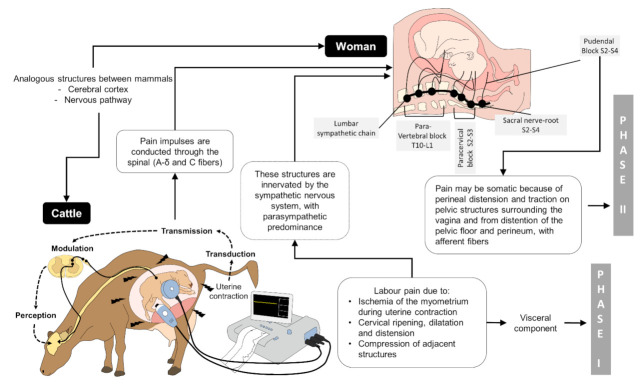
Figure 1
Figure 1
Pathway of pain in labour. In the first stage, there are slight but constant uterine contractions; as the strength of the contractions increases, concomitantly with the distension, effort, and tear of the lower uterine segment and the cervix, it becomes strongest and induces visceral pain with afferent information travelling within the hypogastric and pelvic nerves [15]. In the second labour stage, the expulsion phase is described as the most painful stage due to cervix distension and pressure on the pelvis and perineum, with pudendal nerve innervation. The nociceptive stimuli are processed and transmitted at the dorsal horn of the spinal cord, via the spinothalamic region to the thalamus, brain stem, and cerebellum, where spatial and temporal analysis take place, and also to the hypothalamic and limbic systems [5]. The third stage of labour, the delivery, consists of the expulsion of the placenta and is not painful [86].
Figure 2
Figure 2
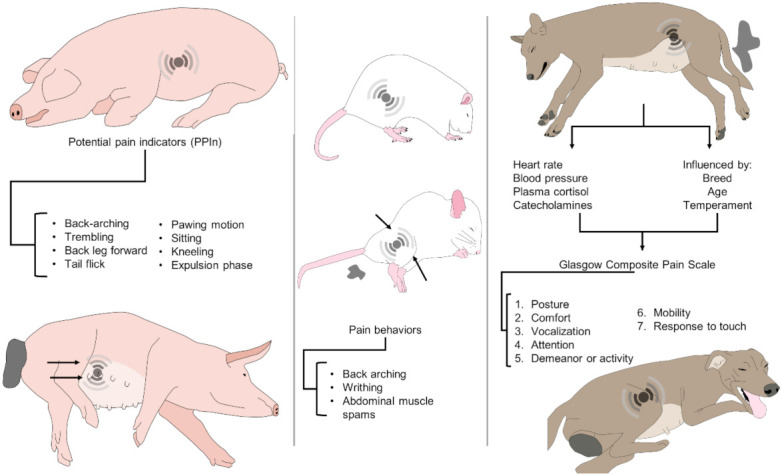
Clinical recognition of pain in sows, rats, and bitches. The recognition of pain during labor in these species can be done by observing altered postures or physiological parameters. In sows, potential pain indicators, such as a back-arching, one back leg forward, sitting, kneeling, trembling, among others, are modified behaviors during parturition. In rats, pain behaviors such as a compact posture, back-arching, writhing, and abdominal muscle contractions are pain signals. Lastly, the Glasgow Composite Scale (CMPS) in dogs uses 7 units in which posture, vocalizations, behavior, mobility, among others, are evaluated together with physiological parameters and plasma cortisol and catecholamine concentrations.
Figure 3
Figure 3
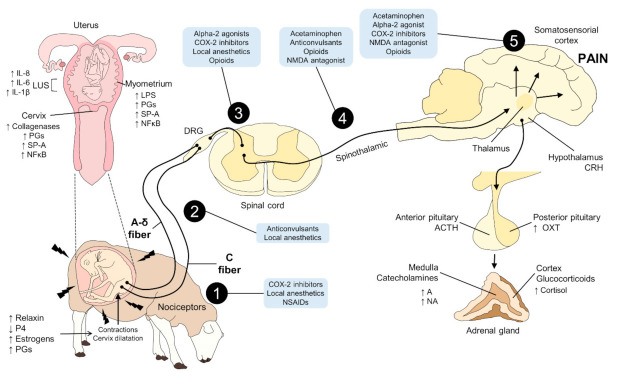
Sites of action of analgesics in the nociceptive pathway of parturition. During labour, hormonal factors such as increases in the concentrations of relaxin, estrogens, and PGs lead to cervical dilation and contractions. In the uterine tissue, LUS, myometrium, and cervix, different pro-inflammatory or degrading substances (such as collagenases) initiate an inflammatory response for the onset of softening and ripening the cervix. All of these factors activate peripheral nociceptors (A-δ and C fibers). These transduce the noxious stimulus into an electrical signal that is transmitted to the DRG of the spinal cord. Once in this structure, nociception modulation occurs, and drugs such as alpha-2 agonists, COX-2 inhibitors, local anesthetics, and opioids act at this site. These spinal neurons project to brain areas such as the thalamus or the somatosensory cortex, where pain perception occurs. Moreover, the activation of thalamic and hypothalamic areas leads to the secretion of other hormones such as ACTH or OXT. The adrenal gland contributes to the increase in circulating levels of A, NA, and cortisol, due to ACTH (cortisol) or by sympathetic influence (A, NA). Local anesthetics, NSAIDs, COX-2 inhibitors, opioids, acetaminophen, NMDA antagonist, and other analgesics act in each of the mentioned stages of the nociceptive pathway, depending on the nature of the drug. 1. transduction; 2: transmission; 3: modulation; 4: projection; 5: perception; A: adrenaline; ACTH: adrenocorticotropic hormone; CRH: corticotropin-releasing hormone; DRG: dorsal root ganglion; IL: interleukin; LPS: lipopolysaccharides; LUS: low uterine segment; NA: noradrenaline; NFκB: nuclear factor κB; NMDA: N-methyl-D-aspartate; NSAIDs: non-steroidal anti-inflammatory drugs; OXT: oxytocin; P4: progesterone; PG: prostaglandins; SP-A: surfactant protein A.

Similar articles

Cited by

References

    1. Van Rens B.T.T.M., Van Der Lende T. Parturition in gilts: Duration of farrowing, birth intervals and placenta expulsion in relation to maternal, piglet and placental traits. Theriogenology. 2004;62:331–352. doi: 10.1016/j.theriogenology.2003.10.008. - DOI - PubMed
    1. Lezama-García K., Mariti C., Mota-Rojas D., Martínez-Burnes J., Barrios-García H., Gazzano A. Maternal behaviour in domestic dogs. Int. J. Vet. Sci. Med. 2019;7:20–30. doi: 10.1080/23144599.2019.1641899. - DOI - PMC - PubMed
    1. Ison S.H., Jarvis S., Hall S.A., Ashworth C.J., Rutherford K.M.D. Periparturient behavior and physiology: Further insight into the farrowing process for primiparous and multiparous sows. Front. Vet. Sci. 2018;5:122. doi: 10.3389/fvets.2018.00122. - DOI - PMC - PubMed
    1. Mędrzycka-Dabrowska W., Czyż-Szypenbejl K., Pietrzak J. A review of randomized trials comparisons of epidural with parenteral forms of pain relief during labour and its impact on operative and cesarean delivery rate. Ginekol. Pol. 2018;89:460–467. doi: 10.5603/GP.a2018.0079. - DOI - PubMed
    1. Lowe N.K. The nature of labor pain. Am. J. Obstet. Gynecol. 2002;186:S16–S24. doi: 10.1016/S0002-9378(02)70179-8. - DOI - PubMed

LinkOut - more resources