


Richter Transformation in Chronic Lymphocytic Leukemia: Update in the Era of Novel Agents
- PMID: 34680290
- PMCID: PMC8533993
- DOI: 10.3390/cancers13205141
Richter Transformation in Chronic Lymphocytic Leukemia: Update in the Era of Novel Agents
Abstract
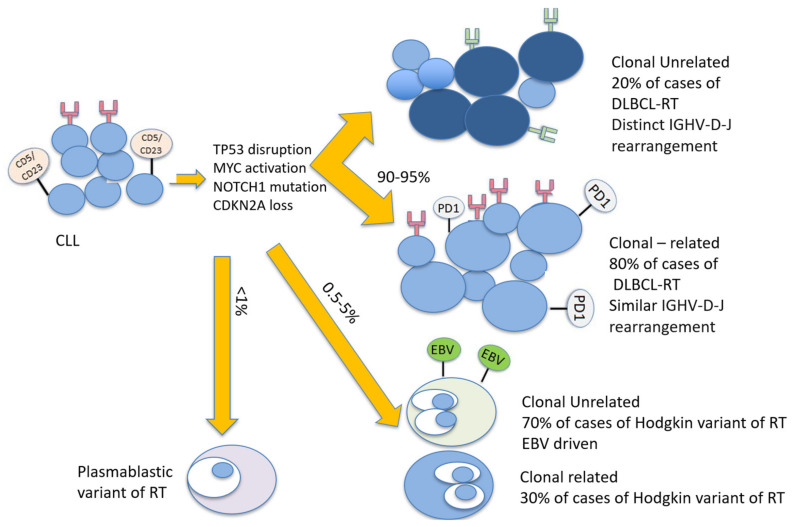
Richter transformation (RT) is a poorly understood complication of chronic lymphocytic leukemia (CLL) with a dismal prognosis. It is associated with a switch in histopathology and biology, generally with a transformation of the original CLL clone to diffuse large B-cell lymphoma (DLBCL) or less frequently to Hodgkin's variant of Richter transformation (HVRT). It occurs in 2-10% of CLL patients, with an incidence rate of 0.5-1% per year, and may develop in treatment-naïve patients, although it is more common following therapy. In recent years, there has been a deeper understanding of the molecular pathogenesis of RT that involves the inactivation of the TP53 tumor suppressor gene in 50-60% of cases and the activation of aberrations of NOTCH1 and MYC pathways in about 30% of cases. Compared to the preceding CLL, 80% of cases with DLBCL-RT and 30% of HVRT harbor the same IGHV-D-J rearrangements, indicating a clonal evolution of the disease, while the remaining cases represent de novo lymphomas that are clonally unrelated. Despite advances in understanding the molecular variations and the pathogenesis of the disease, there is still no significant improvement in patient outcomes. However, if no clinical trials were designed for patients with RT in the past, now there many studies for these patients that incorporate new drugs and novel combinations that are being explored. In this review, we summarize the new information accumulated on RT with special emphasis on results involving the novel therapy tested for this entity, which represents an unmet clinical need.
Keywords: BCL2; BTKi; DLBCL; chronic lymphocytic leukemia; novel agents; richter syndrome; richter transformation.
Conflict of interest statement
The authors have no conflict of interest to declare.
Figures
References
-
- Tsimberidou A.M., O’Brien S., Khouri I., Giles F.J., Kantarjian H.M., Champlin R., Wen S., Do K.A., Smith S.C., Lerner S., et al. Clinical outcomes and prognostic factors in patients with Richter’s syndrome treated with chemotherapy or chemoimmunotherapy with or without stem-cell transplantation. J. Clin. Oncol. 2006;24:2343–2351. doi: 10.1200/JCO.2005.05.0187. - DOI - PubMed
-
- Parikh S.A., Rabe K.G., Call T.G., Zent C.S., Habermann T.M., Ding W., Leis J.F., Schwager S.M., Hanson C.A., Macon W.R., et al. Diffuse large B-cell lymphoma (Richter syndrome) in patients with chronic lymphocytic leukaemia (CLL): A cohort study of newly diagnosed patients. Br. J. Haematol. 2013;162:774–782. doi: 10.1111/bjh.12458. - DOI - PMC - PubMed
Publication types
LinkOut - more resources
Full Text Sources
Research Materials
Miscellaneous
