Review
. 2021 Oct 17;13(20):5206.
doi: 10.3390/cancers13205206.

The Key Differences between Human Papillomavirus-Positive and -Negative Head and Neck Cancers: Biological and Clinical Implications

Affiliations
Review

The Key Differences between Human Papillomavirus-Positive and -Negative Head and Neck Cancers: Biological and Clinical Implications

Steven F Powell et al. Cancers (Basel). .

Abstract

Head and neck squamous cell carcinoma (HNSCC) is a unique malignancy associated with two distinct risk factors: exposure to typical carcinogens and infection of human papillomavirus (HPV). HPV encodes the potent oncoproteins E6 and E7, which bypass many important oncogenic processes and result in cancer development. In contrast, HPV-negative HNSCC is developed through multiple mutations in diverse oncogenic driver genes. While the risk factors associated with HPV-positive and HPV-negative HNSCCs are discrete, HNSCC patients still show highly complex molecular signatures, immune infiltrations, and treatment responses even within the same anatomical subtypes. Here, we summarize the current understanding of biological mechanisms, treatment approaches, and clinical outcomes in comparison between HPV-positive and -negative HNSCCs.

Keywords: clinical outcome; clinical trials; de-escalation strategies; head and neck cancer; head and neck squamous cell carcinoma; human papillomavirus; microbiome; molecular carcinogenesis; surgery; treatment; tumor microenvironment.


Conflict of interest statement

W.C.S. consulting for Bristol Myers Squibb, Regeneron, and Merck. S.F.P. received research grant support to the institution from Merck, Bristol Myers Squib, Pfizer, Vyriad, Incyte, Actuate, Genentech, and Seattle Genetics. Steven Powell received consulting support to the institution from Bristol Myers Squibb. The other authors declare no conflict of interest.

Figures
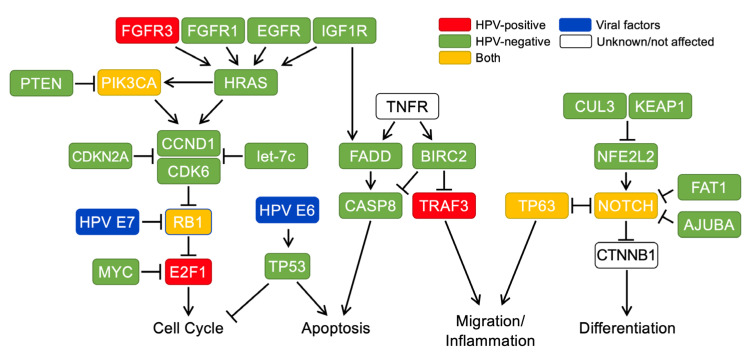
Figure 1
Figure 1
An overview of the key factors and pathways with genome mutations and molecular dysregulations in HPV+ and HPV− HNSCCs [7,10]. Genome mutations and alterations mainly found in HPV+, HPV−, and both HNSCCs are indicated with red, green, and yellow boxes, respectively. The HPV oncogenes E6 and E7 are shown as blue boxes, and unknown or unaffected genes are shown as white boxes. FGFR3, fibroblast growth factor receptor 3; FGFR1, fibroblast growth factor receptor 1; EGFR, epidermal growth factor receptor; IGF1R, insulin like growth factor 1 receptor; PTEN, phosphatase and tensin homolog; PIK3CA, phosphatidylinositol-4,5-bisphosphate 3-kinase catalytic subunit alpha; HRAS, Hras proto-oncogene, GTPase; CCND1, cyclin D1; CDK6, cyclin dependent kinase 6; CDKN2A, cyclin dependent kinase inhibitor 2A; let-7c, microRNA let-7c; RB1, RB transcriptional corepressor 1; MYC, MYC proto-oncogene, BHLH transcription factor; E2F1, E2F transcription factor 1; TP53, tumor protein P53; TNFR, tumor necrosis factor receptor; FADD, fas associated via death domain; CASP8, caspase 8; TRAF3, tumor necrosis factor receptor associated factor 3; CUL3, cullin 3; KEAP1, kelch like ECH associated protein 1; NFE2L2, nuclear factor, erythroid 2 like 2; TP63, tumor protein P63; NOTCH, notch receptor; FAT1, FAT atypical cadherin 1; AJUBA, ajuba LIM protein; CTNNB1, catenin beta 1.
Figure 2
Figure 2
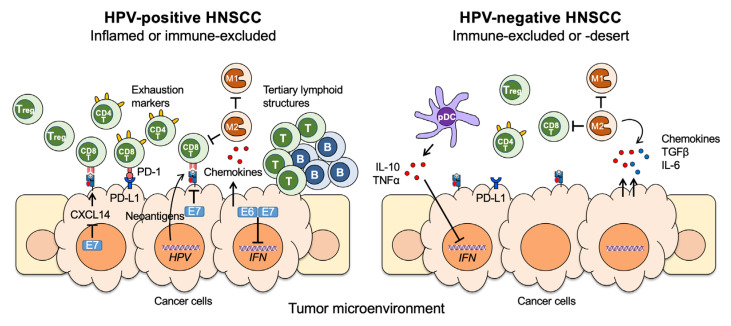
A summary of immune dysregulation and evasion in the tumor microenvironment (TME) of HPV+ (left) and HPV− (right) HNSCCs. The differential immunophenotypes in the TME between HPV+ and HPV− HNSCC are depicted, based on three different spatial distribution of CD8+ T cells previously proposed [83,84]. The highly inflamed phenotype of HPV+ OPSCC may be caused by the anatomical distinction of oropharynx composed of the lymphoid tissue. CD4T, CD4+ T cell; CD8T, CD8+ T cell; Treg, regulatory T cell; B, B cell; T, T cell; M1, M1 macrophage; M2, M2 macrophage; pDC, plasmacytoid dendritic cell; HPV, HPV genome; IFN, interferon-related genes; TNFα, tumor necrosis factor-α; TGFβ, transforming growth factor-β; PD-1, programmed death-1; PD-L1, programmed death ligand-1; IL-6, interleukin 6; IL-10, interleukin 10; CXCL14, C-X-C chemokine 14.

References

    1. Siegel R.L., Miller K.D., Fuchs H.E., Jemal A. Cancer Statistics, 2021. CA Cancer J. Clin. 2021;71:7–33. doi: 10.3322/caac.21654. - DOI - PubMed
    1. Gillison M.L., D’Souza G., Westra W., Sugar E., Xiao W., Begum S., Viscidi R. Distinct risk factor profiles for human papillomavirus type 16-positive and human papillomavirus type 16-negative head and neck cancers. J. Natl. Cancer Inst. 2008;100:407–420. doi: 10.1093/jnci/djn025. - DOI - PubMed
    1. Goldenberg D., Lee J., Koch W.M., Kim M.M., Trink B., Sidransky D., Moon C.S. Habitual risk factors for head and neck cancer. Otolaryngol. Head Neck Surg. 2004;131:986–993. doi: 10.1016/j.otohns.2004.02.035. - DOI - PubMed
    1. Xu M., Yao Y., Chen H., Zhang S., Cao S.M., Zhang Z., Luo B., Liu Z., Li Z., Xiang T., et al. Genome sequencing analysis identifies Epstein-Barr virus subtypes associated with high risk of nasopharyngeal carcinoma. Nat. Genet. 2019;51:1131–1136. doi: 10.1038/s41588-019-0436-5. - DOI - PMC - PubMed
    1. Pyeon D., Newton M.A., Lambert P.F., Boon J.A.D., Sengupta S., Marsit C., Woodworth C.D., Connor J.P., Haugen T., Smith E.M., et al. Fundamental differences in cell cycle deregulation in human papillomavirus-positive and human papillomavirus-negative head/neck and cervical cancers. Cancer Res. 2007;67:4605–4619. doi: 10.1158/0008-5472.CAN-06-3619. - DOI - PMC - PubMed

LinkOut - more resources