


Emerging SARS-CoV-2 Variants of Concern (VOCs): An Impending Global Crisis
- PMID: 34680420
- PMCID: PMC8533361
- DOI: 10.3390/biomedicines9101303
Emerging SARS-CoV-2 Variants of Concern (VOCs): An Impending Global Crisis
Abstract
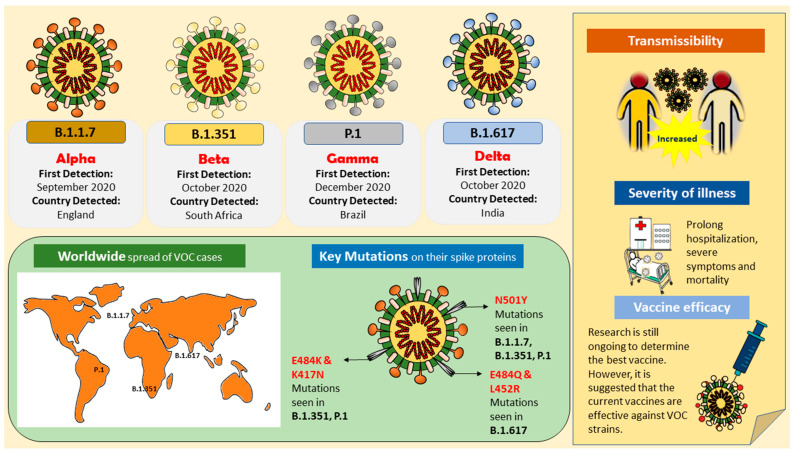
The worldwide battle against the SARS-CoV-2 virus rages on, with millions infected and many innocent lives lost. The causative organism, severe acute respiratory syndrome coronavirus 2 (SARS-CoV-2), is a beta coronavirus that belongs to the Coronaviridae family. Many clinically significant variants have emerged, as the virus's genome is prone to various mutations, leading to antigenic drift and resulting in evasion of host immune recognition. The current variants of concern (VOCs) include B.1.1.7 (Alpha), B.1.351 (Beta), B.1.617/B.1.617.2 (Delta), and P.1 (Gamma). The emerging variants contain various important mutations on the spike protein, leading to deleterious consequences, such as immune invasion and vaccine escape. These adverse effects result in increased transmissibility, morbidity, and mortality and the evasion of detection by existing or currently available diagnostic tests, potentially delaying diagnosis and treatment. This review discusses the key mutations present in the VOC strains and provides insights into how these mutations allow for greater transmissibility and immune evasion than the progenitor strain. Continuous monitoring and surveillance of VOC strains play a vital role in preventing and controlling the virus's spread.
Keywords: SARS-CoV-2; mutations; progenitor; transmissibility; variant of concern (VOC).
Conflict of interest statement
The authors declare no conflict of interest.
Figures
References
-
- Johnson D., Ren S.E.C., Johnson H.D., Letchumanan V. COVID-19: Are Malaysians embracing or suffering the new normality? Prog. Microbes Mol. Biol. 2020;3 doi: 10.36877/pmmb.a0000102. - DOI
-
- Letchumanan V., Ab Mutalib N.-S., Goh B.-H., Lee L.-H. Novel coronavirus 2019-nCoV: Could this virus become a possible global pandemic. Prog. Microbes Mol. Biol. 2020;3 doi: 10.36877/pmmb.a0000068. - DOI
-
- Lee V.S., Chong W.L., Sukumaran S.D., Nimmanpipug P., Letchumanan V., Goh B.H., Lee L.-H., Zain S.M., Abd Rahman N. Computational screening and identifying binding interaction of anti-viral and anti-malarial drugs: Toward the potential cure for SARS-CoV-2. Prog. Drug Discov. Biomed. Sci. 2020;3 doi: 10.36877/pddbs.a0000065. - DOI
-
- Loh H.C., Seah Y.K., Looi I. The COVID-19 pandemic and diet change. Prog. Microbes Mol. Biol. 2021;4 doi: 10.36877/pmmb.a0000203. - DOI
Publication types
Grants and funding
LinkOut - more resources
Full Text Sources
Miscellaneous
