Review
. 2021 Oct 1;9(10):1373.
doi: 10.3390/biomedicines9101373.

Extracellular Vesicle-Based Therapy for COVID-19: Promises, Challenges and Future Prospects

Affiliations
Review

Extracellular Vesicle-Based Therapy for COVID-19: Promises, Challenges and Future Prospects

Vamika Karn et al. Biomedicines. .

Abstract

The COVID-19 pandemic has become a serious concern and has negatively impacted public health and the economy. It primarily targets the lungs, causing acute respiratory distress syndrome (ARDS); however, it may also lead to multiple organ failure (MOF) and enhanced mortality rates. Hence, there is an urgent need to develop potential effective therapeutic strategies for COVID-19 patients. Extracellular vesicles (EVs) are released from various types of cells that participate in intercellular communication to maintain physiological and pathological processes. EVs derived from various cellular origins have revealed suppressive effects on the cytokine storm during systemic hyper-inflammatory states of severe COVID-19, leading to enhanced alveolar fluid clearance, promoted epithelial and endothelial recovery, and cell proliferation. Being the smallest subclass of EVs, exosomes offer striking characteristics such as cell targeting, being nano-carriers for drug delivery, high biocompatibility, safety, and low-immunogenicity, thus rendering them a potential cell-free therapeutic candidate against the pathogeneses of various diseases. Due to these properties, numerous studies and clinical trials have been performed to assess their safety and therapeutic efficacy against COVID-19. Hence, in this review, we have comprehensively described current updates on progress and challenges for EVs as a potential therapeutic agent for the management of COVID-19.

Keywords: COVID-19; SARS-CoV2; extracellular vesicles; therapeutic agents.


Conflict of interest statement

All authors declare no competing interests with the work presented in the manuscript.

Figures
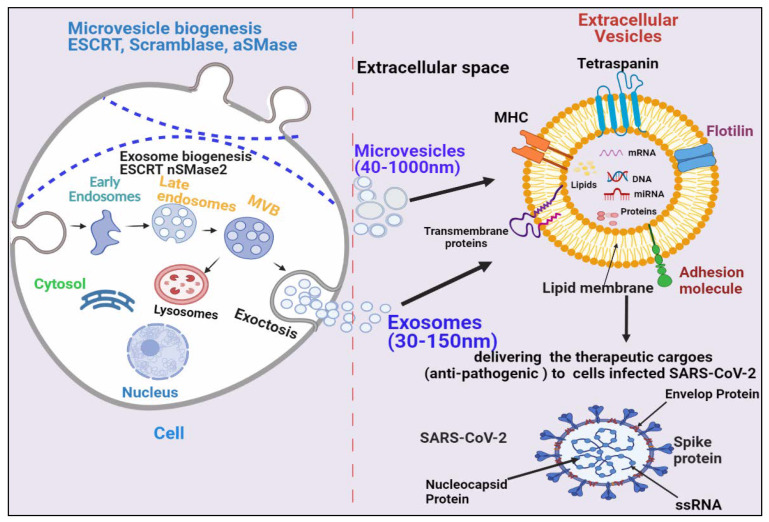
Figure 1
Figure 1
Biogenesis and secretion of EVs (microvesicles and exosomes) and their therapeutic role in COVID-19. The secretion of exosomes into the extracellular environmentundergoes three distinct steps: exosome biogenesis, intracellular trafficking of MVBs, and fusion of MVBs with the plasma membrane. Microvesicles are synthesized through direct outward budding and detachment of the plasma membrane into the extracellular milieu. Several molecules are involved in the biogenesis of both microvesicles and exosomes (small GTPases, ESCRTs, ARRDC1, syndecan, ceramide, tetraspanins). These EVs binds to SARS-COV-2-infected cells and deliver their therapeutic cargos to inhibit their pathogenesis.
Figure 2
Figure 2
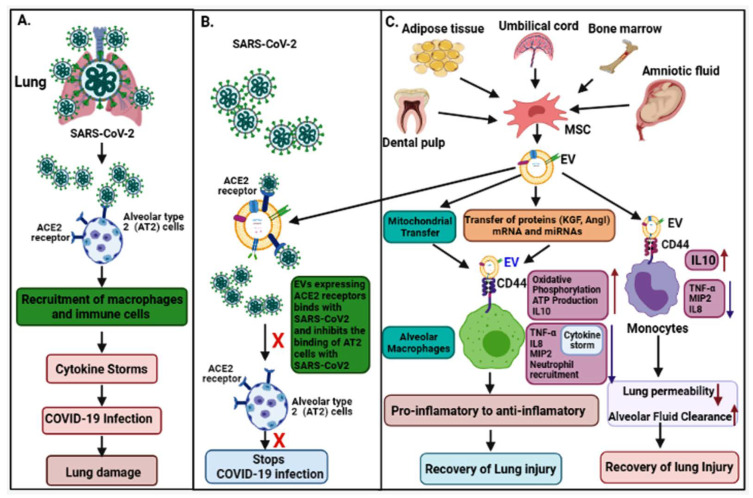
The pathogenesis of COVID-19 and its EV-mediated therapeutic recovery. (A) SARS-CoV-2 binds to ACE2 receptors on alveolar type 2 (AT2) cells in the lung and induces cytokine storms leading to lung damage. (B,C) Therapeutic effects; ACE2 receptors expressed on MSC-derived EVs competitively bind to SARS-CoV-2 and inhibit the binding of the virus to AT2 cells, and consequently inhibit the viral infection. MSC-derived EVs transfer mitochondria, proteins (KGF, and AgoI), mRNA and miRNAs via binding to CD44 receptors on macrophages, suppress the cytokine storm (IL-8, TNF-α, MIP2) and enhance anti-inflammatory cytokines (IL-10), ATP production, and oxidative phosphorylation—which helps in recovery from lung injury. MSC-derived EVs also bind to monocytes via CD44 receptors, repress the cytokine storm, and enhance anti-inflammatory cytokines IL-10, leading to recovery of the injury.
Figure 3
Figure 3
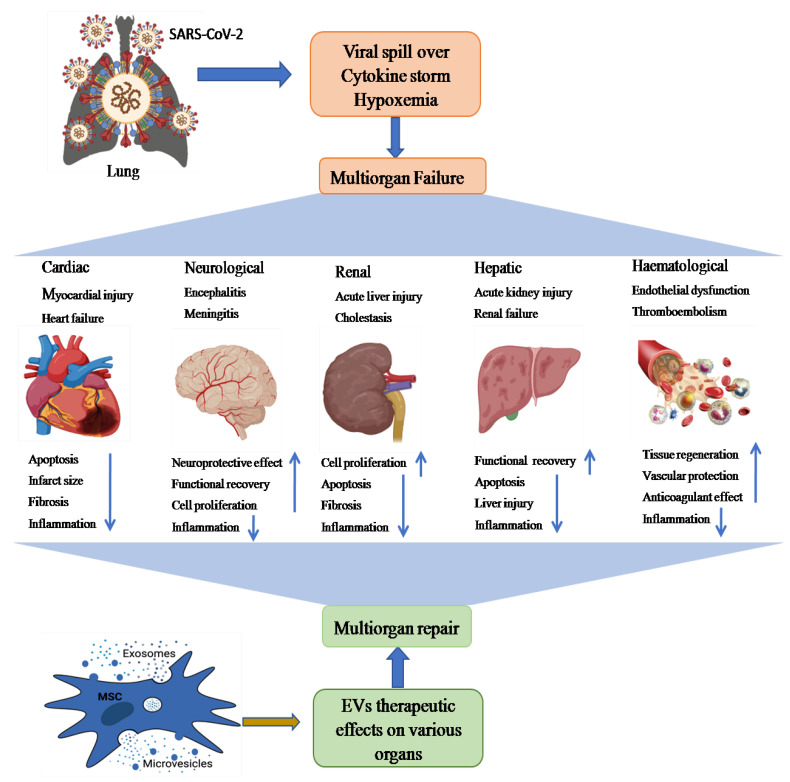
A schematic representation showing possible paths of MSC-EV (exosomes and microvesicles)-mediated therapy of SARS-CoV-2-induced multiple organ failure (heart, kidney, liver, brain injury, and hematological disorders). Multiple organ dysfunction mainly occurs by binding ACE2 receptors on different organs, cytokine storm, and hypoxemia. These multiorgan pathological aberrations could be recovered through anti-inflammatory, tissue regenerative, and neuroprotective effects of EVs.

References

    1. Du J., Dong L., Wang T., Yuan C., Fu R., Zhang L., Liu B., Zhang M., Yin Y., Qin J., et al. Psychological symptoms among frontline healthcare workers during COVID-19 outbreak in Wuhan. Gen. Hosp. Psychiatry. 2020;67:144–145. doi: 10.1016/j.genhosppsych.2020.03.011. - DOI - PMC - PubMed
    1. Huang C., Wang Y., Li X., Ren L., Zhao J., Hu Y., Zhang L., Fan G., Xu J., Gu X., et al. Clinical Features of Patients Infected with 2019 Novel Coronavirus in Wuhan, China. Lancet. 2020;395:497–506. doi: 10.1016/S0140-6736(20)30183-5. - DOI - PMC - PubMed
    1. Nagoor Meeran M.F., Javed H., Sharma C., Goyal S.N., Kumar S., Jha N.K., Ojha S. Can Echinacea Be a Potential Candidate to Target Immunity, Inflammation, and Infection-The Trinity of Coronavirus Disease 2019. Heliyon. 2021;7:e05990. doi: 10.1016/j.heliyon.2021.e05990. - DOI - PMC - PubMed
    1. Zhou F., Yu T., Du R., Fan G., Liu Y., Liu Z., Xiang J., Wang Y., Song B., Gu X., et al. Clinical Course and Risk Factors for Mortality of Adult Inpatients with COVID-19 in Wuhan, China: A Retrospective Cohort Study. Lancet. 2020;395:1054–1062. doi: 10.1016/S0140-6736(20)30566-3. - DOI - PMC - PubMed
    1. Meeran M.F.N., Sharma C., Goyal S.N., Kumar S., Ojha S. CB2 Receptor-Selective Agonists as Candidates for Targeting Infection, Inflammation, and Immunity in SARS-CoV-2 Infections. Drug Dev. Res. 2021;82:7–11. doi: 10.1002/ddr.21752. - DOI - PMC - PubMed

LinkOut - more resources