


Trends in the Application of "Omics" to Ecotoxicology and Stress Ecology
- PMID: 34680873
- PMCID: PMC8535992
- DOI: 10.3390/genes12101481
Trends in the Application of "Omics" to Ecotoxicology and Stress Ecology
Abstract
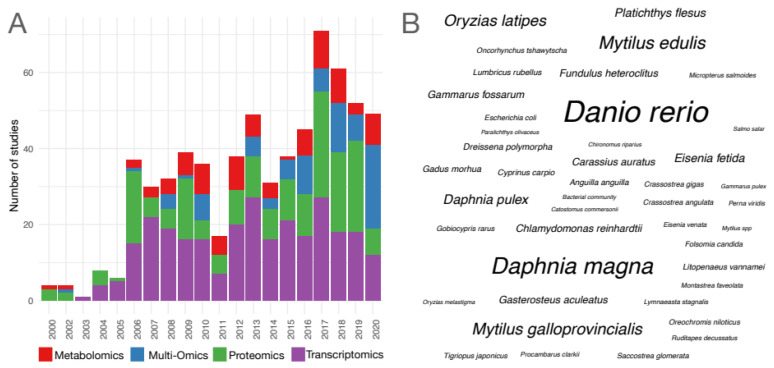
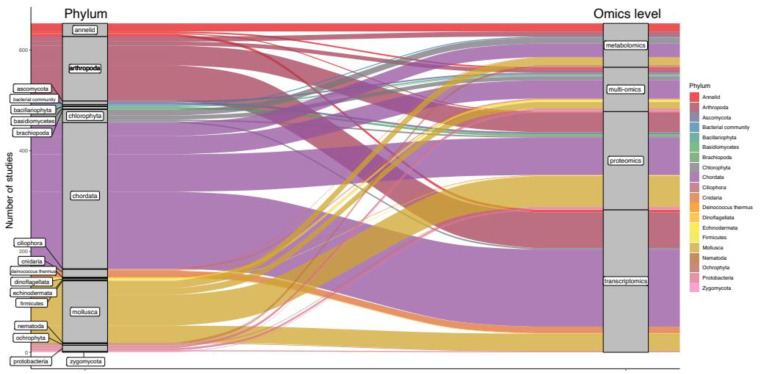
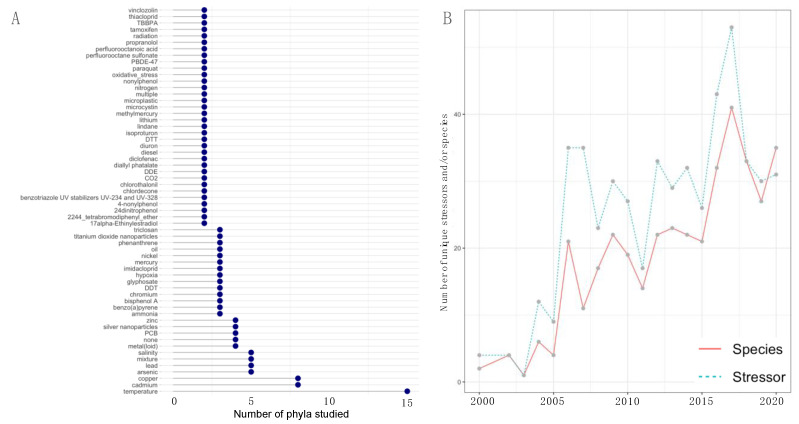
Our ability to predict and assess how environmental changes such as pollution and climate change affect components of the Earth's biome is of paramount importance. This need positioned the fields of ecotoxicology and stress ecology at the center of environmental monitoring efforts. Advances in these interdisciplinary fields depend not only on conceptual leaps but also on technological advances and data integration. High-throughput "omics" technologies enabled the measurement of molecular changes at virtually all levels of an organism's biological organization and thus continue to influence how the impacts of stressors are understood. This bibliometric review describes literature trends (2000-2020) that indicate that more different stressors than species are studied each year but that only a few stressors have been studied in more than two phyla. At the same time, the molecular responses of a diverse set of non-model species have been investigated, but cross-species comparisons are still rare. While transcriptomics studies dominated until 2016, a shift towards proteomics and multiomics studies is apparent. There is now a wealth of data at functional omics levels from many phylogenetically diverse species. This review, therefore, addresses the question of how to integrate omics information across species.
Keywords: cross-species; ecotoxicology; omics; review; stress ecology; taxa; technology; trends.
Conflict of interest statement
The authors declare no conflict of interest. The funders had no role in the design of the study; in the collection, analyses, or interpretation of data; in the writing of the manuscript, or in the decision to publish the results.
Figures
References
-
- Walker C.H., Sibly R.M., Hopkin S.P., Peakall D.B. Principles of Ecotoxicology. 4th ed. CRC Press; Boca Raton, FL, USA: 2012.
Publication types
MeSH terms
LinkOut - more resources
Full Text Sources
