Review
. 2021 Oct 11;10(10):1027.
doi: 10.3390/biology10101027.

The Modulation of Gut Microbiota Composition in the Pathophysiology of Gestational Diabetes Mellitus: A Systematic Review

Affiliations
Review

The Modulation of Gut Microbiota Composition in the Pathophysiology of Gestational Diabetes Mellitus: A Systematic Review

Thubasni Kunasegaran et al. Biology (Basel). .

Abstract

General gut microbial dysbiosis in diabetes mellitus, including gestational diabetes mellitus (GDM), has been reported in a large body of literature. However, evidence investigating the association between specific taxonomic classes and GDM is lacking. Thus, we performed a systematic review of peer-reviewed observational studies and trials conducted among women with GDM within the last ten years using standard methodology. The National Institutes of Health (NIH) quality assessment tools were used to assess the quality of the included studies. Fourteen studies investigating microbial interactions with GDM were found to be relevant and included in this review. The synthesis of literature findings demonstrates that Bacteroidetes, Proteobacteria, Firmicutes, and Actinobacteria phyla, such as Desulfovibrio, Ruminococcaceae, P. distasonis, Enterobacteriaceae, Collinsella, and Prevotella, were positively associated with GDM. In contrast, Bifidobacterium and Faecalibacterium, which produce butyrate, are negatively associated with GDM. These bacteria were associated with inflammation, adiposity, and glucose intolerance in women with GDM. Lack of good diet management demonstrated the alteration of gut microbiota and its impact on GDM glucose homeostasis. The majority of the studies were of good quality. Therefore, there is great potential to incorporate personalized medicine targeting microbiome modulation through dietary intervention in the management of GDM.

Keywords: 16S rRNA; gestational diabetes mellitus; metagenomics; microbiome.


Conflict of interest statement

The authors declare no conflict of interest.

Figures
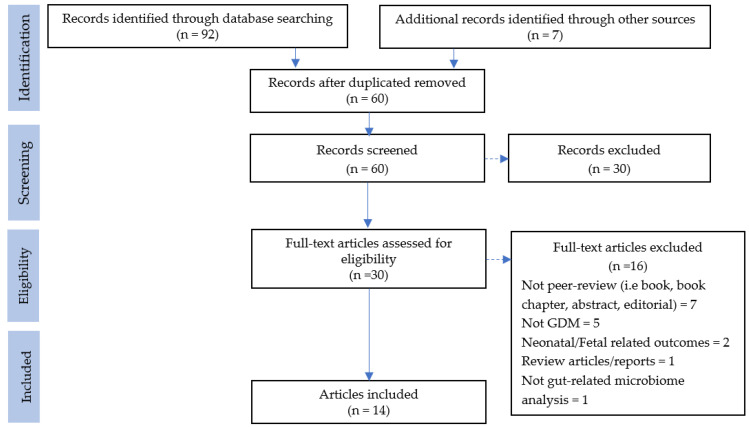
Figure 1
Figure 1
PRISMA flow chart of the article selection process.
Figure 2
Figure 2
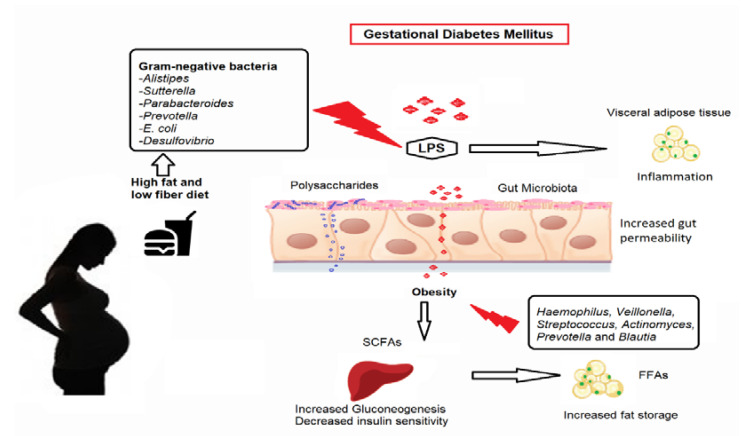
Potential mechanisms of pathobiont adherence and efflux through the gut epithelium in GDM women. LPS, lipopolysaccharides; FFAs, free fatty acids; SCFAs, short-chain fatty acids. Note: Images were obtained separately from Microsoft image search as licensed by the Creative Commons License (CC BY 2.0) and edited in Microsoft Paint. Poor adherence to recommended daily dietary intake, such as an increase in high-fat/low-fiber diet consumption, may have altered the makeup of the normal gut microbiota. It increased the Gram-negative pathobionts and SCFAs. The presence of Gram-negative pathobionts may have raised LPS biosynthesis levels. The increased gut permeability condition permits pathobionts, LPS, and SCFAs to move across the epithelial layer of the gut. The crossed LPS, SCFAs, and pathobionts entered the systemic circulation and reached peripheral tissues. Excessive SCFAs may have increased gluconeogenesis in the liver and elevated plasma glucose levels. In addition, SCFAs might have enhanced FFAs uptake and increased lipogenesis, causing excessive fat storage with the aid of other pathobionts in overweight pregnant women. LPS causes metabolic endotoxemia and inflammatory response activation, resulting in low-grade inflammation and adiposity. These mechanisms lead to glucose intolerance in GDM women.

References

    1. Koh A., Molinaro A., Ståhlman M., Khan M.T., Schmidt C., Mannerås-Holm L., Wu H., Carreras A., Jeong H., Olofsson L.E., et al. Microbially Produced Imidazole Propionate Impairs Insulin Signaling through mTORC1. Cell. 2018;175:947–961.e917. doi: 10.1016/j.cell.2018.09.055. - DOI - PubMed
    1. Prattichizzo F., Giuliani A., Mensà E., Sabbatinelli J., De Nigris V., Rippo M.R., La Sala L., Procopio A.D., Olivieri F., Ceriello A. Pleiotropic effects of metformin: Shaping the microbiome to manage type 2 diabetes and postpone ageing. Ageing Res. Rev. 2018;48:87–98. doi: 10.1016/j.arr.2018.10.003. - DOI - PubMed
    1. Brunkwall L., Orho-Melander M. The gut microbiome as a target for prevention and treatment of hyperglycaemia in type 2 diabetes: From current human evidence to future possibilities. Diabetologia. 2017;60:943–951. doi: 10.1007/s00125-017-4278-3. - DOI - PMC - PubMed
    1. Tang W.H., Kitai T., Hazen S.L. Gut Microbiota in Cardiovascular Health and Disease. Circ. Res. 2017;120:1183–1196. doi: 10.1161/CIRCRESAHA.117.309715. - DOI - PMC - PubMed
    1. DiBaise J.K., Zhang H., Crowell M.D., Krajmalnik-Brown R., Decker G.A., Rittmann B.E. Gut microbiota and its possible relationship with obesity. Mayo Clin. Proc. 2008;83:460–469. doi: 10.4065/83.4.460. - DOI - PubMed

LinkOut - more resources