Review
. 2021 Oct 11;22(20):10973.
doi: 10.3390/ijms222010973.

Organ Specificity and Heterogeneity of Cancer-Associated Fibroblasts in Colorectal Cancer

Affiliations
Review

Organ Specificity and Heterogeneity of Cancer-Associated Fibroblasts in Colorectal Cancer

Naoya Miyashita et al. Int J Mol Sci. .

Abstract

Fibroblasts constitute a ubiquitous mesenchymal cell type and produce the extracellular matrix (ECM) of connective tissue, thereby providing the structural basis of various organs. Fibroblasts display differential transcriptional patterns unique to the organ of their origin and they can be activated by common stimuli such as transforming growth factor-β (TGF-β) and platelet-derived growth factor (PDGF) signaling. Cancer-associated fibroblasts (CAFs) reside in the cancer tissue and contribute to cancer progression by influencing cancer cell growth, invasion, angiogenesis and tumor immunity. CAFs impact on the tumor microenvironment by remodeling the ECM and secreting soluble factors such as chemokines and growth factors. Differential expression patterns of molecular markers suggest heterogeneous features of CAFs in terms of their function, pathogenic role and cellular origin. Recent studies elucidated the bimodal action of CAFs on cancer progression and suggest a subgroup of CAFs with tumor-suppressive effects. This review attempts to describe cellular features of colorectal CAFs with an emphasis on their heterogeneity and functional diversity.

Keywords: FOXL1; PDGF; TGF-β; cancer-associated fibroblast; colorectal cancer.


Conflict of interest statement

The authors declare no conflict of interest.

Figures
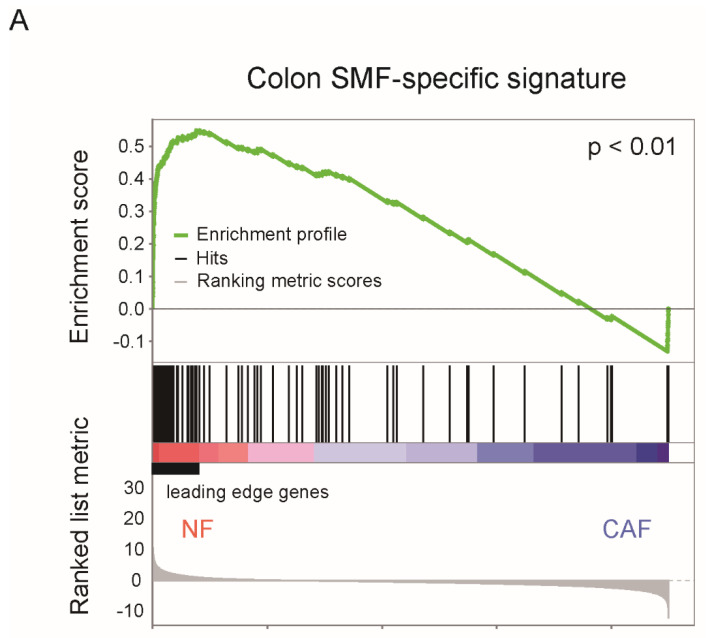
Figure 1
Figure 1
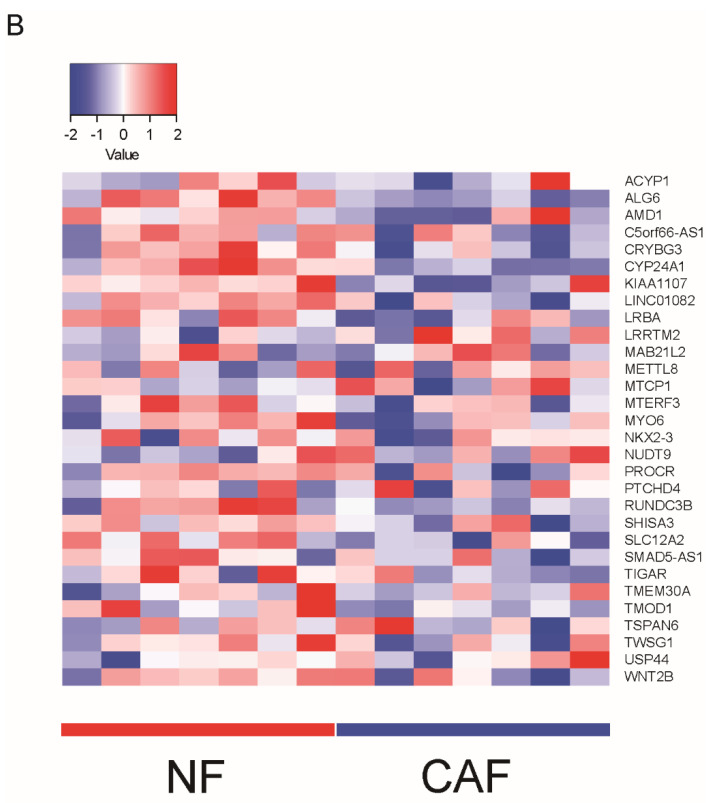
Unique features of colon submucosal fibroblasts. (A) Gene set enrichment analysis (GSEA) was performed using the microarray datasets of colon normal fibroblasts (NFs) and cancer-associated fibroblasts (CAFs). Expression profiling data of colon NFs and colorectal CAFs were obtained from the GSE70468 dataset. A colon SMF-specific signature was identified by differential expression analysis between the colon SMFs (4 samples) and non-GIFs (31samples) obtained from the GSE63626 dataset. SMFs: submucosal fibroblasts. GIFs: gastrointestinal fibroblasts. (B) Heatmap of the relative expression levels of 30 leading-edge genes obtained by GSEA.
Figure 1
Figure 1
Unique features of colon submucosal fibroblasts. (A) Gene set enrichment analysis (GSEA) was performed using the microarray datasets of colon normal fibroblasts (NFs) and cancer-associated fibroblasts (CAFs). Expression profiling data of colon NFs and colorectal CAFs were obtained from the GSE70468 dataset. A colon SMF-specific signature was identified by differential expression analysis between the colon SMFs (4 samples) and non-GIFs (31samples) obtained from the GSE63626 dataset. SMFs: submucosal fibroblasts. GIFs: gastrointestinal fibroblasts. (B) Heatmap of the relative expression levels of 30 leading-edge genes obtained by GSEA.
Figure 2
Figure 2
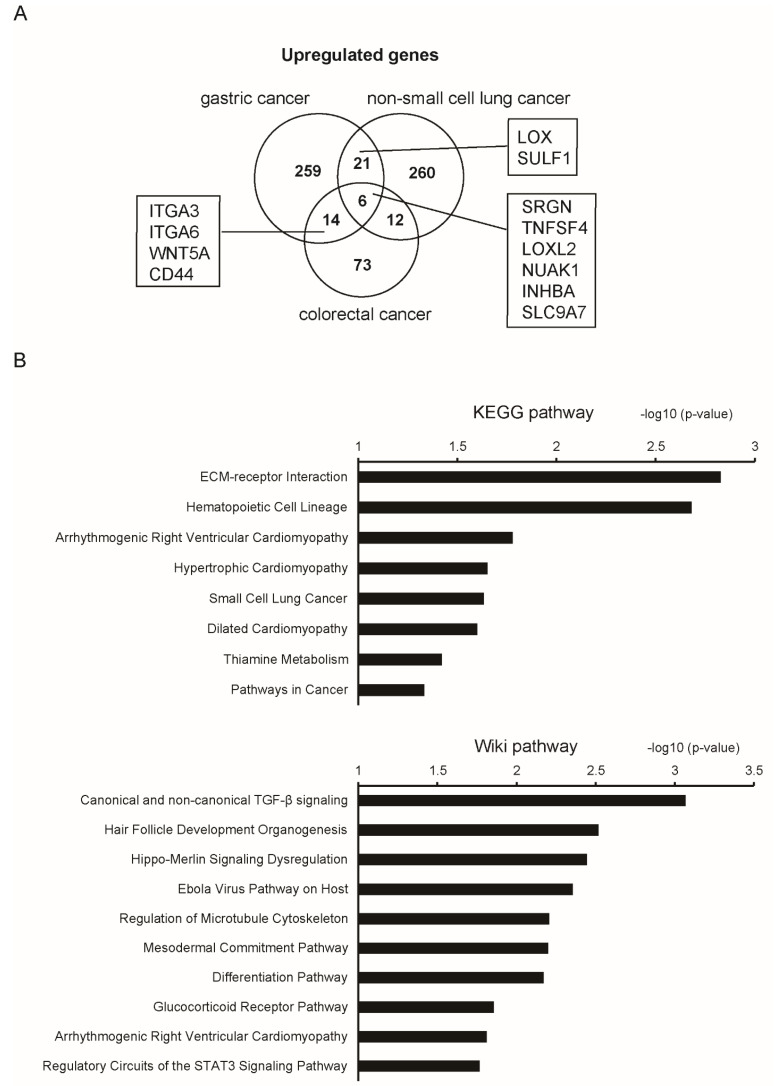
Upregulated genes in CAFs identified in different cancer types. (A) Venn diagram showing the genes upregulated in CAFs relative to NFs in colorectal cancer (CRC), gastric cancer and non-small cell lung cancer. The number of identified genes is indicated. Representative overlapping genes are indicated. Upregulated genes in CAFs were identified as follows. CRC: expression profiling data by microarray were obtained from the GSE70468 dataset. Upregulated genes in CAFs relative to their normal counterparts were extracted by the thresholds of a p-value < 0.05 and log fold-change > 1. Gastric cancer: fragments per kilobase of exon per million reads mapped (FPKM) data of 11 matched NFs and CAFs were obtained from the GSE83834 dataset. Deseq2 was performed and the top 300 upregulated genes were extracted. Non-small cell lung cancer: expression profiling data by microarray were obtained from the GSE22874 dataset. Upregulated genes in CAFs relative to NFs were extracted by the thresholds of a p-value < 0.05 and log fold-change > 1. (B) Pathway analyses (KEGG and Wiki pathways) were performed using CAF-upregulated genes in at least two cancer types.

References

    1. LeBleu V.S., Neilson E.G. Origin and functional heterogeneity of fibroblasts. FASEB J. 2020;34:3519–3536. doi: 10.1096/fj.201903188R. - DOI - PubMed
    1. Lynch M.D., Watt F.M. Fibroblast heterogeneity: Implications for human disease. J. Clin. Investig. 2018;128:26–35. doi: 10.1172/JCI93555. - DOI - PMC - PubMed
    1. Hinz B., Phan S.H., Thannickal V.J., Prunotto M., Desmouliere A., Varga J., De Wever O., Mareel M., Gabbiani G. Recent developments in myofibroblast biology: Paradigms for connective tissue remodeling. Am. J. Pathol. 2012;180:1340–1355. doi: 10.1016/j.ajpath.2012.02.004. - DOI - PMC - PubMed
    1. Herrera M., Islam A.B., Herrera A., Martín P., García V., Silva J., Garcia J.M., Salas C., Casal I., de Herreros A.G., et al. Functional heterogeneity of cancer-associated fibroblasts from human colon tumors shows specific prognostic gene expression signature. Clin. Cancer Res. 2013;19:5914–5926. doi: 10.1158/1078-0432.CCR-13-0694. - DOI - PubMed
    1. Horie M., Saito A., Mikami Y., Ohshima M., Morishita Y., Nakajima J., Kohyama T., Nagase T. Characterization of human lung cancer-associated fibroblasts in three-dimensional in vitro co-culture model. Biochem. Biophys. Res. Commun. 2012;423:158–163. doi: 10.1016/j.bbrc.2012.05.104. - DOI - PubMed

MeSH terms

Substances