


Management of Infectious Lymphadenitis in Children
- PMID: 34682125
- PMCID: PMC8535130
- DOI: 10.3390/children8100860
Management of Infectious Lymphadenitis in Children
Abstract
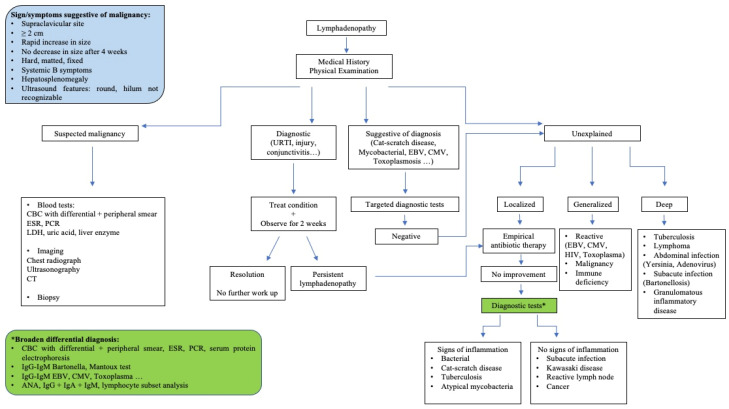
Lymphadenopathy is an irregularity in the size and texture of the lymph nodes, which is quite common in childhood. When the enlargement of lymph nodes is caused by inflammatory and infectious processes, it is called lymphadenitis. The main objective of this manuscript is to summarize the common infectious etiologies and presentations of lymphadenitis in children providing a management guide for clinical practice. PubMed was used to search for all of the studies published up to April 2021 using keywords such as "lymphadenitis" and "children". Literature analysis showed that the differential diagnosis for lymphadenitis in pediatrics is broad. Although lymph node enlargement in children is usually benign and self-limited, it is important to exclude malignant etiology. In most cases, history and physical examination allow to identify the correct diagnosis and start a proper treatment with a prompt resolution of the lymphadenopathy. However, particularly in the case of persistent lymphadenitis, determining the cause of lymph node enlargement may be difficult, and the exact etiology may not be identified despite extensive investigations. Further studies should develop and validate an algorithm to assist pediatricians in the diagnosis and timely treatment of lymphadenitis, suggesting situations in which a watchful waiting may be considered a safe approach, those in which empiric antibiotic therapy should be administered, and those requiring a timely diagnostic work-up.
Keywords: Bartonella henselae; children; lymphadenitis; mycobacterium avium complex.
Conflict of interest statement
The authors declare no conflict of interest.
Figures
References
Publication types
LinkOut - more resources
Full Text Sources
Miscellaneous
