. 2021 Oct 9;7(10):846.
doi: 10.3390/jof7100846.

Sand Particle Size and Phosphorus Amount Affect Rhizophagus irregularis Spore Production Using In Vitro Propagated Spore as a Starter Inoculum in Rhizosphere of Maize (Zea mays) Plantlets

Affiliations

Sand Particle Size and Phosphorus Amount Affect Rhizophagus irregularis Spore Production Using In Vitro Propagated Spore as a Starter Inoculum in Rhizosphere of Maize (Zea mays) Plantlets

Pulak Maitra et al. J Fungi (Basel). .

Abstract

Microbial inoculants, particularly arbuscular mycorrhizal (AM) fungi, have great potential for sustainable crop management. In this study, monoxenic culture of indigenous R. irregularis was developed and used as a tool to determine the minimum phosphorus (P) level for maximum spore production under the in vitro conditions. This type of starter AM fungal inoculum was then applied to an in vivo substrate-based mass-cultivation system. Spore production, colonization rate, and plant growth were examined in maize (Zea mays L.) plant inoculated with the monoxenic culture of R. irregularis in sand graded by particle size with varying P levels in nutrient treatments. In the in vitro culture, the growth medium supplemented with 20 µM P generated the maximum number of spores (400 spores/mL media) of R. irregularis. In the in vivo system, the highest sporulation (≈500 spores g-1 sand) occurred when we added a half-strength Hoagland solution (20 µM P) in the sand with particle size between 500 µm and 710 µm and omitted P after seven weeks. However, the highest colonization occurred when we added a half-strength Hoagland solution in the sand with particle sizes between 710 µm and 1000 µm and omitted P after seven weeks. This study suggests that substrate particle size and P reduction and regulation might have a strong influence on the maximization of sporulation and colonization of R. irregularis in sand substrate-based culture.

Keywords: R. irregularis; arbuscular mycorrhiza; inoculum production; monxenic culture; phosphorus treatment.


Conflict of interest statement

The authors declare no conflict of interest.

Figures
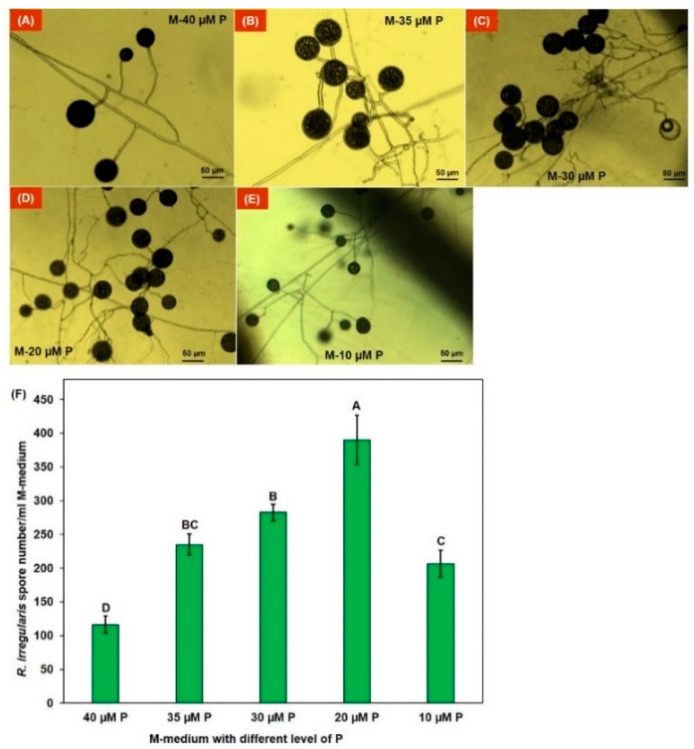
Figure 1
Figure 1
Monoxenic culture of R. irregularis isolate Apex-MYK-01 in M- medium with different phosphorus (P) concentration in the medium (AE) and sporulation rate (F).
Figure 2
Figure 2
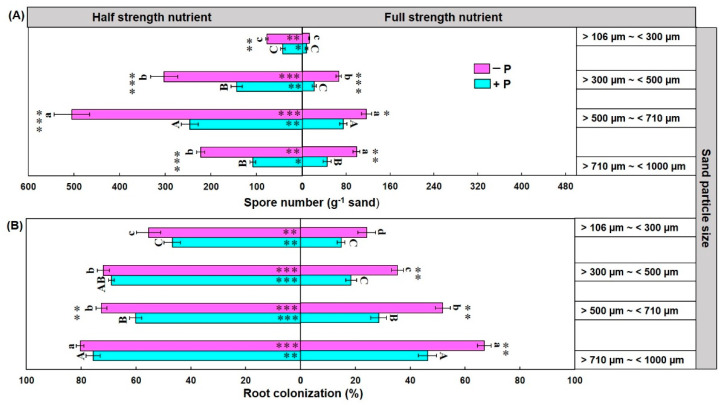
Effect of sand particle size, nutrient strength and phosphorus omission on spore number (A) and colonization rate (B) of R. irregularis grown with maize plant in sand. Data are means ± SE (n = 6). Bars without shared uppercase and lowercase letters indicate significant difference of spore number and root colonization rate among different particle size of sand according to Tukey’s HSD test at p < 0.05. Bars with asterisks represent significant difference of spore density and colonization between phosphorus omission (−P) and phosphorus without omission (+P) treatments. Asterisks within column indicate significant difference of spore number and colonization rate between half strength and full strength nutrient treatments. * p < 0.05, ** p < 0.01, *** p < 0.001.
Figure 3
Figure 3
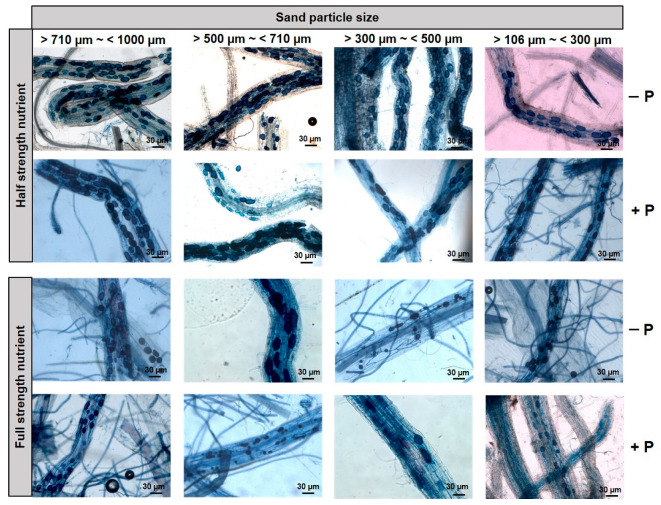
Root colonization of R. irregularis under different treatments with different sand particle used to grow maize.
Figure 4
Figure 4
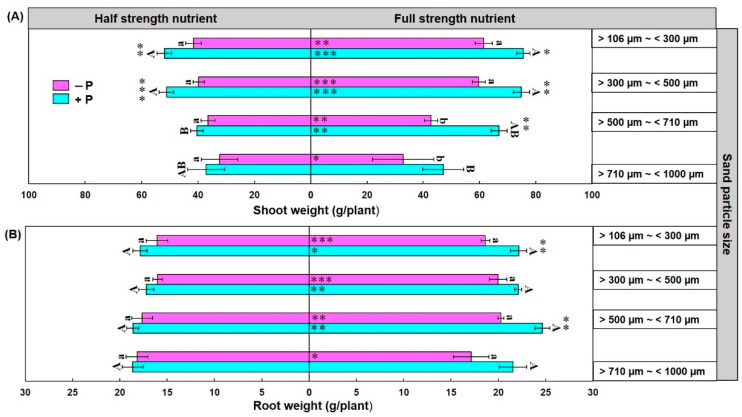
Effect of sand particle size, nutrient strength and phosphorus omission on shoot weight (A) and root weight (B) of maize plant grown with R. irregularis inoculum in sand substrate-based culture. Data are means ± SE (n = 6). Bars without shared uppercase and lowercase letters indicate significant difference of shoot weight and root weight among different particle size of sand according to Tukey’s HSD test at p < 0.05. Bars with asterisks represent significant difference of shoot weight and root weight between phosphorus omission (−P) and phosphorus not omission (+P) treatments. Asterisks within column indicate significant difference of shoot weight and root weight between half strength and full strength nutrient treatments. * p < 0.05, ** p < 0.01, *** p < 0.001.
Figure 5
Figure 5
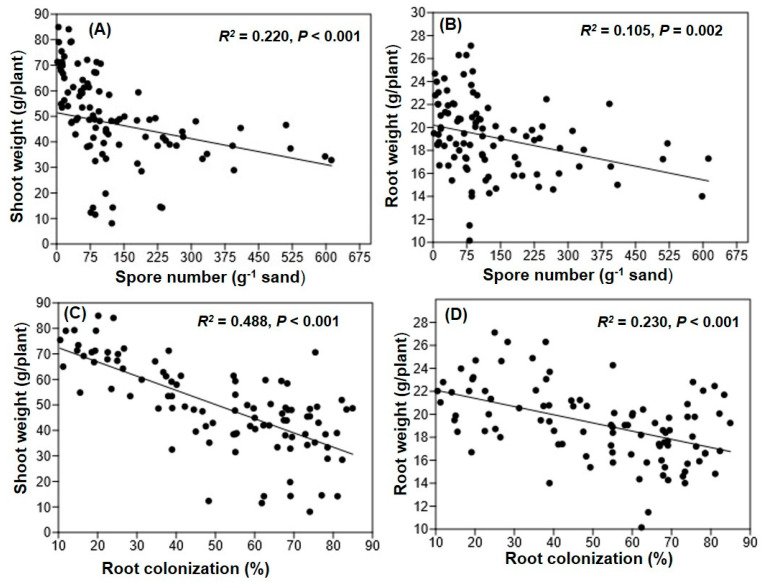
Linear relationships of shoot and root weight with spore number (A,B) and shoot and root weight with root colonization (C,D) of R. irregularis isolate Apex-MYK-01 inoculaed with maize seedlings grown in sand substrate-based culture.
Figure 6
Figure 6
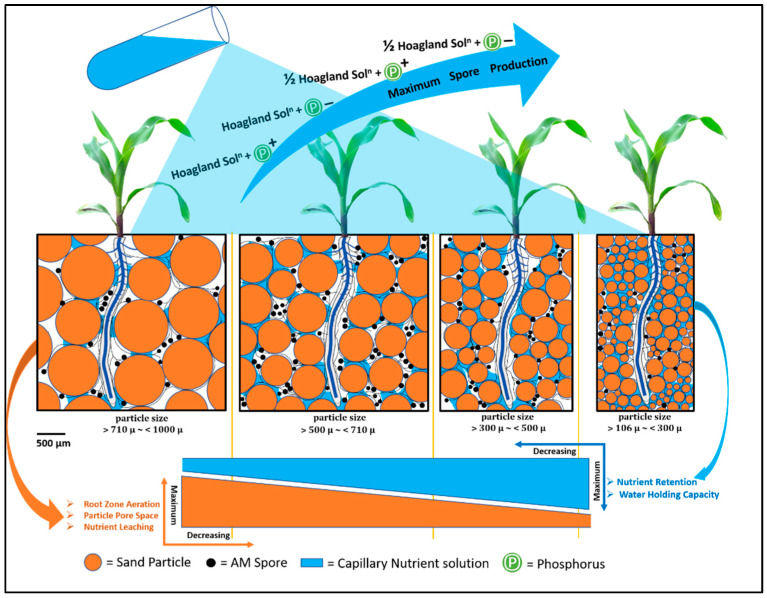
Conceptual framework of in vivo propagation of R. irregularis under maize (Zea mays L.) plant system in sand substrate-based culture.

References

    1. Smith S.E., Read D.J. Mycorrhizal Symbiosis. 3rd ed. Academic Press; London, UK: 2008.
    1. Smith F.A., Jakobsen I., Smith S.E. Spatial differences in acquisition of soil phosphate between two arbuscular mycorrhizal fungi in symbiosis with Medicago truncatula. New Phytol. 2000;147:357–366. doi: 10.1046/j.1469-8137.2000.00695.x. - DOI
    1. Shi S., Luo X., Wen M., Dong X., Sharifi S., Xie D., He X. Funneliformis mosseae improves growth and nutrient accumulation in wheat by facilitating soil nutrient uptake under elevated CO2 at daytime, not nighttime. J. Fungi. 2021;7:458. doi: 10.3390/jof7060458. - DOI - PMC - PubMed
    1. Tedersoo L., Bahram M. Mycorrhizal types differ in ecophysiology and alter plant nutrition and soil processes. Biol. Rev. 2019;94:1857–1880. doi: 10.1111/brv.12538. - DOI - PubMed
    1. Selvakumar G., Shagol C.C., Kang Y., Chung B.N., Han S.G., Sa T. Arbuscular mycorrhizal fungi spore propagation using single spore as starter inoculum and a plant host. J. Appl. Microbiol. 2018;124:1556–1565. doi: 10.1111/jam.13714. - DOI - PubMed

LinkOut - more resources