


Generalized Anxiety as a Risk Factor for Dysfunctional Eating Behavior after Obesity Surgery during the COVID-19 Pandemic
- PMID: 34682635
- PMCID: PMC8536045
- DOI: 10.3390/ijerph182010890
Generalized Anxiety as a Risk Factor for Dysfunctional Eating Behavior after Obesity Surgery during the COVID-19 Pandemic
Abstract
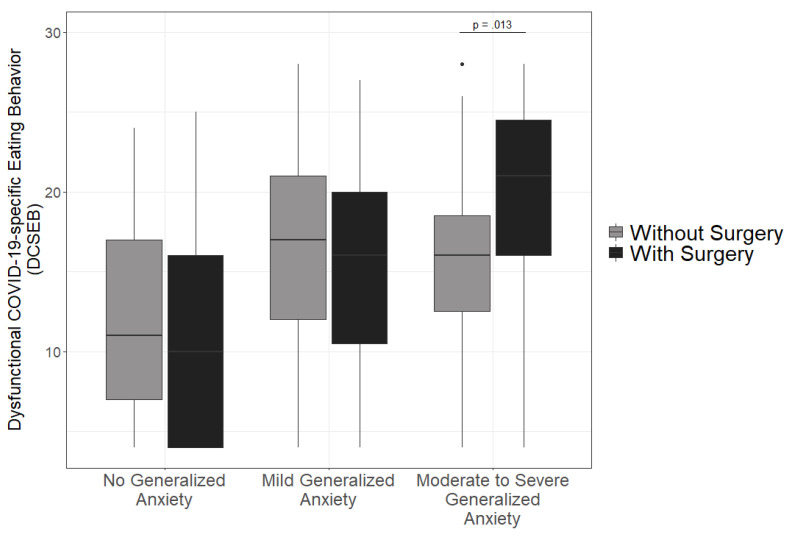
Purpose: The present study investigates the impact of obesity surgery on mental health (i.e., eating behavior and distress) during the COVID-19 pandemic. Methods: Two hundred fifty-four participants were recruited via social media. One hundred fourteen (44.53%) of them were surgery candidates (waiting for obesity surgery), while 142 (55.46%) had already undergone surgery. Participants who underwent surgery were compared to participants that did not yet undergo surgery in terms of mental burden (depression and anxiety), as well as safety and eating behavior. Further moderation analyses attempted to identify risk factors for increased COVID-19-related dysfunctional eating behavior after surgery. Results: Participants who underwent surgery showed generally lower levels of depression and general anxiety on a trend level. Moderation analyses suggested that people with high levels of generalized anxiety actually show more dysfunctional COVID-19-specific eating behavior after obesity surgery. Conclusion: On a trend level, obesity surgery appears to attenuate symptoms of generalized anxiety and depression. Yet, surgery patients with high levels of generalized anxiety exhibit even higher levels of dysfunctional eating during the COVID-19 pandemic. It is therefore particularly important to support people at risk.
Keywords: COVID-19; anxiety; eating disorder; mental health; obesity; obesity surgery.
Conflict of interest statement
The authors declare no conflict of interest.
Figures
References
-
- World Health Organization WHO Director-General’s Remarks at the Media Briefing on 2019-nCoV on 11 February 2020. [(accessed on 23 June 2021)]. Available online: https://www.who.int/dg/speeches/detail/who-director-general-s-remarks-at....
-
- World Health Organization Obesity and Overweight. [(accessed on 23 June 2021)]. Available online: https://www.who.int/news-room/fact-sheets/detail/obesity-and-overweight.
Publication types
MeSH terms
LinkOut - more resources
Full Text Sources
Medical
