Review
. 2021 Oct 13;10(20):4687.
doi: 10.3390/jcm10204687.

Aging with Down Syndrome-Where Are We Now and Where Are We Going?

Affiliations
Review

Aging with Down Syndrome-Where Are We Now and Where Are We Going?

Melissa J Alldred et al. J Clin Med. .

Abstract

Down syndrome (DS) is a form of accelerated aging, and people with DS are highly prone to aging-related conditions that include vascular and neurological disorders. Due to the overexpression of several genes on Chromosome 21, for example genes encoding amyloid precursor protein (APP), superoxide dismutase (SOD), and some of the interferon receptors, those with DS exhibit significant accumulation of amyloid, phospho-tau, oxidative stress, neuronal loss, and neuroinflammation in the brain as they age. In this review, we will summarize the major strides in this research field that have been made in the last few decades, as well as discuss where we are now, and which research areas are considered essential for the field in the future. We examine the scientific history of DS bridging these milestones in research to current efforts in the field. We extrapolate on comorbidities associated with this phenotype and highlight clinical networks in the USA and Europe pursuing clinical research, concluding with funding efforts and recent recommendations to the NIH regarding DS research.

Keywords: Alzheimer’s disease; Down syndrome; aging; biomarkers; neuropathology.


Conflict of interest statement

The authors declare no conflict of interest.

Figures
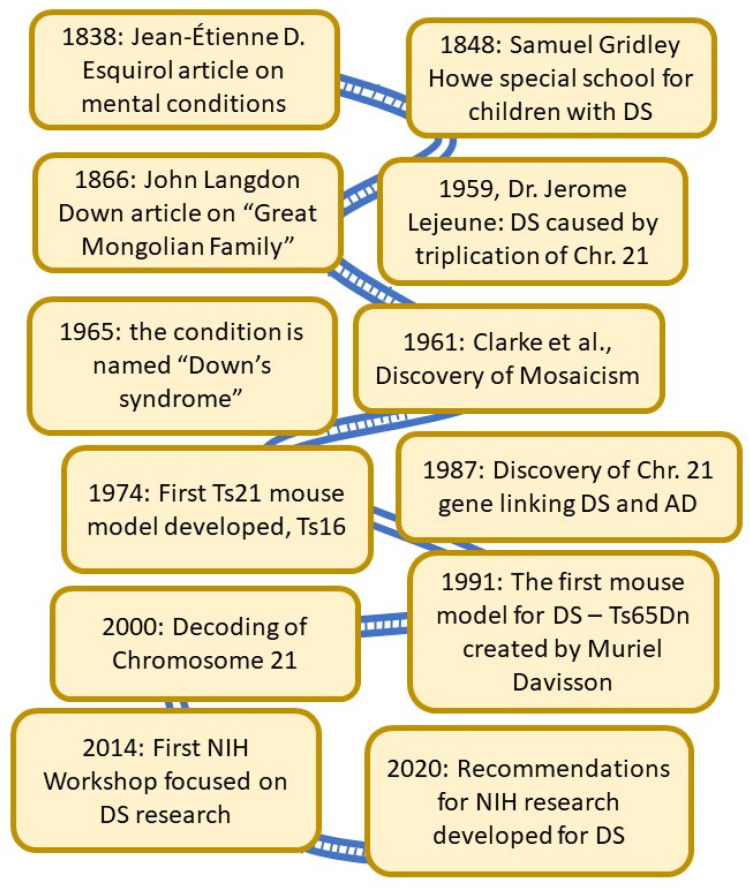
Figure 1
Figure 1
A Brief History of DS research. As noted in this outline, the first known publications focused on children with DS occurred in the mid-1800s. In 1866, Dr. John Langdon Down wrote about “the Great Mongolian Family”, and almost a century later the condition was named after him. Dr. Patterson and his colleagues finished decoding Chr. 21 in the late 1990s, and the sequence was first published in year 2000—only the second chromosome to be fully decoded. Thirty years ago, the first non-lethal mouse model for DS—Ts65Dn—was created by Dr. Muriel Davisson. This model has been used extensively to detect the connection between aging-related brain degeneration and DS and is still used today.
Figure 2
Figure 2
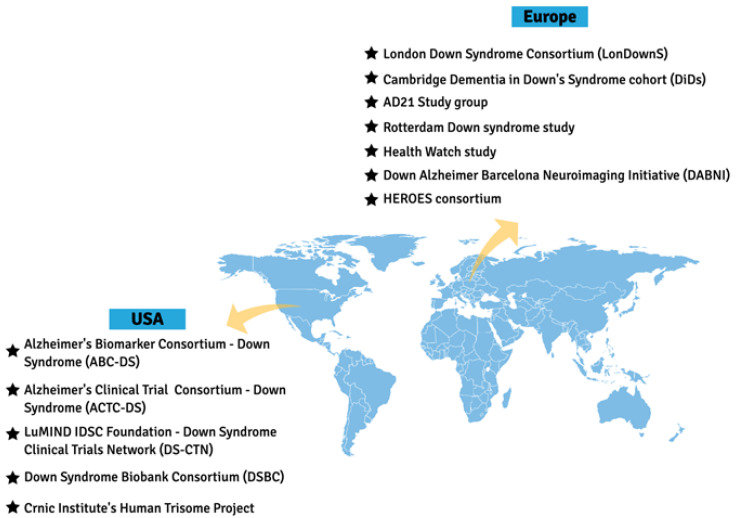
Clinical networks focused on DS in the US and Europe. There are several well-characterized cohorts of adults with DS in Europe, now representing the Horizon 21 consortium, which currently includes 10 different countries in Europe. In the US, there are also several networks, including the AD Biomarker consortium (ABC-DS), the Down syndrome Biobank consortium for collection of brain tissues (DSBC), the LIFE-DSR trial-ready population, and the Crnic Institute’s Human Trisome Project, focused on genetic alterations.
Figure 3
Figure 3
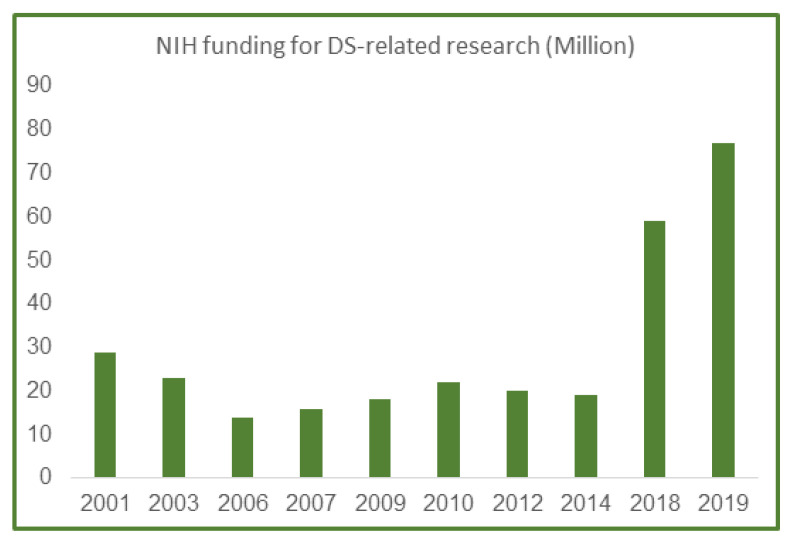
NIH funding in million dollars for DS research from 2001 to 2019. According to the NIH website, total funding for DS research was $29 million in 2001, which has now incrementally increased to more than $70 million in 2019, giving researchers a stellar opportunity to fully investigate clinical comorbidities of DS and AD in the future and with the added guidance provided by the DS NIH plan discussed above.

References

    1. Lejeune J., Gautier M., Turpin R. Study of somatic chromosomes from 9 mongoloid children. Comptes Rendus Hebd. Séances Acad. Sci. 1959;248:1721–1722. - PubMed
    1. Esbensen A.J. Health Conditions Associated with Aging and End of Life of Adults with Down Syndrome. Families. 2010;39:107–126. doi: 10.1016/s0074-7750(10)39004-5. - DOI - PMC - PubMed
    1. O’Toole C., Lee A.S.-Y., Gibbon F.E., van Bysterveldt A.K., Hart N.J. Parent-mediated interventions for promoting communication and language development in young children with Down syndrome. Cochrane Database Syst. Rev. 2018;2018:CD012089. doi: 10.1002/14651858.CD012089.pub2. - DOI - PMC - PubMed
    1. Chapman R.S., Hesketh L.J. Behavioral phenotype of individuals with Down syndrome. Ment. Retard. Dev. Disabil. Res. Rev. 2000;6:84–95. doi: 10.1002/1098-2779(2000)6:2<84::AID-MRDD2>3.0.CO;2-P. - DOI - PubMed
    1. Lott I.T. Neurological phenotypes for Down syndrome across the life span. Prog. Brain Res. 2012;197:101–121. doi: 10.1016/b978-0-444-54299-1.00006-6. - DOI - PMC - PubMed

LinkOut - more resources