. 2021 Oct 17;10(20):4763.
doi: 10.3390/jcm10204763.

Recurrence of Hepatic Encephalopathy after TIPS: Effective Prophylaxis with Combination of Lactulose and Rifaximin

Affiliations

Recurrence of Hepatic Encephalopathy after TIPS: Effective Prophylaxis with Combination of Lactulose and Rifaximin

Leon Louis Seifert et al. J Clin Med. .

Abstract

Background: Transjugular intrahepatic portosystemic shunt (TIPS) implantation is an established procedure to treat portal hypertension with hepatic encephalopathy (HE) as a common complication. There is lack of evidence concerning HE prophylaxis after TIPS.

Methods: N = 233 patients receiving TIPS between 2011 and 2018 at a German tertiary care center were included. Of them, 21% (n = 49) had a history of HE. The follow-up period was 12 months. The risk factors of post-TIPS HE were analyzed via multivariate analysis. The efficacy of prophylactic medication regimens was studied. The results show that 35.6% (n = 83) received no medication (NM), 36.5% (n = 85) received lactulose monoprophylaxis (LM), 2.6% (n = 6) rifaximin monoprophylaxis (RM) and 25.3% (n = 59) lactulose and rifaximin (LR) of which 64.4% received l-ornithin-l-aspartate (LOLA) additionally (LR + LOLA) and 36.6% did not (LRonly).

Results: Multivariate analysis revealed higher age (p = 0.003) and HE episodes prior to TIPS (p = 0.004) as risk factors for HE after TIPS. LM has no prophylactic effect. LR prevents HE recurrence at 1, 3 and 12 months after TIPS (p = 0.003, p = 0.003, p = 0.006) but does not prevent HE in patients with no history of HE (p = 0.234, p = 0.483, p = 0.121). LR prevents HE recurrence compared with LM/NM (25.0% vs. 64.7%, p = 0.007) within 12 months after TIPS, whereas de novo occurrence is unaffected (p = 0.098). The additional administration of LOLA to LR has no benefit (LRonly: 25.0%, LR + LOLA: 29.7%, p = 0.780).

Conclusions: Higher age and previous HE are risk factors post-TIPS HE. In patients with HE prior to TIPS, effective prophylaxis of HE is feasible via combination of lactulose and rifaximin with no additional benefit from LOLA.

Keywords: complications of liver cirrhosis; decompensated liver cirrhosis; hepatic encephalopathy; portal hypertension; transjugular intrahepatic portosystemic shunt.


Conflict of interest statement

The authors declare no conflict of interest.

Figures
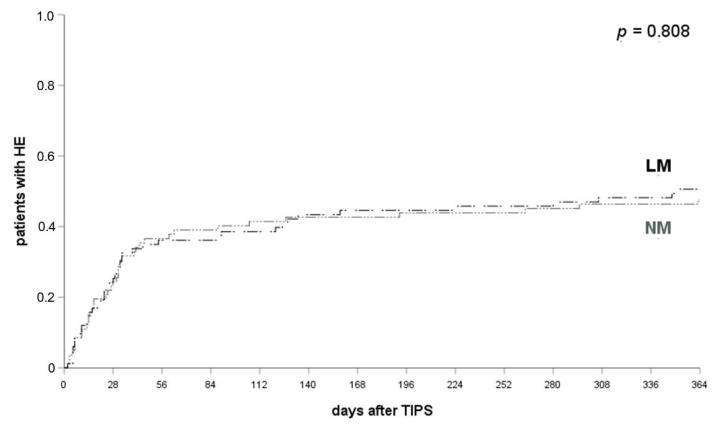
Figure 1
Figure 1
HE occurrence in patients with LM and NM. HE occurred in 38.8% of patients with NM and 33.7% of patients with LM at 1 month (p = 0.581), 44.3% and 40.9% at 3 months (p = 0.723) and 53.7% and 50.6% at 12 months after their TIPS implantation (p = 0.808). log-rank test applied. HE, hepatic encephalopathy; LM, lactulose monoprophylaxis; NM, no prophylactic medication.
Figure 2
Figure 2
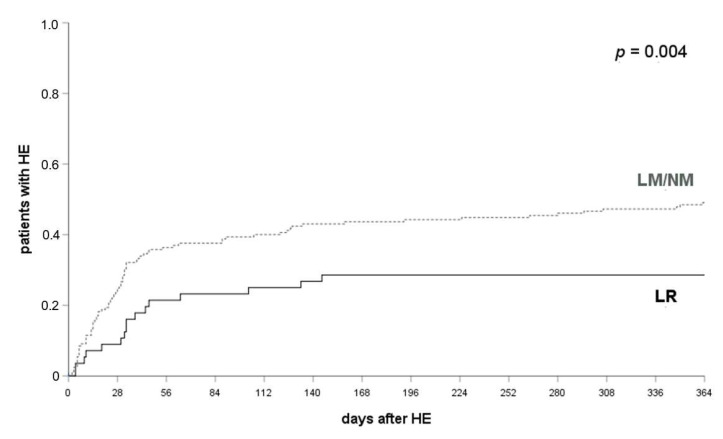
HE occurrence in patients with LR and LR/NM. HE occurred in 36.1% of patients with LM or NM and 15.8% of patients with LR at 1 month (p = 0.007), 42.6% and 25.0% at 3 months (p < 0.05) and 52.1% and 28.1% at 12 months after their TIPS implantation (p = 0.004). A log-rank test was applied. HE, hepatic encephalopathy; LR, lactulose and rifaximin; LM, lactulose monoprophylaxis; NM, no prophylactic medication.
Figure 3
Figure 3
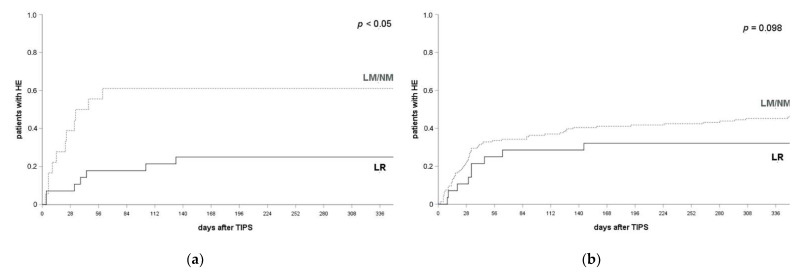
HE occurrence and prophylactic efficacy by history of HE prior to a TIPS implantation. (a) In patients with at least one HE episode prior to their TIPS placement, HE occurred in 44.4% of patients with LM/NM and 10.7% of patients with LR at 1 month (p = 0.009), 61.4% and 20.0% at 3 months (p = 0.003) and 64.7% and 25.0% at 12 months after a TIPS implantation (p = 0.007). A log-rank test ws applied. (b) In patients with no history of HE prior to their TIPS implantation, HE occurred in 34.7% of patients with LM/NM and 20.7% of patients with LR at 1 month (p = 0.173), 39.6% and 29.6% at 3 months (p = 0.364) and 50.7% and 31.0% at 12 months after their TIPS implantation (p = 0.098). log-rank test applied. HE, hepatic encephalopathy; LR, lactulose and rifaximin; LM, lactulose monoprophylaxis; NM, no prophylactic medication.
Figure 4
Figure 4
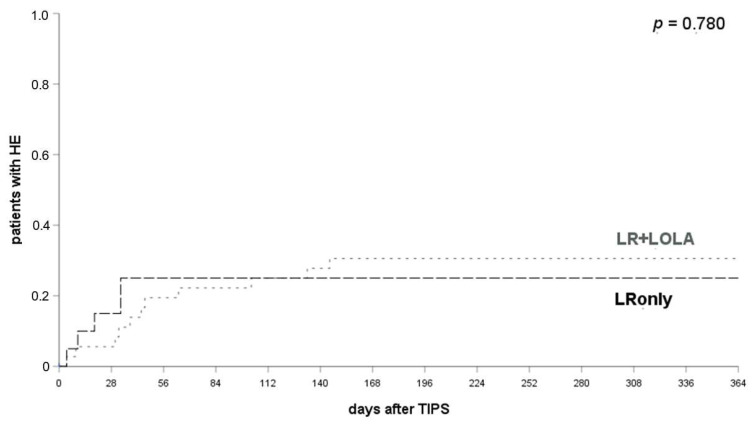
Comparison of HE occurrence in patients with LRonly or LR + LOLA for HE prophylaxis. HE occurred in 20.0% of patients with LRonly and 21.6% of patients with LR + LOLA at 1 month (p = 0.815), 25.0% and 25.0% at 3 months (p = 0.979) and 25.0% and 29.7% at 12 months after a TIPS implantation (p = 0.780). A log-rank test ws applied. LR, lactulose and rifaximin; LOLA, l-ornithin-l-aspartate; LRonly, LR without LOLA; LR + LOLA, LR with addition of LOLA.

References

    1. Schultheiß M., Bettinger D., Thimme R., Rössle M. 30 Jahre transjugulärer intrahepatischer portosystemischer Shunt (TIPS)—Rückblick und Perspektive. Z. Gastroenterol. 2020;58:877–889. doi: 10.1055/a-1217-7866. - DOI - PubMed
    1. Berry K., Lerrigo R., Liou I.W., Ioannou G.N. Association Between Transjugular Intrahepatic Portosystemic Shunt and Survival in Patients With Cirrhosis. Clin. Gastroenterol. Hepatol. 2016;14:118–123. doi: 10.1016/j.cgh.2015.06.042. - DOI - PubMed
    1. Garcia-Pagan J.C., Saffo S., Mandorfer M., Garcia-Tsao G. Where does TIPS fit in the management of patients with cirrhosis? JHEP Rep. 2020;2:100122. doi: 10.1016/j.jhepr.2020.100122. - DOI - PMC - PubMed
    1. Rose C.F., Amodio P., Bajaj J.S., Dhiman R.K., Montagnese S., Taylor-Robinson S.D., Vilstrup H., Jalan R. Hepatic encephalopathy: Novel insights into classification, pathophysiology and therapy. J. Hepatol. 2020;73:1526–1547. doi: 10.1016/j.jhep.2020.07.013. - DOI - PubMed
    1. Garcovich M., Zocco M.A., Roccarina D., Ponziani F.R., Gasbarrini A. Prevention and treatment of hepatic encephalopathy: Focusing on gut microbiota. World J. Gastroenterol. 2012;18:6693–6700. doi: 10.3748/wjg.v18.i46.6693. - DOI - PMC - PubMed

LinkOut - more resources