


Dynamic Hip Screw versus Cannulated Cancellous Screw in Pauwels Type II or Type III Femoral Neck Fracture: A Systematic Review and Meta-Analysis
- PMID: 34683158
- PMCID: PMC8541281
- DOI: 10.3390/jpm11101017
Dynamic Hip Screw versus Cannulated Cancellous Screw in Pauwels Type II or Type III Femoral Neck Fracture: A Systematic Review and Meta-Analysis
Abstract
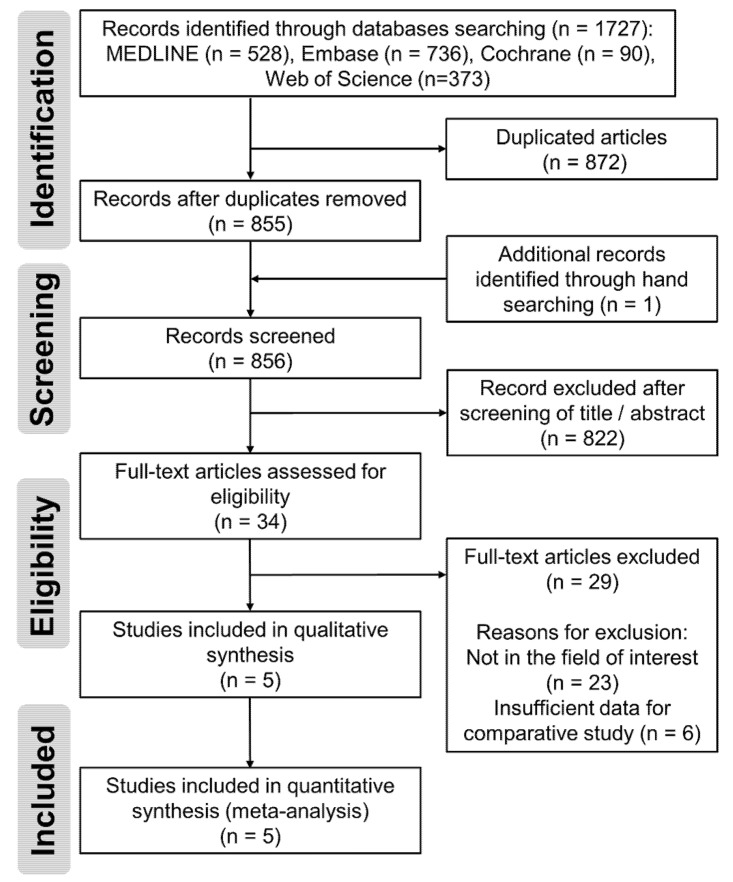
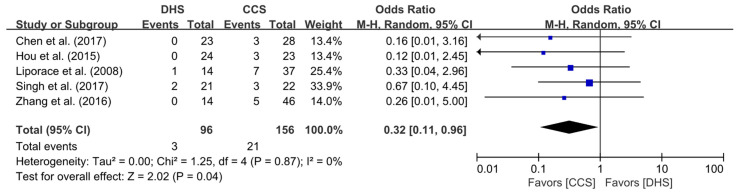
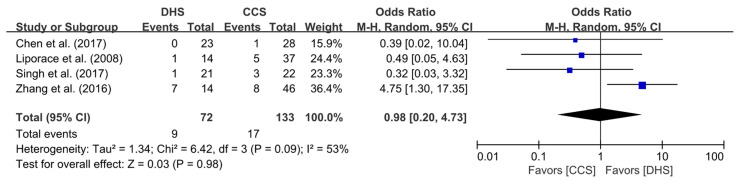
Vertically oriented femoral neck fractures (FNFs) are known to be especially unstable FNFs, and they have a higher associated risk of failure. The dynamic hip screw (DHS) technique and the cannulated cancellous screw (CCS) technique are the two main fixation techniques used in the treatment of FNFs. However, no large clinical study has compared the DHS and CCS techniques in patients with high-shear-angle FNFs. MEDLINE, Embase, Cochrane Library, and Web of Science were systematically searched for studies that compared the DHS and CCS techniques for the treatment of Pauwels type II or type III FNF. Pooled analysis was performed to identify differences between the DHS and CCS techniques in Pauwels type II or type III FNF, with a focus on postoperative complications such as fracture nonunion and osteonecrosis of the femoral head (ONFH). We included five studies with a total of 252 patients. The DHS technique was used in 96 patients (DHS group), and the CCS technique was used in 156 patients (CCS group). The pooled analysis revealed that the nonunion rate in the CCS group was significantly higher than that in the DHS group (OR = 0.32; 95% CI, 0.11-0.96; p = 0.04, I2 = 0%), but there was no difference in the incidence of ONFH between the groups (OR = 0.98; 95% CI, 0.20-4.73; p = 0.98, I2 = 53%). For vertically oriented FNFs, the DHS technique is more favorable and has a lower risk of fracture nonunion than the CCS technique.
Keywords: Pauwels type; cannulated screw; dynamic hip screw; femoral neck fracture; vertical.
Conflict of interest statement
The authors declare no conflict of interest.
Figures
References
-
- Kazley J., Bagchi K. StatPearls. StatPearls Publishing; Treasure Island, FL, USA: 2020. Femoral Neck Fractures. - PubMed
-
- Pauwels F. Gesammelte Abhandlungen zur Funktionellen Anatomie des Bewegungsapparates. Springer; Berlin/Heidelberg, Germany: 1965. Der Schenkelhalsbruch; pp. 1–138.
-
- Singh D.M., Sonkar D.D., Verma D.R., Shukla D.J., Gaur D.S. Comparison of the functional outcome of DHS versus cannulated cancellous screws in pauwels type II and III fracture neck femur in young adults. Int. J. Orthop. Sci. 2017;3:745–749. doi: 10.22271/ortho.2017.v3.i2h.80. - DOI
Publication types
LinkOut - more resources
Full Text Sources
