. 2021 Sep 25;9(10):2027.
doi: 10.3390/microorganisms9102027.

Bacillus licheniformis and Bacillus subtilis, Probiotics That Induce the Formation of Macrophage Extracellular Traps

Affiliations

Bacillus licheniformis and Bacillus subtilis, Probiotics That Induce the Formation of Macrophage Extracellular Traps

Carol M Romo-Barrera et al. Microorganisms. .

Abstract

Probiotics are considered living microorganisms that help preserve the health of the host who uses them. Bacillus are a genus of Gram-positive bacteria used as probiotics for animal and human consumption. They are currently distributed in various commercial forms. Two of the species used as probiotics are B. licheniformis and B. subtilis. Macrophages are central cells in the immune response, being fundamental in the elimination of microbial pathogens, for which they use various mechanisms, including the formation of extracellular traps (METs). There have been very few studies carried out on the participation of macrophages in response to the interaction of probiotics of the genus Bacillus with the host. In this work, we used macrophages from the J774A mouse cell line.1, and we found that they are susceptible to infection by the two Bacillus species. However, both species were eliminated as the infection progressed. Using confocal microscopy, we identified the formation of METs from the first hours of infection, which were characterized by the presence of myeloperoxidase (MPO) and citrullinated histone (Hit3Cit). Quantitative data on extracellular DNA release were also obtained; release was observed starting in the first hour of infection. The induction of METs by B. licheniformis caused a significant decrease in the colony-forming units (CFU) of Staphylococcus aureus. The induction of METS by bacteria of the Bacillus genus is a mechanism that participates in controlling the probiotic and potentially pathogenic bacteria such as S. aureus. The induction of METs to control pathogens may be a novel mechanism that could explain the beneficial effects of probiotics of the genus Bacillus.

Keywords: Bacillus licheniformis; Bacillus subtilis; bacillus; macrophage extracellular trap; probiotic.


Conflict of interest statement

The authors declare no conflict of interest.

Figures
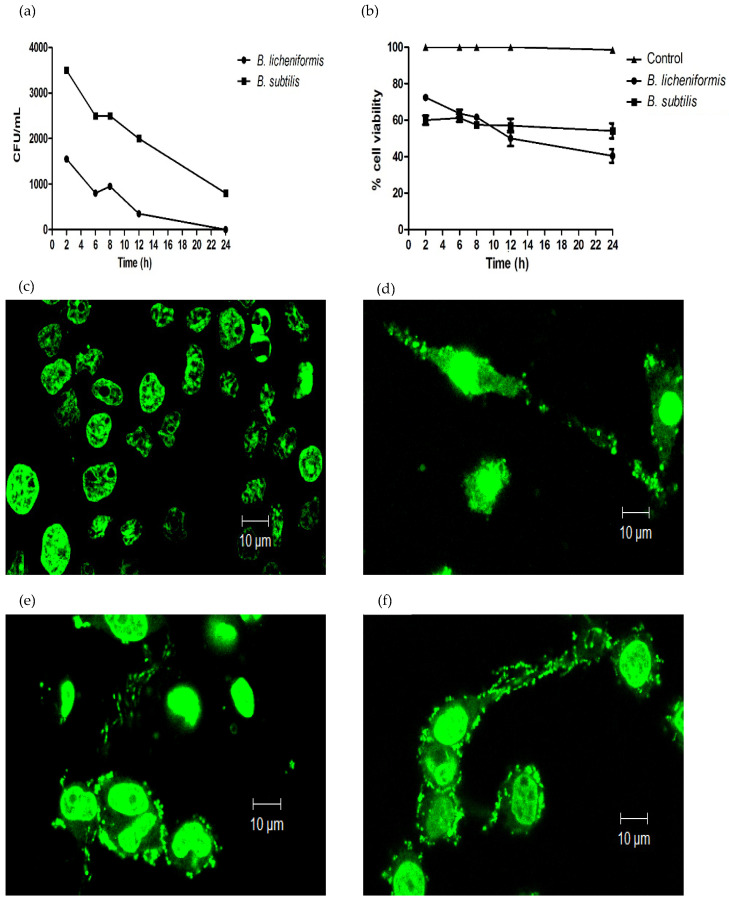
Figure 1
Figure 1
Macrophages of the J774A.1 cell line. When infected with Bacillus licheniformis and Bacillus subtilis, they die as a result of infection and produce METs. (a) Intracellular B. licheniformis and B. subtilis colony-forming units were determined at different infection times. (b) Macrophage cell viability was determined by the trypan blue exclusion assay at different infection times. As a consequence of the infection, there were nuclear and cellular changes, which were evidenced by Sytox Green staining after 3 h of infection and observed by confocal microscopy (c) Control cells. (d) Zymosan treated cells. (e) B. licheniformis and (f) B. subtilis. 630× magnification. Representative results of three experiments.
Figure 2
Figure 2
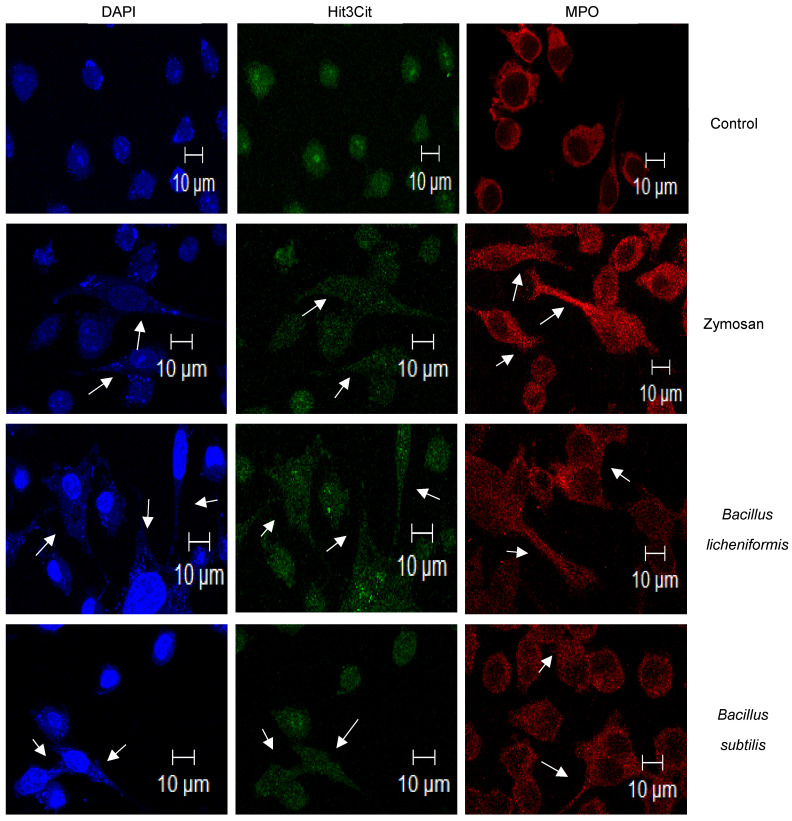
Bacillus licheniformis and Bacillus subtilis induce the formation of macrophage extracellular traps. Macrophages were infected or treated with zymosan for 3 h. Immunofluorescence showed the presence of nuclear and cellular distribution of Hit3Cit (green), MPO (red), and nuclear DNA (blue), fundamental components of METs. Arrows pointed to METs extensions containing DNA, Hit3Cit, and MPO. Representative images of three experiments. The preparations were observed under a confocal microscope at 630× magnification.
Figure 3
Figure 3
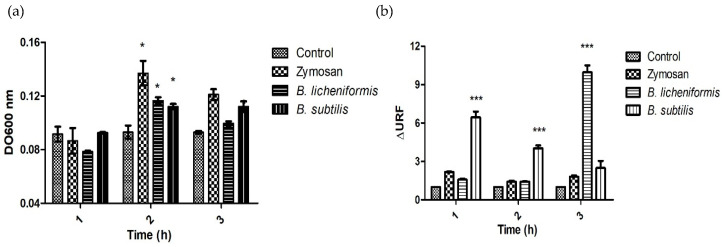
Macrophages infected with probiotics produce ROS and METs. (a) ROS production by macrophages infected with Bacillus species and treated with zymosan. (b) Quantification of DNA released by macrophages infected with Bacillus species and treated with zymosan determined by SYTOX fluorometry. Representative results of three experiments. ANOVA test for repeated measures was performed, followed by a post hoc t-test with a Bonferroni correction. * p < 0.05, *** p < 0.001.
Figure 4
Figure 4
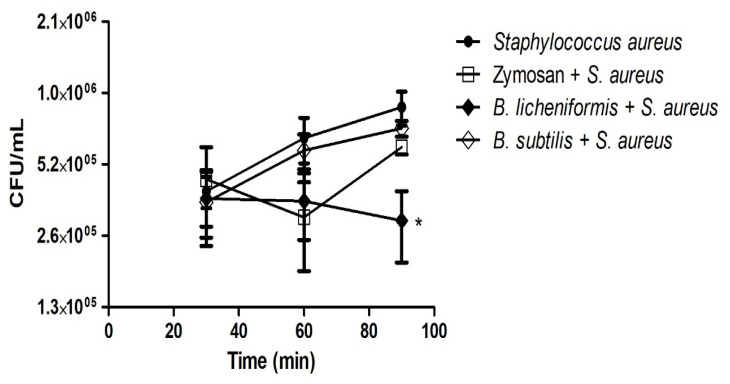
B. licheniformis reduces the CFU/mL of Staphylococcus aureus. The formation of METs was induced in macrophages infected with Bacillus species for 1 h. The METs formed were challenged with S. aureus for 30, 60, and 90 min. The CFU/mL of S. aureus were determined. The repeated measures ANOVA test was performed, followed by a post hoc t-test with a Bonferroni correction. * p < 0.05.

References

    1. FAO. OMS . Probióticos en los Alimentos: Propiedades Saludables y Nutricionales y Directrices para la Evaluación. FAO; Rome, Italy: 2006.
    1. Goldenberg J., Yap C., Lytvyn L., Lo C., Beardsley J., Mertz D., Johnston B. Probiotics for the prevention of Clostridium difficile-associated diarrea in adults and children. Coch. Data Syst. Rev. 2017;12:CD006095. doi: 10.1002/14651858.CD006095.pub4. - DOI - PMC - PubMed
    1. Williams N. Probiotics. Am. J. Health Syst. Pharm. 2010;67:449–458. doi: 10.2146/ajhp090168. - DOI - PubMed
    1. Sorokulova I. Modern status and perspectives of Bacillus bacteria as probiotics. J. Probio. Health. 2013;1 doi: 10.4172/2329-8901.1000e106. - DOI
    1. Stenfors Arnesen L., Fagerlund A., Granum P. From soil to gut: Bacillus cereus and its food poisoning toxins. FEMS Micro. Rev. 2008;32:579–606. doi: 10.1111/j.1574-6976.2008.00112.x. - DOI - PubMed