


Increased Adiposity Appraised with CUN-BAE Is Highly Predictive of Incident Hypertension. The SUN Project
- PMID: 34684310
- PMCID: PMC8537177
- DOI: 10.3390/nu13103309
Increased Adiposity Appraised with CUN-BAE Is Highly Predictive of Incident Hypertension. The SUN Project
Abstract
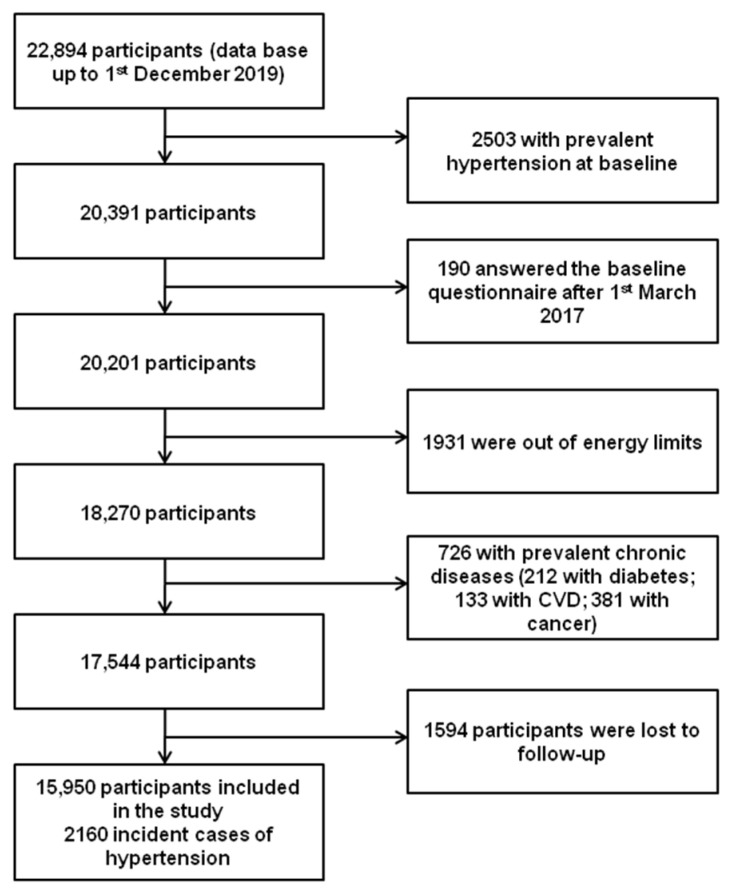
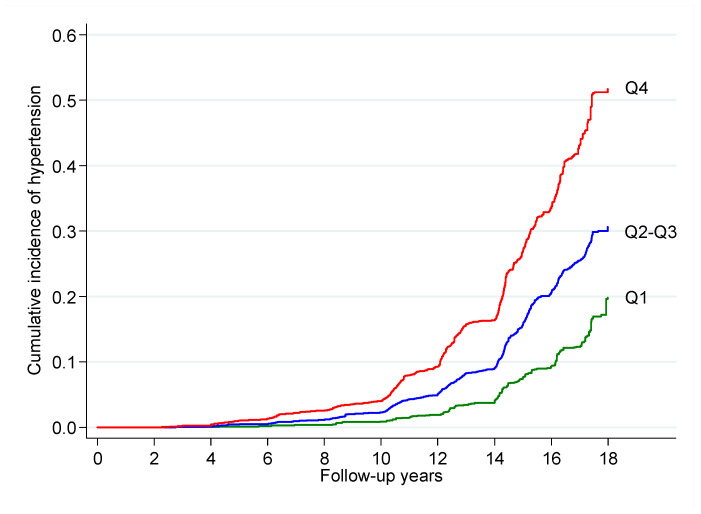
Overweight and obesity are growing worldwide and strongly associated with hypertension. The Clínica Universidad de Navarra-Body Adiposity Estimator (CUN-BAE) index is proposed as an optimal indicator of body fatness. We aimed to investigate the association of body fat as captured by the CUN-BAE index with incident hypertension in a Mediterranean population. We assessed 15,950 participants of the SUN (Seguimiento Universidad de Navarra) prospective cohort (63.7% women) initially free of hypertension. Participants completed follow-up questionnaires biennially. A validated 136-item food-frequency questionnaire was administered at baseline. We used Cox models adjusted for multiple confounders. Among 12.3 years of median follow-up (interquartile range: 8.3, 15.0 years), 2160 participants reported having received a diagnosis of hypertension. We observed a strong direct association between progressively higher the CUN-BAE index at baseline and incident hypertension during follow-up in multivariable-adjusted models for men and women, even after further adjustment for BMI ≥ 30 kg/m2, showing a significant association also in non-obese participants. For each 2-unit increase in the CUN-BAE index, hypertension risk increased by 27% and 29% in men and women, respectively. The results remained significant when considering longitudinal repeated measures of changes in body fat assessed with the CUN-BAE index among the different biennial follow-up questionnaires. Our results emphasize the importance of reducing and maintaining a low body fat to prevent hypertension.
Keywords: CUN-BAE; adiposity; blood pressure; body fat; cohort studies; diet; hypertension; obesity; overweight.
Conflict of interest statement
The authors declare no conflict of interest.
Figures
Similar articles
-
CUN-BAE adiposity index prediction of incident type 2 diabetes: the Seguimiento Universidad de Navarra prospective cohort.J Nutr Health Aging. 2025 May;29(5):100545. doi: 10.1016/j.jnha.2025.100545. Epub 2025 Mar 26. J Nutr Health Aging. 2025. PMID: 40147296 Free PMC article.
-
The Clínica Universidad de Navarra-Body Adiposity Estimator index is a reliable tool for screening metabolic dysfunction-associated steatotic liver disease: an analysis from a gender perspective.Lipids Health Dis. 2024 Sep 27;23(1):311. doi: 10.1186/s12944-024-02299-3. Lipids Health Dis. 2024. PMID: 39334354 Free PMC article.
-
The relationship between the CUN-BAE body fatness index and incident diabetes: a longitudinal retrospective study.Lipids Health Dis. 2023 Feb 6;22(1):21. doi: 10.1186/s12944-023-01784-5. Lipids Health Dis. 2023. PMID: 36747216 Free PMC article.
-
CUN-BAE Index as a Screening Tool to Identify Increased Metabolic Risk in Apparently Healthy Normal-Weight Adults and Those with Obesity.J Nutr. 2021 Aug 7;151(8):2215-2225. doi: 10.1093/jn/nxab117. J Nutr. 2021. PMID: 33978191 Clinical Trial.
-
Comparison of body mass index (BMI) with the CUN-BAE body adiposity estimator in the prediction of hypertension and type 2 diabetes.BMC Public Health. 2016 Jan 27;16:82. doi: 10.1186/s12889-016-2728-3. BMC Public Health. 2016. PMID: 26817835 Free PMC article.
Cited by
-
CUN-BAE adiposity index prediction of incident type 2 diabetes: the Seguimiento Universidad de Navarra prospective cohort.J Nutr Health Aging. 2025 May;29(5):100545. doi: 10.1016/j.jnha.2025.100545. Epub 2025 Mar 26. J Nutr Health Aging. 2025. PMID: 40147296 Free PMC article.
-
The Clínica Universidad de Navarra-Body Adiposity Estimator index is a reliable tool for screening metabolic dysfunction-associated steatotic liver disease: an analysis from a gender perspective.Lipids Health Dis. 2024 Sep 27;23(1):311. doi: 10.1186/s12944-024-02299-3. Lipids Health Dis. 2024. PMID: 39334354 Free PMC article.
References
-
- Landsberg L., Aronne L.J., Beilin L.J., Burke V., Igel L.I., Lloyd-Jones D., Sowers J. Obesity-related hypertension: Pathogenesis, cardiovascular risk, and treatment: A position paper of The Obesity Society and the American Society of Hypertension. J. Clin. Hypertens. 2013;15:14–33. doi: 10.1111/jch.12049. - DOI - PMC - PubMed
MeSH terms
LinkOut - more resources
Full Text Sources
Medical
